
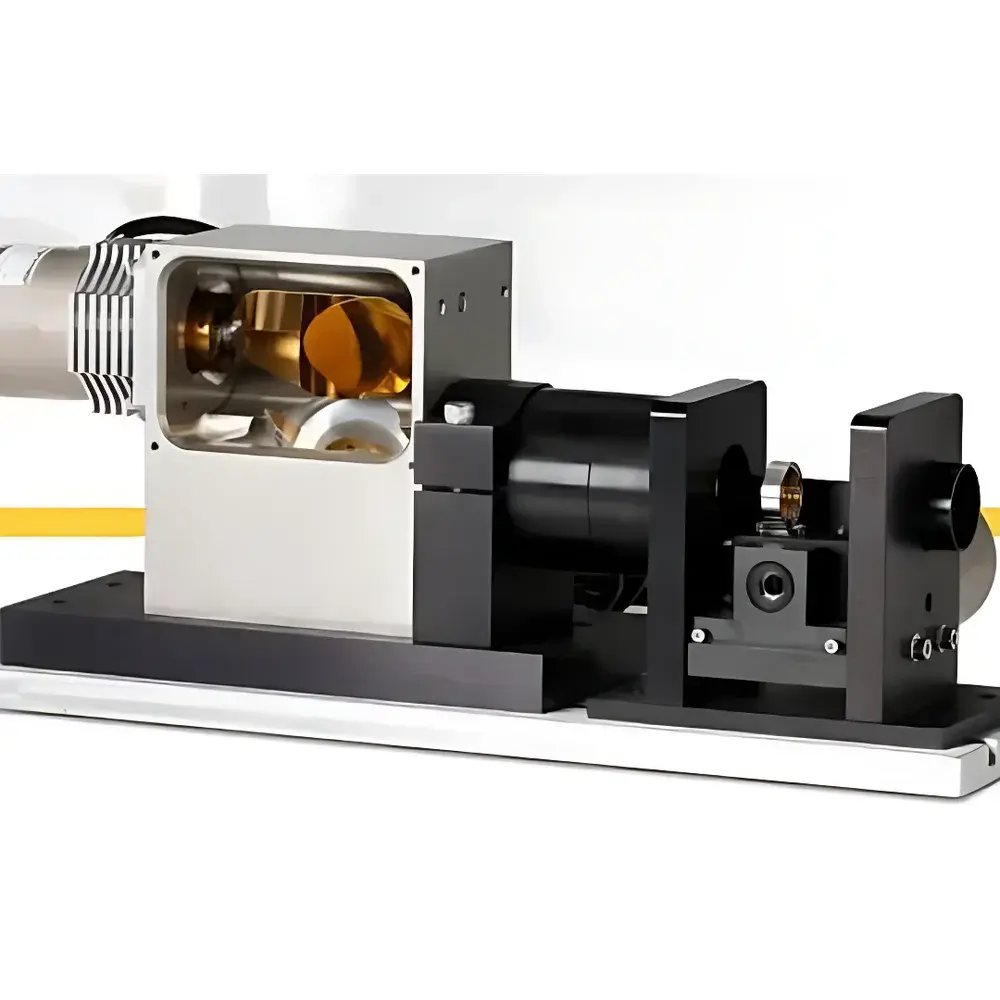
Novanta Cambridge Technology Lightning II-3-Axis High-Speed Laser Scanning Galvanometer
| Brand | Novanta |
|---|---|
| Origin | United Kingdom |
| Manufacturer | Cambridge Technology (a Novanta company) |
| Model | Lightning II-3-Axis |
| Optical Aperture | 20 mm / 30 mm / 50 mm |
| Scan Angle | ±20° / ±22° / ±22° |
| Wavelength Options | 355 nm |
| Standard Angular Velocity | 50 rad/s / 50 rad/s / 18 rad/s |
| Working Distance Range | 200–2500 mm / 100–1200 mm / 100–1000 mm |
| Input Beam Diameter | 1–3 mm / 2–3 mm / 10 mm / 17 mm |
| Minimum Spot Size (at 200×200 mm FOV) | 12 µm / 18 µm / 21 µm / 213 µm |
| Tracking Delay | 0.2 ms / 0.2 ms / 0.4 ms |
| Command Resolution | 24-bit |
| Repeatability | <2 µrad |
| Long-Term Drift | <10 µrad |
| Thermal Drift | <2 µrad/°C / <20 µrad/°C / <2 µrad/°C |
Overview
The Novanta Cambridge Technology Lightning II-3-Axis High-Speed Laser Scanning Galvanometer is a precision-engineered, digitally controlled 3D scanning system designed for industrial laser material processing applications requiring micron-level spatial accuracy, high dynamic response, and long-term thermal and mechanical stability. Unlike conventional 2D galvanometric scanners, the Lightning II-3-Axis integrates a proprietary Dynamic Focus Module (DFM) — a coaxial, motorized Z-axis actuator — enabling real-time, closed-loop axial focal position adjustment without mechanical repositioning of the entire optical train. This architecture implements a hybrid scanning principle: XY deflection via high-bandwidth galvanometer mirrors coupled with Z-axis focus modulation via voice-coil-driven lens translation, all synchronized within a single deterministic timing framework. The system operates on the principle of vector-based beam steering, where incident laser radiation is reflected by two orthogonal, servo-controlled mirrors to define instantaneous beam direction in Cartesian space, while the DFM dynamically adjusts the focal plane to maintain diffraction-limited spot quality across variable working distances and non-planar surfaces. It is engineered for integration into Class 1 or Class 4 laser systems compliant with IEC 60825-1 and meets functional safety requirements per ISO 13849-1 PL e.
Key Features
- Digital servo architecture with 24-bit command resolution and sub-micro-radian repeatability (<2 µrad), ensuring consistent beam placement over extended operational cycles
- Integrated Dynamic Focus Module (DFM) providing programmable Z-axis focal depth control with tracking delay as low as 0.2 ms — enabling true 3D surface contouring and through-focus drilling
- Three aperture variants (20 mm, 30 mm, 50 mm) optimized for different beam diameters and power handling requirements; compatible with UV (355 nm), NIR (1050–1080 nm), and CO₂ (9.36 µm / 10.6 µm) laser sources
- Thermally compensated mirror mounts and low-drift analog driver electronics, delivering <10 µrad long-term angular drift and <2 µrad/°C thermal sensitivity in standard configurations
- Ruggedized mechanical housing rated for continuous operation in industrial environments (IP54 equivalent), with vibration resistance up to 5 g RMS per IEC 60068-2-6
- Real-time synchronization interface supporting TTL, analog ±10 V, and digital EtherCAT protocols for deterministic motion-laser triggering
Sample Compatibility & Compliance
The Lightning II-3-Axis is compatible with a broad range of laser sources used in precision manufacturing, including picosecond and femtosecond pulsed lasers, CW fiber lasers, and RF-excited CO₂ lasers. Its optical design accommodates input beam diameters from 1 mm to 17 mm and supports focal spot sizes down to 12 µm (at 200 × 200 mm field of view), making it suitable for microvia drilling, selective laser melting (SLM), laser-induced forward transfer (LIFT), and thin-film ablation. The system conforms to electromagnetic compatibility standards EN 61326-1 and EN 55011, laser safety classifications per IEC 60825-1:2014, and is validated for use in GMP-aligned production environments. While not intrinsically certified for explosive atmospheres, it may be integrated into ATEX-compliant enclosures when paired with appropriate laser interlocks and ventilation controls.
Software & Data Management
Cambridge Technology provides the CTI Studio software suite — a Windows-based configuration, calibration, and diagnostic platform supporting full parametric control of scan velocity, acceleration profiles, DFM focal offset, and multi-point pattern sequencing. All motion commands are timestamped and logged with nanosecond resolution, enabling post-process traceability required under FDA 21 CFR Part 11 for audit-ready electronic records. The system exposes a standardized API (CTI SDK) supporting C++, Python, and LabVIEW integration, allowing seamless incorporation into MES or SCADA frameworks. Firmware updates are delivered via signed binary packages with SHA-256 verification; configuration files support version-controlled storage and rollback capability. Optional hardware-accelerated pattern generation modules enable real-time interpolation of complex 3D trajectories at >10 kHz update rates.
Applications
- High-aspect-ratio microvia drilling in PCBs and flex circuits, leveraging Z-axis dynamic focusing to maintain consistent kerf width across stacked dielectric layers
- Multi-layer powder bed fusion (PBF) in metal additive manufacturing, where variable focal depth compensates for layer-wise thermal distortion and powder settling effects
- Laser micromachining of medical devices — including stent cutting, catheter marking, and bioresorbable polymer structuring — requiring sub-20 µm positional fidelity and minimal heat-affected zones
- 3D surface texturing and functional structuring of optical components, molds, and tribological surfaces using synchronized XY-Z path planning
- Direct-write fabrication of micro-optical elements (e.g., diffractive lenses, GRIN structures) via point-by-point energy deposition control
FAQ
What distinguishes the Lightning II-3-Axis from standard 2D galvo scanners?
It integrates a coaxial Dynamic Focus Module (DFM) that enables real-time, software-controlled Z-axis focal plane adjustment — eliminating the need for mechanical Z-stage movement and enabling true volumetric scanning.
Is the DFM compatible with all laser wavelengths listed?
Yes; the DFM uses reflective optics and motorized lens translation, making it wavelength-agnostic across the supported spectral range (355 nm to 10.6 µm).
Can the system operate under vacuum or inert gas environments?
The standard unit is rated for ambient air operation; custom versions with stainless-steel housings and hermetic feedthroughs are available upon request for controlled-atmosphere integration.
Does the Lightning II-3-Axis support closed-loop position feedback?
Yes — all variants include high-resolution encoder feedback on both XY mirrors and the DFM actuator, with optional analog or digital error signal outputs for external PID integration.
What calibration procedures are required for ISO 17025-compliant metrology use?
Traceable calibration services are offered by Cambridge Technology’s UK and US service centers, including angular accuracy mapping, focal plane flatness verification, and dynamic response characterization per ISO 230-2 and ISO 230-6.





