
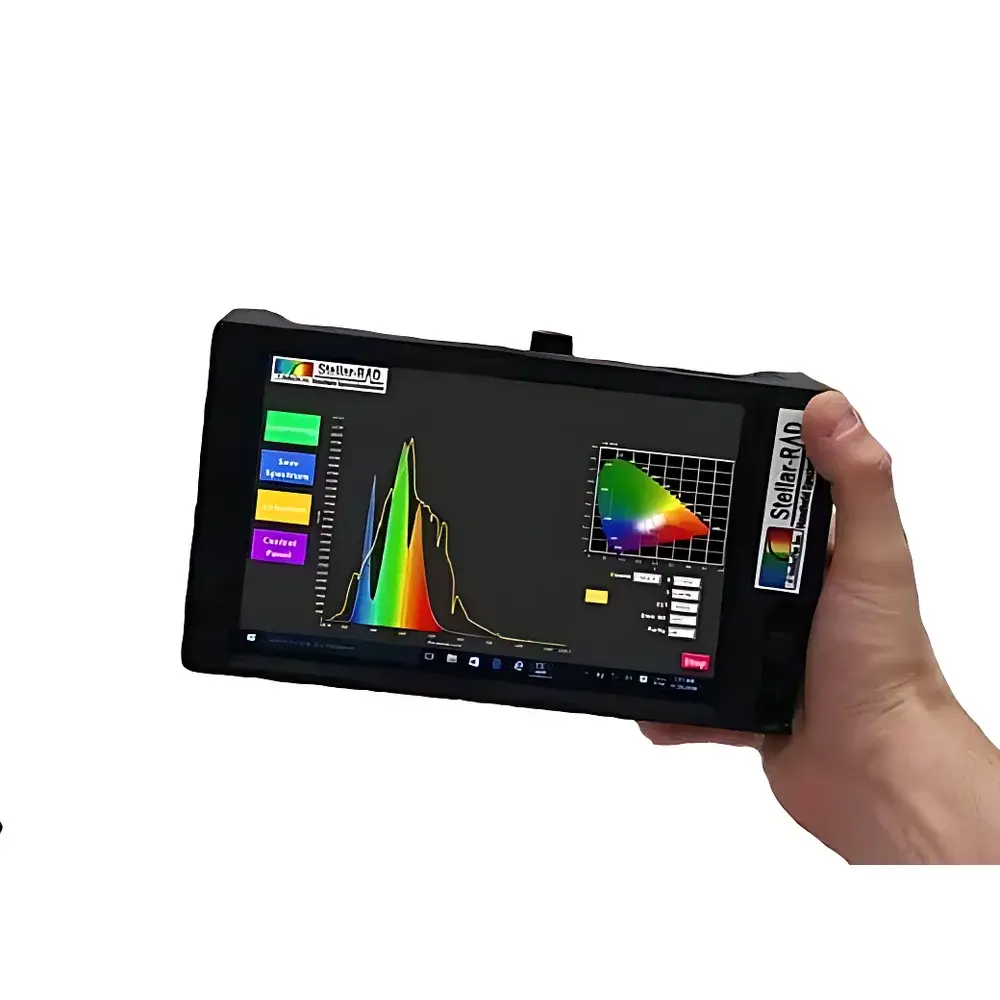
StellarNet Stellar-RAD Handheld Spectroradiometer
| Brand | StellarNet |
|---|---|
| Origin | USA |
| Manufacturer Type | Authorized Distributor |
| Import Status | Imported |
| Model | Stellar-RAD |
| Price Range | USD $38,000–$64,000 (FOB USA) |
| Spectral Range | 350–1150 nm (UV-Vis-NIR) |
| Wavelength Accuracy | <0.25 nm |
| Spectral Resolution | <1 nm (FWHM) |
| Irradiance Accuracy | ±5% (NIST-traceable) |
| Illuminance Range | 0.05–400,000 lx |
| Radiant Flux Range | 0.25–1600 W/m² |
| Colorimetric Accuracy | ±0.001 Δx,Δy (vs. NIST SRM lamps) |
| CCT Accuracy | ±2% |
| Integration Time | 10 ms–60 s |
| Detector | Sony 2048-pixel CCD |
| Optical Design | Scientific-grade Crossed Czerny-Turner |
| Input Optics | Cosine-corrected diffuser (f/2.5) |
| Data Interface | USB 2.0 (bus-powered) |
| Software | SpectraWiz v24.x (Windows 10/11) |
| Compliance | NIST-traceable calibration certificate included |
| Optional Modules | UV (250–400 nm), NIR (900–1700 nm), radiance/luminance lens kits, integrating sphere compatibility (e.g., IS-200, IS-500) |
Overview
The StellarNet Stellar-RAD Handheld Spectroradiometer is a field-deployable, research-grade optical measurement instrument engineered for high-fidelity spectral irradiance, illuminance, colorimetric, and photosynthetic photon flux (PAR) characterization. Based on a precision crossed Czerny-Turner optical architecture with a scientific-grade Sony 2048-pixel CCD detector, the Stellar-RAD delivers sub-1 nm full-width-at-half-maximum (FWHM) spectral resolution across its standard 350–1150 nm range—enabling discrimination of narrowband LED peaks, mercury line structures, and phosphor emission shoulders with laboratory-grade fidelity. Unlike consumer-grade photometers or low-resolution handheld spectrometers, the Stellar-RAD embeds NIST-traceable calibration directly into its firmware and factory-certified spectral response functions, eliminating post-acquisition correction dependencies. Its cosine-corrected input optic meets ISO/CIE requirements for angular response (f/2.5 acceptance), ensuring metrologically valid measurements under non-normal incidence conditions typical in architectural lighting, horticultural lighting, display validation, and daylighting studies. The device operates as a self-contained system—requiring only USB power from a Windows laptop—and achieves up to five hours of continuous operation per charge cycle when used with external battery packs (optional).
Key Features
- Sub-1 nm optical resolution (FWHM) enables precise spectral feature identification—including LED peak separation, UV-C line verification, and NIR water absorption band analysis
- NIST-traceable calibration certified per ISO/IEC 17025:2017; includes individual certificate with uncertainty budgets for irradiance (W/m²/nm), illuminance (lx), and chromaticity (x,y)
- Real-time CIE 1931 chromaticity diagram overlay with dynamic calculation of correlated color temperature (CCT), dominant wavelength, excitation purity, and optional CRI (Ra) / CQS (Qa) metrics
- Integrated PAR (Photosynthetically Active Radiation, 400–700 nm) quantification compliant with ASTM E308 and ISO 11664-3 for horticultural and photobiological applications
- Modular optical interface supports interchangeable accessories: radiance lenses (f/2.5 to f/8), fiber-optic probes, and direct coupling to StellarNet integrating spheres (IS-200, IS-500) for total luminous flux (lumens) and radiant flux (watts) measurement
- USB bus-powered operation with no external power supply required; compatible with Windows 10/11 systems via SpectraWiz software suite
- 16-bit digitization with 10 ms–60 s programmable integration time—optimized for both pulsed sources (e.g., flash LEDs) and low-light ambient monitoring
Sample Compatibility & Compliance
The Stellar-RAD is validated for use across diverse light sources including narrowband LEDs (265–1700 nm with optional UV/NIR modules), OLED panels, fluorescent tubes, HID lamps, sunlight, and bioluminescent samples. Its cosine-corrected diffuser satisfies CIE S 023/E:2013 and IES LM-79-19 angular response specifications. All factory calibrations are performed in accordance with NIST SP 250-94 and traceable to NIST Standard Reference Materials (SRMs) 1930, 2020, and 2030. The system supports audit-ready data logging compliant with FDA 21 CFR Part 11 when used with SpectraWiz’s optional electronic signature and audit trail module—making it suitable for GLP/GMP environments in pharmaceutical lighting validation, medical device phototherapy QA, and regulated horticultural facility commissioning.
Software & Data Management
SpectraWiz software (v24.x) provides a unified platform for acquisition, real-time spectral visualization, multi-parameter export (CSV, XML, SDF), and automated report generation. It includes built-in algorithms for spectral weighting (e.g., photopic V(λ), scotopic V’(λ), erythemal action spectrum), spectral power distribution (SPD) normalization, and comparative spectral overlay. Data files embed full metadata—including calibration date, serial number, integration time, and environmental sensor readings (optional external temperature/humidity probe)—ensuring FAIR (Findable, Accessible, Interoperable, Reusable) data practices. Batch processing supports pass/fail thresholding against user-defined spectral masks or photometric limits, enabling automated QC workflows in production line testing.
Applications
- LED and SSL product development: spectral binning, chromaticity shift monitoring, R9 rendering evaluation
- Horticultural lighting design and validation: PPFD mapping, phytochrome photostationary state (PSS) calculation, far-red (700–750 nm) quantification
- Architectural daylighting and circadian lighting studies: melanopic EDI (Equivalent Daylight Index), α-opic irradiance modeling
- Display and AR/VR device characterization: gamut coverage, metamerism index, temporal flicker analysis (with optional trigger sync)
- Environmental light pollution monitoring: skyglow spectral profiling per IDA/IES TM-112
- Regulatory compliance testing: ENERGY STAR, DLC, Title 24, and EU Ecodesign Annex IV spectral reporting requirements
FAQ
Is the Stellar-RAD calibrated to NIST standards?
Yes—the instrument ships with a NIST-traceable calibration certificate covering spectral irradiance (W/m²/nm), illuminance (lx), and chromaticity (x,y). Calibration is performed at three temperature-stabilized wavelengths (365, 550, and 950 nm) using NIST SRM reference lamps.
Can the Stellar-RAD measure absolute radiance or luminance?
Yes—when paired with an optional calibrated lens adapter (e.g., RAD-Lens-100), the system performs NIST-traceable radiance (W/sr·m²) and luminance (cd/m²) measurements per CIE 127:2007 and IES LM-79-19 Annex B.
Does it support integration with integrating spheres?
Yes—StellarNet’s IS-200 (2-inch) and IS-500 (5-inch) spheres mount directly to the Stellar-RAD via SMA-threaded adapters, enabling total flux measurements traceable to NIST SRM 2241.
What spectral ranges are available beyond the standard 350–1150 nm?
Optional UV extension (250–400 nm) and NIR extension (900–1700 nm) modules are available, each with dedicated grating and detector optimization—no hardware modification required.
Is SpectraWiz software compatible with LabVIEW or Python?
Yes—SpectraWiz provides a documented DLL API and Python wrapper (stlrn_spectrawiz) for programmatic control, spectral acquisition, and real-time data streaming into third-party analysis environments.





