
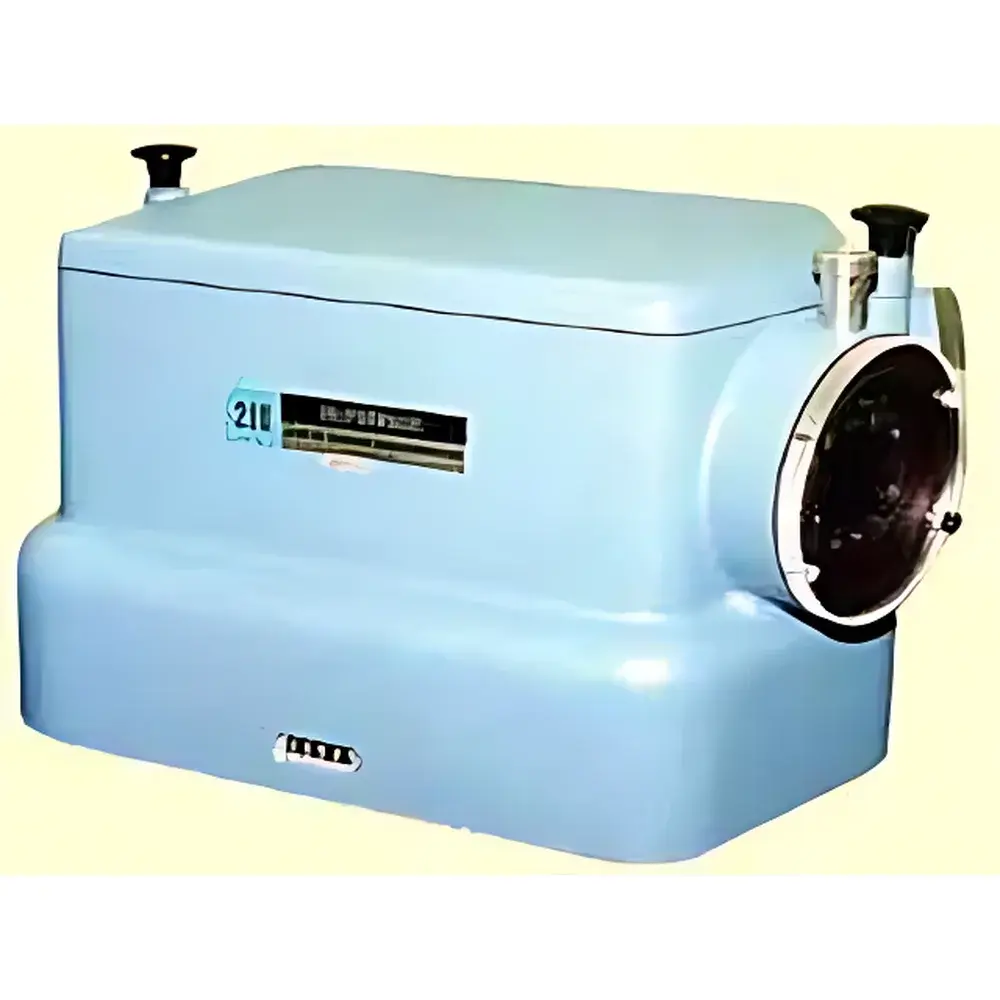
McPherson Model 218 Vacuum Ultraviolet Monochromator
| Brand | McPherson |
|---|---|
| Origin | USA |
| Model | Model 218 |
| Focal Length | 300 mm |
| Optical Design | Crossed Czerny-Turner |
| Beam Angle (Input/Output) | 44° |
| f/# | f/5.3 |
| Grating Size | 50 × 50 mm |
| Wavelength Accuracy | ±0.10 nm (mechanical counter, 1200 grooves/mm grating) |
| Wavelength Repeatability | ±0.005 nm (1200 grooves/mm grating) |
| Focal Plane Width | up to 17 mm |
| Wavelength Range | configurable per grating selection (VUV to LWIR) |
Overview
The McPherson Model 218 Vacuum Ultraviolet Monochromator is a precision optical instrument engineered for high-fidelity spectral isolation in the vacuum ultraviolet (VUV, 105–200 nm) and extended spectral regions—from deep VUV through near-infrared (NIR) and long-wave infrared (LWIR)—depending on grating selection and operational environment. It employs a patented crossed Czerny-Turner optical architecture, where the incident and diffracted beams intersect at a fixed 44° angle. This geometry minimizes optical path length while maximizing mechanical stability and spectral fidelity. Unlike conventional monochromators with collinear or parallel beam layouts, the Model 218’s orthogonal beam arrangement reduces stray light, improves spectral line shape (reduced aberration-induced broadening), and enhances resolution reproducibility—particularly critical for quantitative VUV absorption, photoemission, and synchrotron beamline applications. Its all-aluminum cast housing ensures thermal and dimensional stability under vacuum (<10⁻⁶ Torr) or gas-purged (e.g., He, N₂, Ar) conditions, and its orientation-independent operation enables integration into vertical, horizontal, or inverted experimental configurations—including end-station chambers and ultra-high vacuum (UHV) systems.
Key Features
- Patented crossed-beam Czerny-Turner design with 44° input/output separation—enabling compact footprint (≤0.5 m³) without sacrificing focal length (300 mm) or optical throughput (f/5.3)
- Vacuum-compatible construction: fully bakeable aluminum body, metal-sealed kinematic mounts, and non-outgassing optical coatings optimized for VUV reflectance (>65% at 121.6 nm with MgF₂-coated gratings)
- Modular grating compatibility: accepts standard 50 × 50 mm ruled or holographic gratings (120–3600 grooves/mm); wavelength range dynamically selectable from 105 nm to >10 µm via grating exchange and detector pairing
- Digital wavelength control: compatible with McPherson Model 789A-3 motorized scan controller, supporting programmable step-scan, continuous sweep, and absolute position feedback via optical encoder
- Retrofit-ready platform: legacy Model 218 units (pre-2005) can be upgraded with stepper-motor drives, digital encoders, and modern USB/Ethernet interfaces—maintaining full mechanical and optical heritage
- CCD-compatible focal plane: 17 mm linear usable width supports back-illuminated scientific CCDs (e.g., Andor iDus, Princeton Instruments PIXIS); optional slit adapters and fiber-optic couplers available for spectrograph mode
Sample Compatibility & Compliance
The Model 218 operates as a stand-alone scanning monochromator or as the dispersive core of custom VUV spectrometers, ellipsometers, or actinometers. It accommodates gaseous, solid, and thin-film samples placed at the entrance slit, sample chamber, or focal plane—enabling transmission, reflection, fluorescence, and photoelectron yield measurements. Its vacuum integrity meets ASTM E577-22 (Standard Practice for Calibration of Vacuum Ultraviolet Spectrometers) and ISO 11146-3 (Laser beam parameters—Beam widths and divergence—Part 3: Measurement accuracy). When integrated into GLP- or GMP-regulated environments (e.g., semiconductor process monitoring, aerospace materials testing), the Model 789A-3 controller supports audit-trail logging and user-access-level configuration—aligned with FDA 21 CFR Part 11 requirements for electronic records and signatures when paired with compliant software platforms.
Software & Data Management
Control and data acquisition are implemented via McPherson’s WinSpec-compatible driver suite (Windows/Linux), offering native support for LabVIEW, MATLAB, and Python (PyVISA, NumPy). The system logs wavelength-position correspondence with timestamped metadata—including grating ID, slit width, detector gain, and environmental pressure—ensuring traceability per ISO/IEC 17025:2017 Clause 7.7 (Uncertainty of measurement). All firmware updates, calibration coefficients, and grating dispersion polynomials are stored in non-volatile memory and validated via checksum verification. Remote operation over Ethernet (TCP/IP) enables integration into centralized lab automation networks without compromising real-time scan synchronization (<10 ms jitter).
Applications
- VUV absorption spectroscopy of atomic hydrogen, helium, and molecular gases (e.g., O₂ Schumann–Runge bands, NO Lyman–Birge–Hopfield system)
- Synchrotron radiation beamline monochromation for time-resolved photoelectron spectroscopy (TR-PES) and resonant inelastic X-ray scattering (RIXS)
- Calibration source characterization for space-based UV telescopes (e.g., Hubble/COS, JWST/NIRSpec reference lamps)
- Plasma diagnostics in fusion research (Dα, He II, C IV line profiling at 656.3 nm, 468.6 nm, 154.8 nm)
- Thin-film optical constant determination via VUV variable-angle spectroscopic ellipsometry (VASE)
- Photochemical reaction monitoring in catalytic surface science under UHV conditions
FAQ
Can the Model 218 operate outside vacuum?
Yes—it functions reliably under dry nitrogen purge or in ambient air when equipped with appropriate VUV-transmissive windows (e.g., MgF₂) and sealed optical compartments; however, spectral cutoff below ~190 nm requires vacuum or He-purge due to atmospheric oxygen absorption.
What grating options are certified for VUV use?
McPherson supplies holographic and ruled gratings with enhanced VUV efficiency: 1200 g/mm Au-coated (115–200 nm), 2400 g/mm Pt-coated (105–180 nm), and custom blazed variants optimized for specific orders (e.g., 3rd-order 121.6 nm H Lyman-α line).
Is remote firmware update supported?
Yes—via secure SSH or McPherson’s authenticated web interface; all updates include cryptographic signature validation and rollback capability.
How is wavelength calibration performed?
Using traceable emission lines (e.g., Ne, Ar, Hg lamps) or synchrotron bending magnet spectra; factory calibration certificates include residual error maps referenced to NIST SRM 2036 and ISO 14644-1 cleanroom-compliant handling protocols.
Can I integrate a PMT and CCD simultaneously?
Not natively—the focal plane supports one detector at a time; however, motorized detector turrets (Model 218-DT) enable automated switching between PMT, Si photodiode, and CCD modules within <500 ms.




