
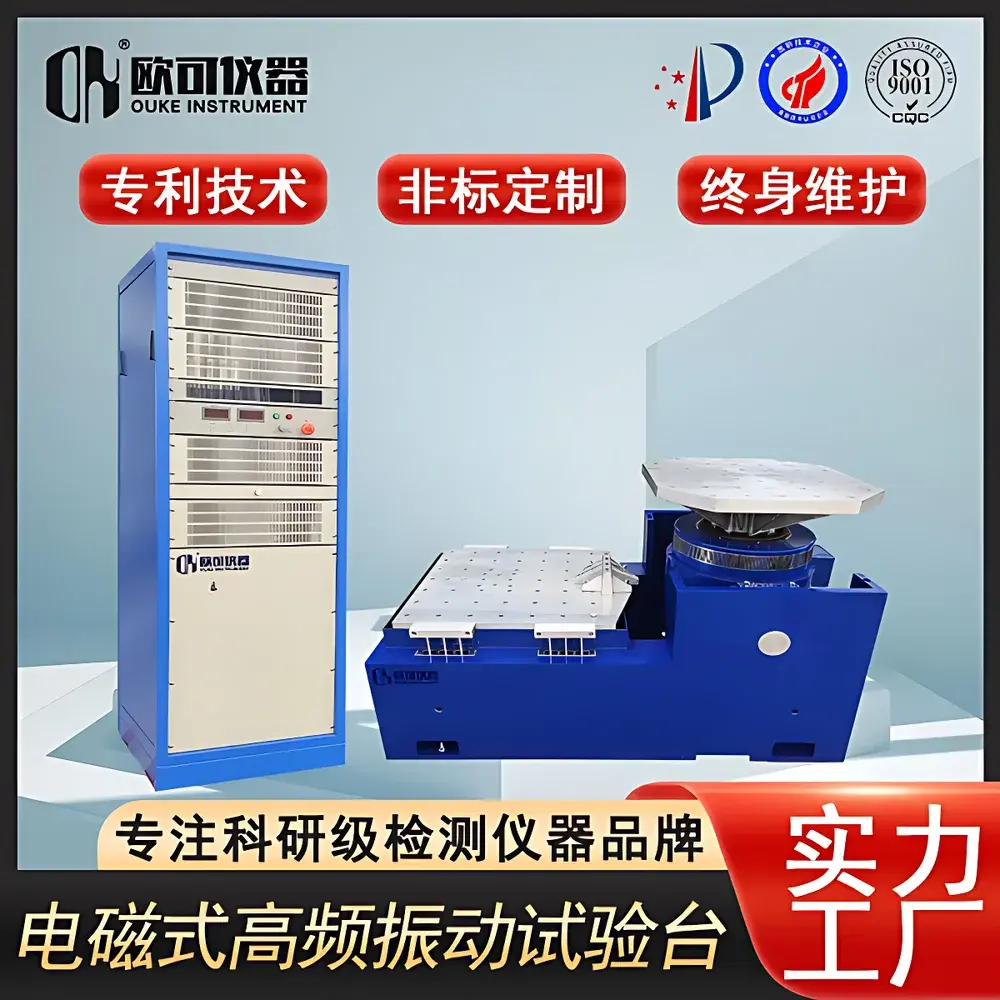
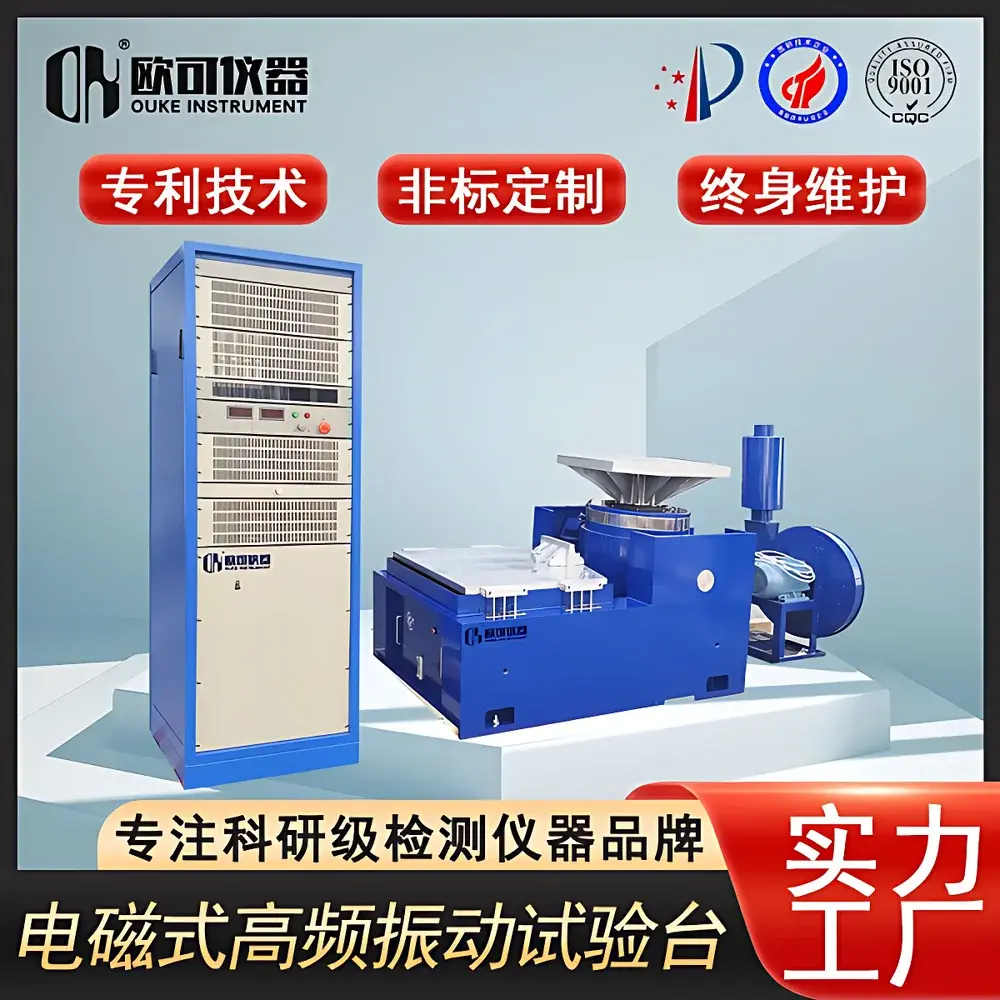
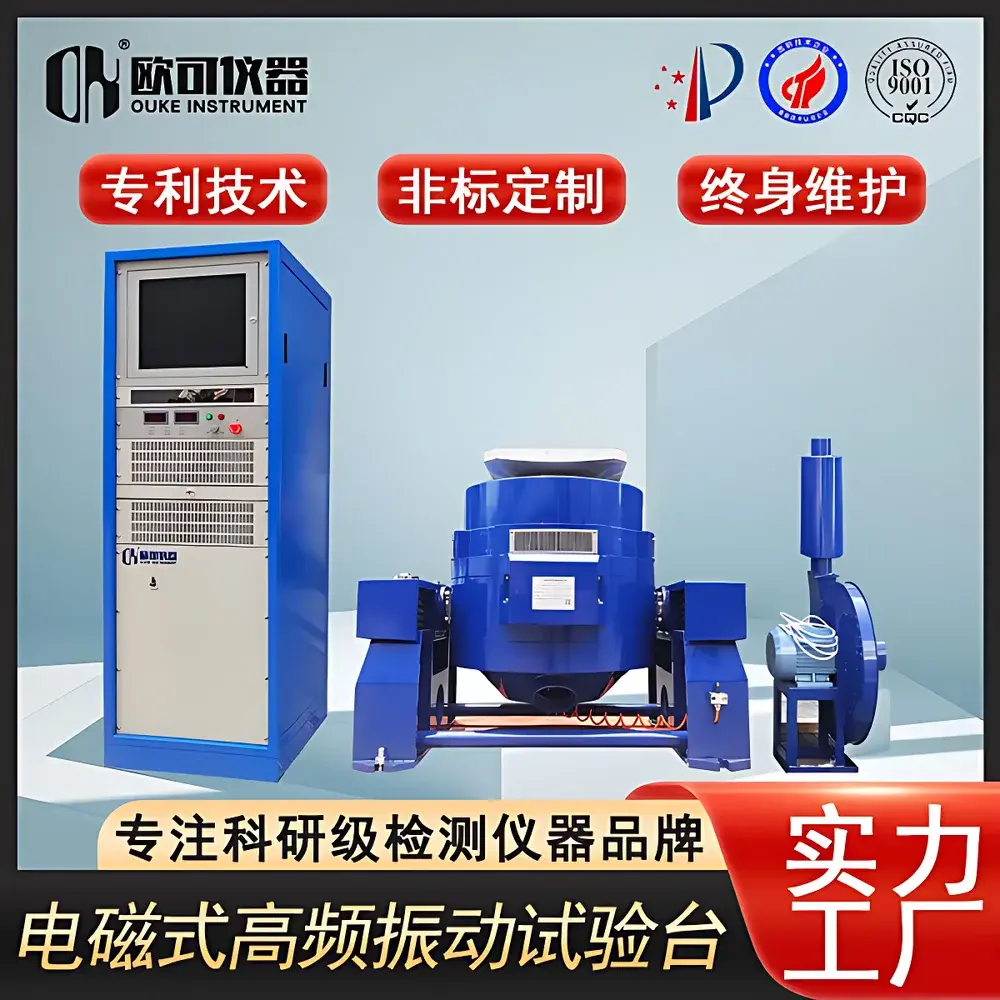
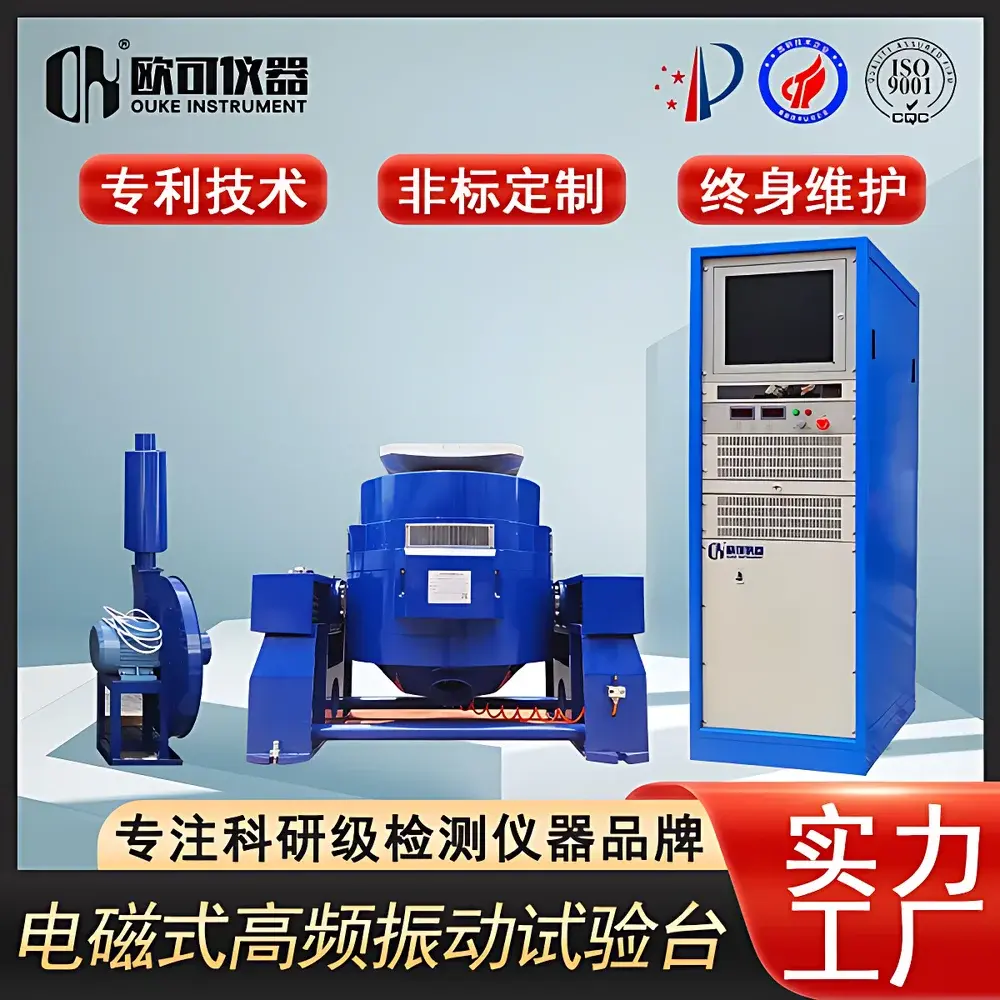
OK Instruments OK-ES-3.0000000 Electromagnetic Vertical Vibration Shaker
| Brand | OK Instruments |
|---|---|
| Origin | Guangdong, China |
| Manufacturer Type | Direct Manufacturer |
| Instrument Type | Electromagnetic Vibration Shaker |
| Rated Sinusoidal Force | 1.98 kN |
| Frequency Range | 5–5000 Hz |
| Maximum Test Load | 70 kg |
| Tabletop Dimensions | 300 × 300 × 30 mm |
| Maximum Acceleration | 10 g |
| Tabletop Mounting Pattern | Standard M6/M8 threaded holes (center-to-center spacing per ISO 5344) |
Overview
The OK Instruments OK-ES-3.0000000 Electromagnetic Vertical Vibration Shaker is a precision-engineered electrodynamic shaker system designed for controlled, repeatable vertical-axis excitation in laboratory and industrial reliability testing environments. It operates on the principle of Lorentz force actuation: an air-core voice coil (moving element) is suspended within a high-flux permanent magnet gap. When a time-varying current—generated by a high-fidelity power amplifier—is applied to the coil, a proportional axial force (F = B·L·I) is produced, inducing linear displacement of the rigidly coupled tabletop along the vertical (Z-axis) direction. This fundamental transduction mechanism ensures minimal harmonic distortion, excellent phase fidelity, and high dynamic linearity across its specified 5–5000 Hz operational bandwidth. Unlike hydraulic or mechanical exciters, the OK-ES-3.0000000 delivers superior waveform integrity for sine, random, shock, and transient vibration profiles—making it suitable for applications demanding traceable, standards-compliant excitation, including MIL-STD-810H, IEC 60068-2-6, ISO 10816, and ASTM D999.
Key Features
- Rated sinusoidal force of 1.98 kN enables high-acceleration testing of medium-mass specimens up to 70 kg under controlled loading conditions.
- Wide frequency coverage from 5 Hz to 5000 Hz supports low-frequency structural resonance characterization as well as high-frequency component-level screening.
- Vertical-only configuration optimized for single-axis qualification testing; compatible with optional horizontal slip tables (sold separately) for orthogonal axis extension.
- Robust mechanical architecture includes precision-machined aluminum tabletop (300 × 300 × 30 mm), multi-layer elastomeric suspension system, and dual-stage air bearing guidance for minimal lateral motion and high axial stiffness.
- Integrated thermal management via forced-air cooling ensures stable performance during extended random vibration tests at rated force levels.
- Compliant with IEC 60068-2-84 mechanical interface requirements; tabletop features standardized M6 and M8 threaded mounting patterns conforming to ISO 5344 for universal fixture compatibility.
Sample Compatibility & Compliance
The OK-ES-3.0000000 accommodates test specimens ranging from small electronic modules (<1 kg) to assembled subsystems (up to 70 kg), provided mass distribution remains within moment-of-inertia limits defined by the suspension design. Its rigid tabletop and low-profile geometry support direct mounting of accelerometers, laser Doppler vibrometers, and strain gauge arrays without signal interference. The system meets electromagnetic compatibility (EMC) Class B emission limits per CISPR 11 and conforms to safety requirements outlined in IEC 61000-4 series for immunity testing. For regulated industries—including aerospace, automotive Tier-1 suppliers, and medical device manufacturers—the shaker integrates seamlessly into GLP/GMP-compliant test workflows when paired with validated control software supporting 21 CFR Part 11 audit trails, electronic signatures, and data integrity logging.
Software & Data Management
Control is executed via a dedicated digital vibration controller running real-time deterministic firmware. Supported test modes include sine sweep (linear/logarithmic), resonant dwell, random vibration (PSD synthesis up to 8192 lines resolution), classical shock (half-sine, trapezoidal, sawtooth), and transient synthesis (time-history replay). The controller accepts feedback from triaxial accelerometers mounted on the tabletop or test article, enabling closed-loop amplitude regulation with ±0.25 dB amplitude tolerance and ±2° phase error across the full frequency range. All test configurations, raw time histories, PSD spectra, and pass/fail reports are stored in vendor-neutral HDF5 format. Optional API integration (TCP/IP, UDP, MATLAB® engine interface) allows automation within LabVIEW™, Python-based CI/CD pipelines, or enterprise MES platforms.
Applications
- Product reliability qualification per MIL-STD-810H Method 514.8 (vibration), IEC 60068-2-64 (random vibration), and JEDEC JESD22-B103 (mechanical shock).
- Modal parameter identification through broadband random excitation and FRF analysis using industry-standard modal software (e.g., Siemens Testlab, ME’scope).
- HALT/HASS screening protocols requiring rapid temperature–vibration interaction or multi-axis profile sequencing.
- Vibration fatigue life assessment of PCB assemblies, MEMS sensors, battery packs, and automotive ECUs under spectrum-defined road-load data.
- Calibration of reference-grade accelerometers and charge amplifiers in accordance with ISO 16063-21 and NIST-traceable procedures.
- Structural health monitoring (SHM) research involving baseline shift detection, damage localization, and nonlinear response characterization.
FAQ
What is the maximum allowable off-center load for this shaker?
For optimal axial force transmission and minimized rocking moments, the center of gravity of the test specimen must remain within ±25 mm of the tabletop centerline. Loads exceeding 35 kg require symmetrical mounting and verification of moment balance prior to operation.
Is water cooling required for continuous operation?
No—forced-air cooling is standard and sufficient for all rated duty cycles, including 8-hour random vibration tests at 1.5 kN RMS force. Water-cooled amplifier options are available upon request for high-duty-cycle production environments.
Can the system be integrated into an existing environmental chamber?
Yes. The shaker base is configured for bottom-mount installation with 120 mm clearance beneath the tabletop. Custom feedthroughs for sensor cabling and pneumatic cooling lines can be supplied to match chamber port specifications.
Does OK Instruments provide calibration certificates traceable to national standards?
Yes. Each unit ships with a factory calibration report referencing NIM (China National Institute of Metrology) traceability. On-site ISO/IEC 17025 accredited calibration services are available globally through authorized partners.
What safety interlocks are built into the system?
Hardware-enforced interlocks include tabletop over-acceleration cutoff (12 g threshold), amplifier over-temperature shutdown, emergency stop circuitry compliant with ISO 13850, and door-switch monitoring for optional safety enclosures.



