
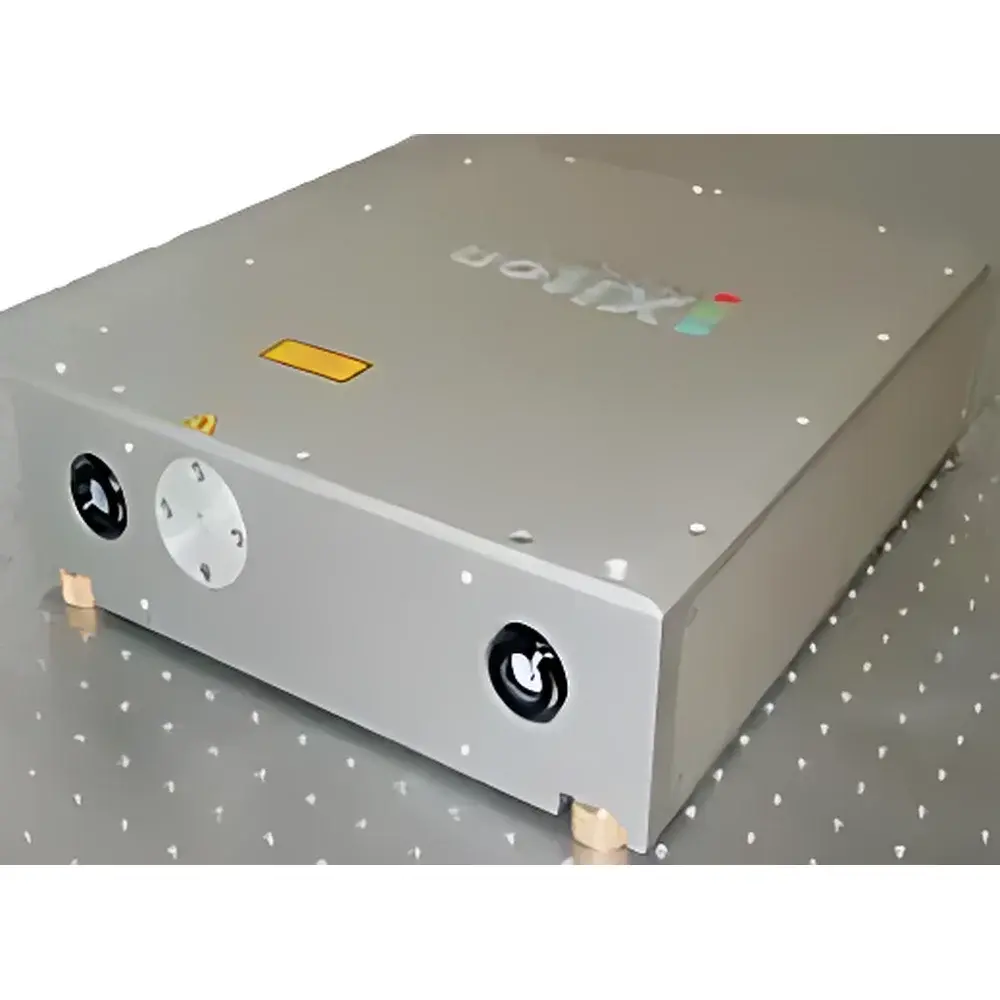
XITON IMPRESS Series 213/224 Deep-UV Nanosecond Solid-State Laser
| Brand | XITON |
|---|---|
| Origin | Germany |
| Manufacturer Type | Authorized Distributor |
| Product Category | Imported Instrument |
| Model | IMPRESS 213 / IMPRESS 224 |
| Core Configuration | Diode-Pumped Q-Switched Solid-State Laser System |
| Wavelength | 213 nm / 224 nm |
| Average Output Power | 150 mW / 300 mW |
| Pulse Width | <7 ns / <9 ns |
| Pulse Energy | >15 µJ / >30 µJ |
| Repetition Rate | 0.1–30 kHz |
| Beam Quality (M²) | <1.6 / <1.6 |
| Control Interface | RS-232 |
| Beam Mode | TEM₀₀ |
| Cooling | Air-Cooled |
| Duty Cycle | Continuous Industrial Operation (24/7) |
Overview
The XITON IMPRESS Series 213/224 is a high-repetition-rate, diode-pumped, Q-switched solid-state laser system engineered for precision deep-ultraviolet (DUV) applications requiring short-wavelength photon energy and nanosecond temporal resolution. Operating at fixed wavelengths of 213 nm and 224 nm—generated via fifth-harmonic generation (213 nm) and fourth-harmonic generation (224 nm) from a Nd:YAG fundamental source—the system delivers stable, diffraction-limited TEM₀₀ output with M² < 1.6. Its deep-UV photon energy enables direct photochemical interaction with wide-bandgap materials, making it suitable for non-thermal ablation, single-photon absorption lithography, and high-spatial-resolution photonic device fabrication. Designed for integration into automated metrology and industrial microprocessing platforms, the IMPRESS series supports deterministic pulse-on-demand triggering via RS-232 and external TTL inputs, ensuring synchronization with motion stages, CCD detectors, or optical delay lines.
Key Features
- Stable deep-UV output at 213 nm and 224 nm with <7 ns and <9 ns pulse widths respectively—optimized for minimal thermal diffusion and high spatial confinement.
- TEM₀₀ beam profile with M² < 1.6 ensures diffraction-limited focusing down to sub-micron spot sizes, critical for FBG inscription and semiconductor mask repair.
- Air-cooled, compact architecture eliminates reliance on chiller systems—reducing footprint, power consumption, and long-term maintenance overhead.
- Diode-pumped design delivers >10,000 hours of pump diode lifetime and eliminates flashlamp degradation mechanisms common in legacy UV lasers.
- Full computer control via RS-232 interface with programmable repetition rate (0.1–30 kHz), pulse selection, and interlock monitoring compliant with IEC 60825-1 Class 4 safety requirements.
- “Green photonics” design philosophy: no hazardous gases, mercury-free operation, RoHS-compliant materials, and energy-efficient diode pumping.
Sample Compatibility & Compliance
The IMPRESS 213/224 is compatible with fused silica, borosilicate glass, UV-grade CaF₂ optics, hydrogen-loaded and non-hydrogenated photosensitive fibers (e.g., Ge-doped SMF-28), silicon nitride waveguides, and polyimide-based flexible substrates. Its 213 nm output satisfies ISO 11146-1 beam characterization standards and meets spectral stability requirements for FBG inscription per ITU-T G.671 Annex A. The system conforms to CE marking directives (2014/30/EU EMC, 2014/35/EU LVD), IEC 60825-1:2014 for laser product safety, and supports audit-ready operational logs required under ISO/IEC 17025 and GLP environments when integrated with validated host software.
Software & Data Management
The laser operates under XITON’s IMPRESS Control Suite—a Windows-based application supporting real-time parameter logging (pulse energy, repetition rate, temperature, interlock status) with CSV export and timestamped metadata. Optional SDK (C/C++, .NET, LabVIEW) enables integration into custom automation frameworks adhering to SEMI E10 and ASTM E2655 data traceability guidelines. All configuration changes are recorded with user ID, timestamp, and parameter delta—supporting 21 CFR Part 11-compliant electronic records when deployed with qualified IT infrastructure and role-based access control.
Applications
- Fiber Bragg grating (FBG) inscription in standard and radiation-hardened telecom fibers without pre-loading—enabling rapid prototyping and volume production of strain/temperature sensors.
- Direct-write lithography for micro-optical elements, diffractive optical components, and photonic crystal templates using single-photon absorption in SU-8 and other DUV-sensitive resists.
- Display panel repair: precise ablation of defective TFT traces and pixel electrodes on AMOLED and LCD substrates with minimal substrate damage.
- Micro-machining of ceramics, sapphire, and SiC wafers for MEMS packaging and through-silicon via (TSV) definition.
- Time-resolved photoluminescence (TRPL) excitation in wide-bandgap semiconductors (e.g., GaN, AlN, diamond) with sub-nanosecond jitter for carrier lifetime analysis.
- Replacement for frequency-doubled argon-ion lasers in Raman spectroscopy and UV resonance fluorescence setups—offering superior wall-plug efficiency and stability.
FAQ
What safety certifications does the IMPRESS 213/224 hold?
The system complies with IEC 60825-1:2014 (Class 4 laser product), CE (EMC & LVD), and RoHS 2011/65/EU. Full safety documentation—including hazard classification reports and interlock schematics—is provided upon request.
Is hydrogen loading required for FBG inscription?
No. The 213 nm wavelength enables efficient Type-I grating formation in standard germanosilicate fiber without hydrogenation—reducing process complexity and improving long-term grating stability.
Can the laser be synchronized with external equipment?
Yes. RS-232 command protocol and hardware TTL trigger input/output support precise timing alignment with motion controllers, cameras, and lock-in amplifiers—jitter < 5 ns RMS.
What is the expected mean time between failures (MTBF)?
Based on field data from industrial installations operating >12 h/day, MTBF exceeds 20,000 hours under nominal environmental conditions (20–25 °C, <60% RH).
Does XITON provide application support for process development?
Yes. Application engineers offer remote and on-site technical support—including beam profiling, pulse energy calibration, and process parameter optimization—for FBG writing, micromachining, and photoluminescence excitation workflows.





