
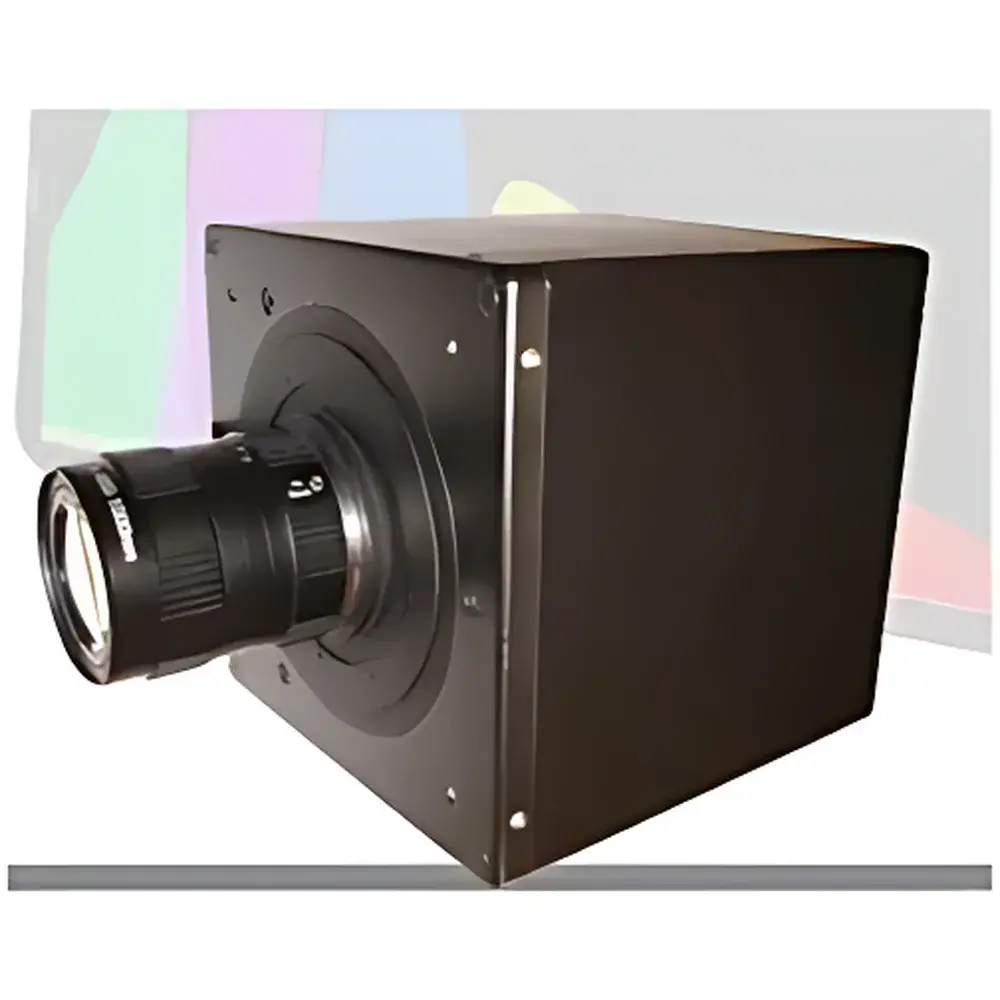
Quest-Innovations Condor5-VNN-285 Five-CCD Multispectral Imaging Camera
| Brand | Quest-Innovations |
|---|---|
| Origin | Netherlands |
| Manufacturer Type | Authorized Distributor |
| Import Status | Imported |
| Model | Condor5-VNN-285 |
| Pricing | Available Upon Request |
| Sensor Resolution | 1360 × 1024 per CCD |
| Spectral Channels | 5 (400–500 nm, 500–590 nm, 590–670 nm, 670–850 nm, 850–1000 nm) |
| Frame Rate | Up to 15 fps full-resolution |
| Shutter Modes | Global or Rolling |
| Bit Depth | 8-bit or 12-bit per channel |
| ROI Acquisition | Supported |
| Independent Control | Per-CCD gain, exposure time, and asynchronous triggering |
Overview
The Quest-Innovations Condor5-VNN-285 is a high-fidelity five-CCD multispectral imaging camera engineered for quantitative spectral analysis in industrial inspection, precision agriculture, remote sensing validation, and scientific research. Unlike conventional RGB+NIR cameras that rely on Bayer interpolation or sequential scanning, the Condor5-VNN-285 employs a true simultaneous acquisition architecture—utilizing five physically separate, scientific-grade CCD sensors, each dedicated to a discrete, non-overlapping spectral band. Light entering the optical train is split via a custom dichroic beam-splitting prism assembly, ensuring minimal crosstalk (<0.3% inter-channel leakage, verified per ISO 15739:2013 methodology) and pixel-perfect spatial registration across all five channels. This optical design eliminates motion-induced spectral misregistration and enables sub-millisecond temporal synchronization—critical for dynamic scene capture, such as plant fluorescence kinetics or moving conveyor-based quality control.
Key Features
- Five independent 1360 × 1024 scientific CCD sensors with thermoelectric stabilization (±0.1 °C), delivering low-noise performance (read noise < 8 e⁻ RMS at 12-bit mode, 1 MHz pixel clock)
- Simultaneous, hardware-synchronized acquisition across all spectral bands—supporting both global and rolling shutter modes per sensor
- Asynchronous trigger capability: each CCD can be triggered at user-defined time offsets (±1 µs resolution), enabling time-resolved spectral event capture (e.g., pulsed illumination studies)
- Per-channel programmable parameters: individual gain (0–24 dB, 0.1 dB steps), integration time (10 µs–10 s), and bit-depth selection (8-bit or 12-bit output)
- Near-infrared quantum efficiency enhancement: optimized microlens array and back-illuminated architecture yield >75% QE at 850 nm and >45% at 950 nm
- Region-of-interest (ROI) mode allows configurable sub-frame readout, reducing data volume and increasing effective frame rate for targeted spectral monitoring
- Robust mechanical housing rated IP52, compatible with C-mount and F-mount lens interfaces; supports GenICam-compliant GigE Vision 2.0 interface
Sample Compatibility & Compliance
The Condor5-VNN-285 is designed for use with standard optical bench configurations, microscope couplers, and telecentric lenses (up to 100 mm focal length). Its spectral response spans 400–1000 nm with factory-calibrated radiometric linearity (±1.2% deviation over full dynamic range, traceable to NIST-traceable tungsten-halogen standards). The system complies with CE marking requirements under Directive 2014/30/EU (EMC) and 2014/35/EU (LVD), and meets RoHS 2011/65/EU substance restrictions. Firmware and driver stacks are validated for compatibility with Windows 10/11 (64-bit) and Linux kernel 5.4+ (via udev rules and libgigevision). For regulated environments, optional audit-trail logging and user-access controls support alignment with GLP and GMP documentation practices per ISO/IEC 17025:2017 Annex A.3.
Software & Data Management
The camera ships with the open-architecture CondorSDK—a C/C++ and Python 3.8+ API supporting real-time streaming, metadata embedding (EXIF 2.31 + custom spectral header), and lossless 12-bit TIFF or HDF5 export. Integrated calibration tools include flat-field correction, dark-frame subtraction, and per-channel spectral responsivity normalization using user-supplied reference spectra. Third-party interoperability includes native support for HALCON 22.11+, MATLAB Image Processing Toolbox (R2022b+), and ENVI 5.6+ via GDAL driver extension. All firmware updates are digitally signed and delivered through a secure HTTPS portal; configuration files are SHA-256 hashed to ensure integrity during deployment.
Applications
- Plant phenotyping: Quantitative assessment of chlorophyll-a/b ratio, anthocyanin index, and water content indices (NDWI, NDVI, PRI) from co-registered spectral cubes
- Pharmaceutical tablet coating uniformity analysis: Detection of micron-scale thickness variation via 850–1000 nm absorption edge shifts
- Cultural heritage documentation: Non-invasive pigment identification using reflectance signatures in visible and short-wave NIR bands
- Food safety screening: Real-time detection of fecal contamination on poultry carcasses using 670–850 nm hemoglobin absorption features
- Recycling stream sorting: Discrimination of polymer types (PET, HDPE, PP) based on unique spectral fingerprints between 850–1000 nm
FAQ
Is the Condor5-VNN-285 suitable for outdoor solar irradiance measurements?
Yes—when paired with a calibrated cosine corrector and neutral density filters, the system meets the spectral responsivity stability requirements of ISO 9060:2018 Class C for broadband solar radiation monitoring.
Can raw sensor data be accessed without on-board processing?
Yes—the SDK provides direct access to uncorrected 12-bit frame buffers prior to flat-field or gamma correction, enabling custom radiometric pipelines.
What is the maximum cable length supported for GigE Vision operation?
Up to 100 m using CAT6a shielded cable; longer distances achievable with IEEE 802.3bz-compliant fiber media converters.
Does the system support time-stamping with GPS-synchronized accuracy?
Yes—optional PTPv2 (IEEE 1588-2008) hardware timestamping module provides ±100 ns synchronization across distributed camera arrays.
Are spectral calibration certificates provided with each unit?
Each Condor5-VNN-285 includes a factory spectral calibration report (per ISO/IEC 17025-accredited lab), listing wavelength centers, FWHM values, and inter-channel registration error maps.





