
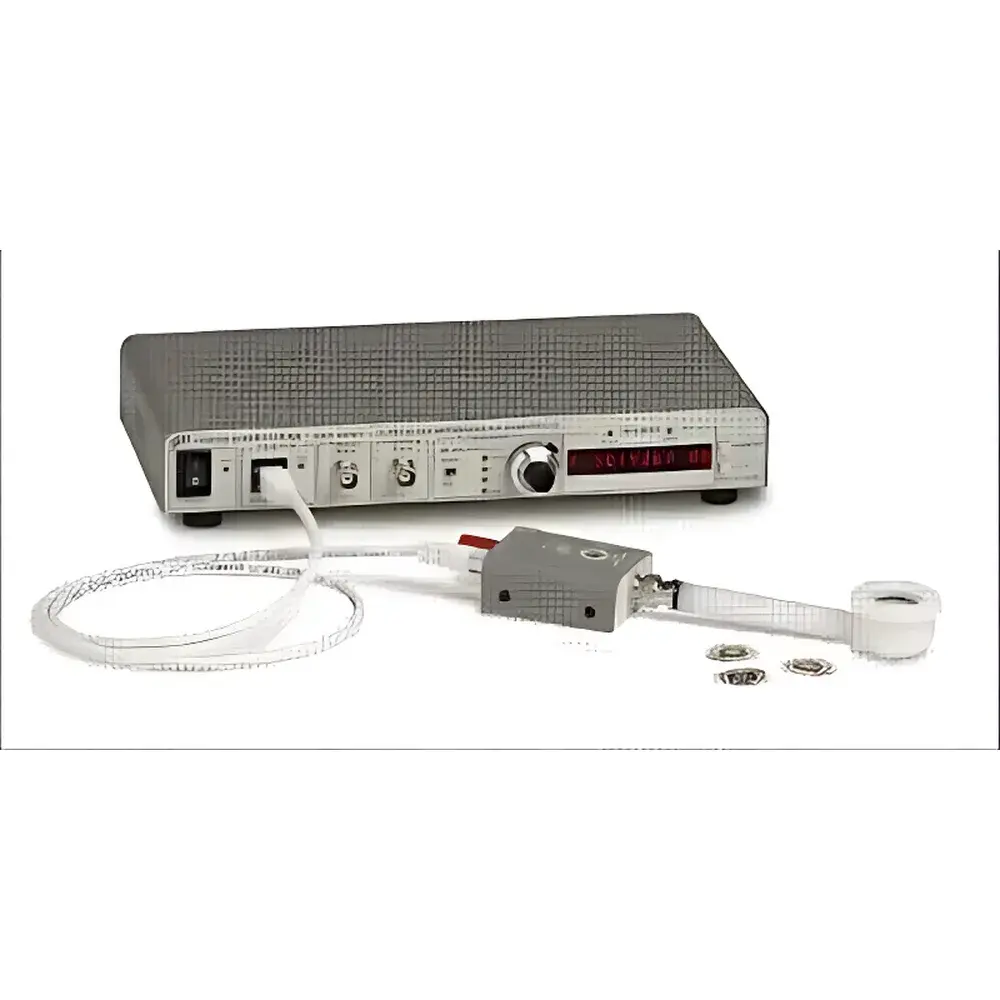
Stanford Research Systems QCM200 Quartz Crystal Microbalance System
| Brand | SRS/Stanford Research Systems |
|---|---|
| Origin | USA |
| Manufacturer Type | Authorized Distributor |
| Import Status | Imported |
| Model | QCM200 System |
| Pricing | Available Upon Request |
| Measurement Accuracy | ±1.5 ppm |
| Minimum Detectable Mass Change | 1 ng |
| Operating Frequency | >5 MHz |
| Interface | RS-232 |
Overview
The Stanford Research Systems QCM200 Quartz Crystal Microbalance System is a high-precision, real-time mass sensing platform engineered for nanogram-level gravimetric analysis at solid–liquid and solid–gas interfaces. It operates on the fundamental principle of piezoelectric resonance: when mass adsorbs or desorbs onto the gold-coated quartz crystal resonator (typically 5–10 MHz AT-cut), the resonant frequency shifts in direct proportion to the areal mass change, as described by the Sauerbrey equation (Δf = −Cf·Δm, where Cf is the sensitivity constant). This linear, label-free transduction mechanism enables quantitative, in situ monitoring of interfacial processes with sub-monolayer resolution—capable of resolving mass changes equivalent to <0.1 nm of uniform film thickness or ~1012 molecules/cm². Unlike conventional microbalances, the QCM200 does not require vacuum environments or static weighing; it delivers continuous, time-resolved data under ambient, electrochemical, or liquid-phase conditions—making it indispensable for dynamic surface science investigations.
Key Features
- High-stability 5.0–10.0 MHz AT-cut quartz crystal sensor with evaporated gold electrodes (standard 14 mm diameter, custom sizes available)
- Digital frequency counter with ±1.5 ppm absolute accuracy and 0.1 Hz resolution over full operating range
- Integrated oscillator circuit optimized for low phase noise and minimal temperature drift (<±0.01 °C stability via optional oven control)
- RS-232 serial interface compliant with standard ASCII command protocol for seamless integration into LabVIEW, Python, MATLAB, or custom acquisition software
- Modular design supporting interchangeable sensor holders for liquid cells, electrochemical flow cells, gas-phase chambers, and vacuum-compatible mounts
- Real-time frequency output (TTL-compatible) and analog voltage output (0–10 V proportional to Δf) for external DAQ synchronization
Sample Compatibility & Compliance
The QCM200 accommodates a broad spectrum of sample types and experimental configurations—including aqueous electrolytes, organic solvents, humidified gases, and ultra-high vacuum environments (with appropriate chamber integration). Its gold electrode surface supports thiol-based SAM formation, antibody immobilization, polymer film deposition, and metal electrodeposition. The system complies with ISO/IEC 17025 calibration traceability requirements when used with NIST-traceable frequency standards. While not inherently FDA 21 CFR Part 11–compliant, its data output architecture supports integration into validated GxP workflows when paired with audit-trail-enabled software platforms. All hardware meets CE marking requirements for electromagnetic compatibility (EN 61326-1) and safety (EN 61010-1).
Software & Data Management
The QCM200 operates without proprietary software—its ASCII command set enables full remote control and data streaming via terminal emulators or custom scripts. Users commonly implement acquisition using Python (pySerial + NumPy), MATLAB Instrument Control Toolbox, or LabVIEW VIs. Frequency-time datasets are exported in CSV or HDF5 format for downstream analysis—including Sauerbrey mass conversion, Voigt viscoelastic modeling (via QCM-D extension modules), dissipation monitoring (when coupled with impedance analyzers), and kinetic fitting using nonlinear regression tools (e.g., OriginPro, Prism). Raw frequency logs retain full timestamping and metadata (sensor ID, temperature, fluid environment), satisfying GLP documentation requirements for method validation reports.
Applications
- Electrochemical QCM (EQCM): In situ monitoring of ion insertion/extraction in battery materials, hydrogen underpotential deposition (H-UPD) on Pt/Pd, and redox-switched polymer swelling
- Biosensing: Real-time kinetics of antigen–antibody binding, DNA hybridization, aptamer–target interactions, and whole-cell adhesion (bacteria, mammalian cells)
- Thin-film science: Growth dynamics of Langmuir–Blodgett films, layer-by-layer polyelectrolyte assembly, and molecular imprinting polymer (MIP) recognition events
- Corrosion & surface chemistry: Oxide layer formation on Al/Cu/Fe alloys, inhibitor adsorption efficacy, and passive film breakdown mechanisms
- Soft matter & interfaces: Viscoelastic characterization of hydrogels, surfactant micellization at interfaces, and bubble/nanobubble nucleation kinetics
- Advanced materials: MEMS/NEMS device contamination tracking, graphene oxide film hydration hysteresis, and stimuli-responsive hydrogel actuation
FAQ
What is the minimum detectable mass change for the QCM200 system?
The system resolves mass changes down to 1 ng (nanogram) on a standard 14-mm-diameter crystal—equivalent to ~0.3 ng/cm² surface density.
Can the QCM200 be used in liquid-phase electrochemical measurements?
Yes—when integrated with a Faraday cage, potentiostat, and flow-through liquid cell, it functions as a robust EQCM platform for simultaneous current and mass monitoring.
Is temperature control supported?
The base unit does not include active thermal regulation, but it is compatible with commercial crystal ovens (e.g., SRS TC-300) enabling operation from −20 °C to +80 °C with ±0.01 °C stability.
How is frequency drift compensated during long-term experiments?
Drift correction is implemented post-acquisition using reference measurements (e.g., solvent-only baseline, dual-crystal differential mode) or in situ referencing via temperature-compensated oscillators.
Are third-party sensor crystals compatible?
Yes—the system accepts industry-standard 14-mm or 25-mm AT-cut quartz crystals with gold electrodes and BNC or SMA connections, provided they meet impedance and motional resistance specifications.



