
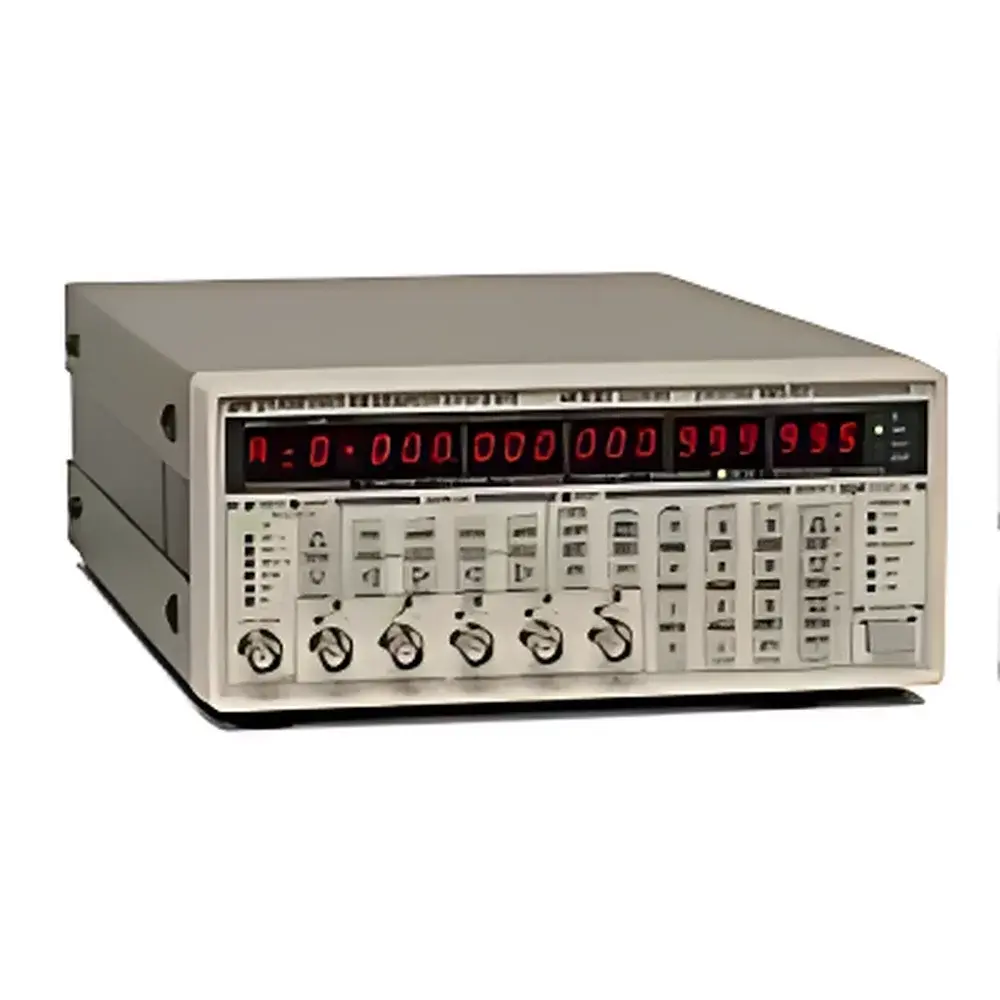
SRS DG645 Eight-Channel Digital Delay Generator
| Brand | SRS/Stanford Research Systems |
|---|---|
| Origin | USA |
| Model | DG645 |
| Output Channels | 4 TTL pulse outputs with up to 8 independently programmable delay transitions |
| Timing Jitter | <25 ps RMS |
| Maximum Trigger Rate | 10 MHz |
| Laser Synchronization | Yes, lockable to 80 MHz external reference |
| Time Resolution | 5 ps per channel |
| Clock Source | Oven-controlled rubidium oscillator |
| Interfaces | Ethernet, GPIB (IEEE-488), RS-232 |
Overview
The SRS DG645 Eight-Channel Digital Delay Generator is a precision timing instrument engineered for demanding applications in ultrafast optics, laser synchronization, time-resolved spectroscopy, and multi-instrument coordination. Based on a low-phase-noise oven-controlled rubidium oscillator, the DG645 delivers exceptional long-term stability and short-term timing fidelity. Its core architecture implements digital delay synthesis using high-speed, deterministic logic paths—ensuring sub-picosecond resolution and minimal propagation skew across all output channels. Unlike analog delay generators, the DG645 employs fully digital timebase interpolation with hardware-accelerated delay calculation, eliminating drift and hysteresis associated with voltage-controlled delay lines. The device operates as a master timing controller in heterogeneous experimental setups, enabling precise orchestration of pulsed lasers, gated detectors (e.g., PMTs, ICCDs), Q-switches, Pockels cells, and data acquisition triggers.
Key Features
- Four independent TTL-compatible pulse outputs, each configurable with up to two delay transitions—enabling up to eight discrete, synchronized timing events per trigger cycle
- 5 ps minimum delay resolution and <25 ps RMS jitter across all channels, verified under continuous operation at full 10 MHz trigger rate
- Integrated rubidium atomic frequency standard (±5 × 10⁻¹¹/day aging rate) for long-term timing stability without external calibration
- Multi-interface remote control via 10/100 Ethernet (TCP/IP, Telnet, HTTP), IEEE-488.2 (GPIB), and RS-232 serial protocols—fully SCPI-compliant
- Real-time synchronization capability to external 80 MHz clock sources (e.g., mode-locked Ti:sapphire lasers), supporting phase-locked delay programming
- Fast edge transition times (<2 ns rise/fall) and output skew <100 ps between channels, critical for pump-probe and time-of-flight experiments
- Non-volatile memory for storing up to 16 complete instrument configurations, including delay tables, trigger modes, and interface settings
Sample Compatibility & Compliance
The DG645 is designed for integration into ISO/IEC 17025-accredited laboratories and GLP-compliant research environments. Its timing performance meets requirements for traceable time-domain measurements referenced to NIST-traceable standards. While not a measurement instrument per se, its output stability supports compliance with ASTM E2912 (Standard Practice for Time-Resolved Spectroscopy), IEC 61000-4-30 (power quality timing), and laser safety standards (IEC 60825-1) requiring precise interlock sequencing. The device conforms to FCC Part 15 Class A and CE EMC Directive 2014/30/EU. All firmware versions undergo internal verification against IEEE 1149.1 (JTAG) boundary-scan test patterns during manufacturing.
Software & Data Management
The DG645 supports native command-line control via Telnet or socket-based TCP/IP connections, enabling seamless integration into Python (PyVISA), MATLAB, LabVIEW, and EPICS-based control systems. SRS provides a Windows-compatible configuration utility with graphical delay mapping, waveform preview, and batch parameter export (CSV/JSON). Instrument state logging—including timestamped delay changes, trigger counts, and error registers—is accessible via Ethernet and can be redirected to external syslog servers. Audit trails comply with FDA 21 CFR Part 11 requirements when used with validated third-party software platforms that enforce electronic signatures and role-based access control. Firmware updates are performed over secure HTTPS with SHA-256 signature verification.
Applications
- Laser cavity dumping and regenerative amplifier triggering in ultrafast laser systems
- Synchronization of pump-probe experiments involving femtosecond lasers and streak cameras or time-correlated single-photon counting (TCSPC) modules
- Time-gated fluorescence lifetime imaging (FLIM) and phosphorescence decay analysis
- Multi-channel event timing in particle physics detector arrays and scintillation coincidence systems
- Calibration of time-of-flight mass spectrometers (TOF-MS) and ion mobility spectrometers
- Automated test equipment (ATE) for semiconductor parametric testing requiring nanosecond-accurate stimulus-response alignment
- Quantum optics experiments requiring deterministic photon-pair arrival timing and heralding signal conditioning
FAQ
What is the maximum number of independent delay events supported per trigger cycle?
The DG645 supports up to eight delay transitions across four outputs—each output may be configured with two edges (e.g., leading and trailing), allowing complex pulse trains.
Can the DG645 be phase-locked to an external 80 MHz laser repetition rate?
Yes—the instrument accepts an 80 MHz reference input and automatically locks its internal rubidium oscillator to maintain phase coherence within ±100 fs RMS jitter over 1 s averaging.
Is remote programming supported over standard network infrastructure?
Yes—Ethernet connectivity enables zero-configuration mDNS discovery, static IP assignment, and persistent connection handling without driver installation.
Does the DG645 support triggered burst mode or programmable repetition patterns?
Yes—via the “burst” trigger mode, users can define variable-length sequences of delays with user-defined inter-burst intervals and total shot counts.
How is timing accuracy verified and maintained over temperature fluctuations?
The integrated OCXO is housed in a dual-stage thermostatically controlled oven; factory calibration includes thermal drift characterization from 15 °C to 35 °C, with published stability specifications covering this range.





