
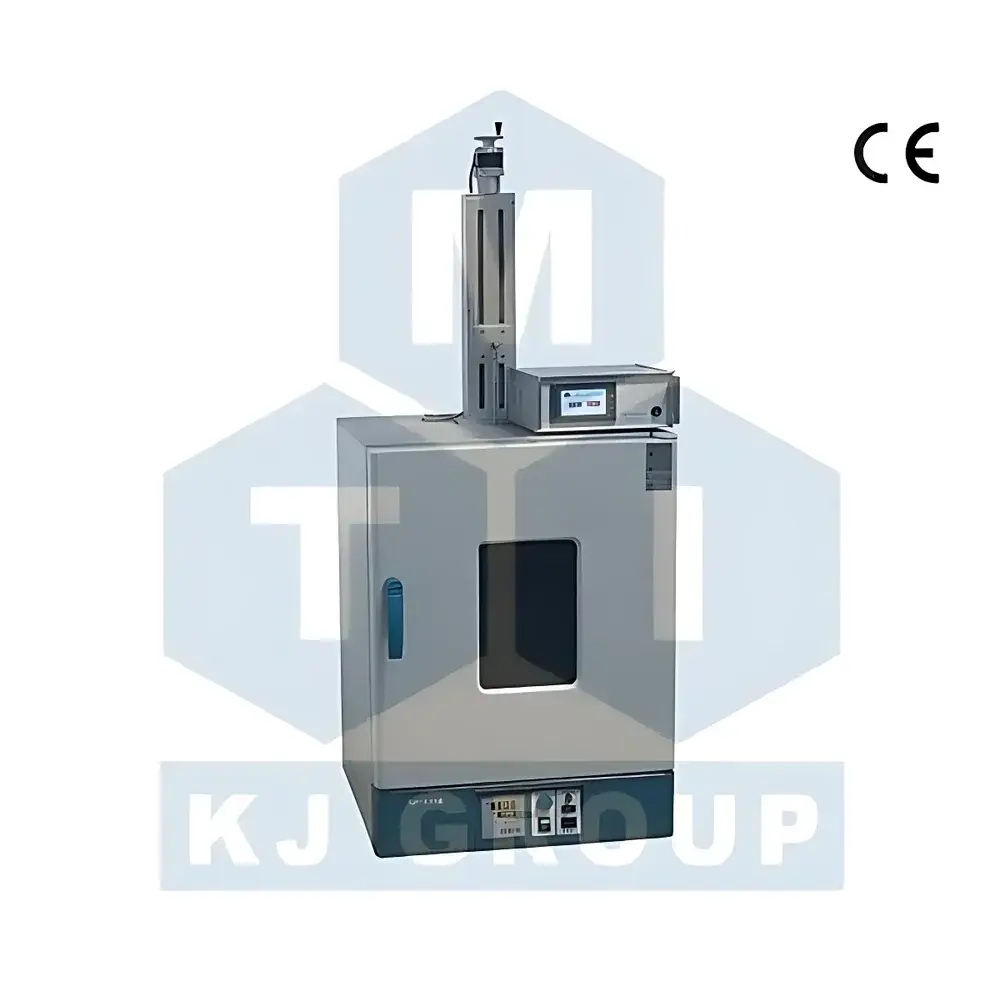
Brookfield PTL-MMB02-200 Constant-Temperature Vertical Dip-Coating System
| Brand | Hefei Kejing |
|---|---|
| Origin | Anhui, China |
| Model | PTL-MMB02-200 |
| Power Supply | 220 V, 50 Hz |
| Heating Power | 2.3 kW |
| Withdrawal Speed Range | 1–200 mm/min |
| Stroke Length | 250 mm |
| Operating Temperature Range | 80–200 °C |
| Temperature Accuracy | ±1.5 °C |
| Fuse Rating | 15 A |
| Sample Dimensions (Max) | 407 mm × 229 mm × (1–10) mm |
| Maximum Load Capacity | ≤5 kg |
| Overall Dimensions | 636 mm × 680 mm × 1520 mm |
| Warranty | 12 months (lifetime technical support) |
Overview
The Brookfield PTL-MMB02-200 Constant-Temperature Vertical Dip-Coating System is an engineered platform for controlled, reproducible thin-film deposition via vertical immersion and withdrawal from liquid-phase precursors. It operates on the principle of dip-coating kinetics—where film thickness, uniformity, and microstructure are governed by withdrawal speed, bath temperature, solution viscosity, and evaporation dynamics within a thermally stabilized environment. Unlike conventional ovens or ambient dip systems, this instrument integrates precise thermal regulation (80–200 °C) with high-resolution motion control to decouple thermal effects from mechanical variables—enabling systematic study of sol-gel, polymer, perovskite, and metal-oxide film formation under defined interfacial conditions. Its architecture supports both fundamental research into coating rheology and applied development of functional coatings for optoelectronics, sensors, and protective layers.
Key Features
- Integrated constant-temperature chamber with PID-controlled heating system (range: 80–200 °C; stability: ±1.5 °C), ensuring minimal thermal drift during extended withdrawal cycles
- High-resolution vertical motion system driven by a microstepping two-phase hybrid stepper motor, delivering smooth, jitter-free withdrawal across the full 1–200 mm/min range with sub-micron repeatability
- 250 mm linear stroke optimized for standard substrate formats, accommodating samples up to 407 mm × 229 mm × 10 mm with ≤5 kg total load
- Intuitive 7-inch capacitive touchscreen interface for real-time parameter entry, multi-step program storage (e.g., acceleration/deceleration profiles), and live speed/temperature feedback
- CE-certified electrical design compliant with IEC 61000-6-2 (immunity) and IEC 61000-6-4 (emission) standards; includes 15 A thermal fuse and grounded chassis for laboratory safety
- Modular configuration: includes dedicated control console, thermostatically isolated dipping tank, and rigid frame with vibration-damped base—designed for stable operation in shared lab environments
Sample Compatibility & Compliance
The PTL-MMB02-200 accommodates rigid planar substrates—including silicon wafers, glass slides, stainless steel foils, and ceramic plates—within defined dimensional and mass limits. Its temperature-stabilized bath minimizes convective turbulence and solvent boiling artifacts, supporting reproducible meniscus formation critical for Marangoni-driven film uniformity. The system meets CE marking requirements for electromagnetic compatibility and low-voltage directive compliance (2014/35/EU). While not classified as GLP/GMP equipment per se, its programmable parameters, non-volatile step logging, and traceable temperature/speed calibration paths align with ISO/IEC 17025 documentation expectations for method validation in academic and industrial R&D labs.
Software & Data Management
The embedded firmware enables local storage of up to 50 user-defined coating protocols, each specifying withdrawal speed, dwell time at immersion depth, ramp profiles, and target temperature setpoints. All operational logs—including actual speed vs. setpoint deviation, temperature variance over time, and motor current draw—are timestamped and exportable via USB to CSV format. No cloud connectivity or proprietary software installation is required; however, exported datasets integrate natively with MATLAB, Python (pandas), or JMP for statistical process analysis. Audit trails are retained locally for ≥30 days and support manual archiving for regulatory review.
Applications
- Sol-gel synthesis of TiO₂, SiO₂, and ZnO antireflective or photocatalytic films
- Deposition of perovskite precursor layers for photovoltaic device optimization
- Controlled fabrication of polymer electrolyte membranes (e.g., Nafion® derivatives) for fuel cell studies
- Functionalization of biosensor surfaces via layer-by-layer (LbL) polyelectrolyte assembly under thermal modulation
- Investigation of evaporation-driven self-assembly in colloidal nanocrystal inks
- Process window mapping for industrial-scale dip-coating scalability assessments
FAQ
What substrates are compatible with the PTL-MMB02-200?
Standard rigid flat substrates up to 407 mm × 229 mm × 10 mm and ≤5 kg total mass—including glass, silicon, quartz, stainless steel, and alumina. Flexible or highly curved substrates are not supported.
Is temperature calibration traceable to national standards?
The integrated PT100 sensor is factory-calibrated against NIST-traceable references; users may perform field verification using a calibrated external thermometer inserted into the bath’s auxiliary port.
Can the system operate unattended overnight?
Yes—programmed sequences execute autonomously with built-in thermal cut-off and motor stall detection. However, solvent flammability and bath replenishment must be assessed per institutional EHS guidelines prior to extended runs.
Does the unit support vacuum or inert-atmosphere operation?
No—the chamber is ambient-air sealed only. Optional glovebox integration is possible via custom mounting flanges (contact engineering support for mechanical interface drawings).
What maintenance is required beyond annual verification?
Routine cleaning of the dipping tank and guide rails with isopropanol; inspection of belt tension and stepper motor coupling every 6 months; replacement of the 15 A fuse only if tripped due to overload or short circuit.



