
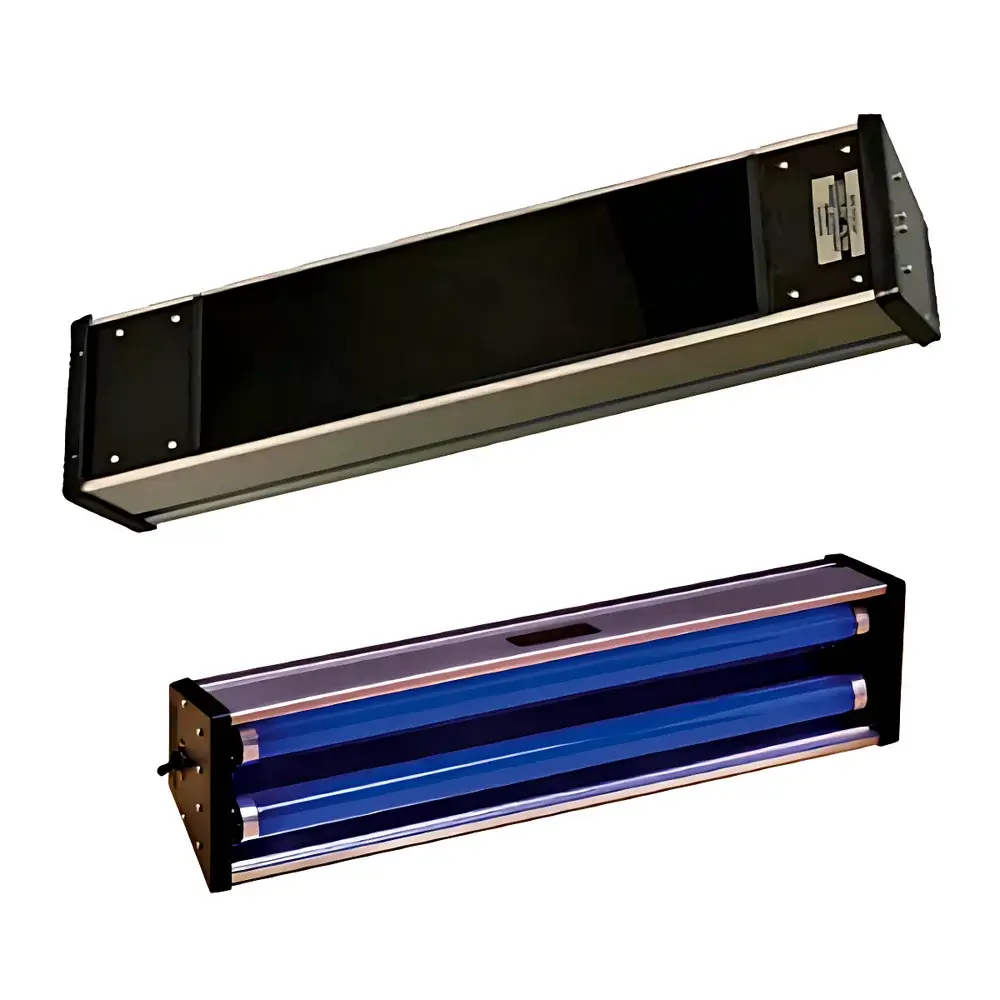
Spectro-UV X-Series UV Lamps
| Brand | Spectro-UV |
|---|---|
| Origin | USA |
| Model Variants | X-15G, XX-15A, XX-15BF, XX-40 |
| Power Options | 15 W or 40 W |
| Wavelength Options | UV-A (365 nm), UV-B (312 nm), UV-C (254 nm) |
| Illumination Mode | External (Top-Down or Side-Irradiation) |
| Dimensions (X-15 Series) | 47.6 cm × 11.4 cm × 8.9 cm |
| Weight (X-15 Series) | 2.72–3.32 kg |
| Dimensions (XX-40) | 121.9 cm × 15.1 cm × 10.2 cm |
| Weight (XX-40) | 7.71 kg |
| Compliance | CE, RoHS, UL-listed components (per model configuration) |
| Lamp Type | High-intensity quartz-housed mercury-vapor discharge lamps |
Overview
The Spectro-UV X-Series UV Lamps are precision-engineered ultraviolet illumination systems designed for demanding applications in laboratory research, non-destructive testing (NDT), forensic analysis, materials inspection, and quality assurance workflows. These lamps operate on the principle of mercury-vapor arc discharge within fused quartz envelopes, enabling stable, high-radiance output across defined UV spectral bands—specifically UV-A (365 nm), UV-B (312 nm), and UV-C (254 nm). Each model is configured with calibrated spectral filtering to isolate target wavelengths while suppressing visible and infrared emissions, ensuring compliance with ASTM E3022, ISO 3059, and NDT industry standards for fluorescent penetrant and magnetic particle inspection. The X-Series architecture emphasizes thermal stability, electrical safety, and long-term irradiance consistency—critical for reproducible fluorescence excitation, photostability studies, and UV-curing validation.
Key Features
- Multi-wavelength capability: Selectable UV-A (365 nm), UV-B (312 nm), and UV-C (254 nm) emission profiles across distinct models—enabling cross-application versatility without hardware substitution.
- Filtered and unfiltered lamp options: Integrated bandpass filters (e.g., Wood’s glass for UV-A) minimize visible bleed and enhance contrast in fluorescence visualization; unfiltered variants support broad-spectrum UV exposure protocols.
- Modular power design: 15 W models (X-15G, XX-15A, XX-15BF) deliver optimized irradiance for benchtop microscopy, small-part inspection, and portable field use; the 40 W XX-40 variant provides extended working distance and uniform intensity over larger surface areas (e.g., aerospace composite panels).
- Robust mechanical construction: Aluminum chassis with heat-dissipating fins, reinforced quartz lamp housings, and UL-listed ballasts ensure operational reliability under continuous duty cycles and ambient temperature fluctuations (10–40 °C).
- Ergonomic form factor: All X-15 series units feature identical footprint (47.6 × 11.4 × 8.9 cm) and low center-of-gravity design for vibration-resistant placement on optical tables or fume hoods; XX-40 includes integrated handle and cable management for mobile deployment.
Sample Compatibility & Compliance
The X-Series accommodates a wide range of sample geometries—from microcentrifuge tubes and Petri dishes to aircraft skin sections and polymer-coated substrates—without requiring custom fixtures. Its external irradiation geometry enables non-contact, top-down or lateral UV exposure, preserving sample integrity during fluorescence-based assays (e.g., GFP-tagged protein localization), UV-induced DNA damage quantification, or phosphor activation screening. All units meet CE marking requirements for electromagnetic compatibility (EN 61326-1) and safety (EN 61000-6-3), and incorporate RoHS-compliant components. For regulated environments—including GLP laboratories and FDA-audited manufacturing sites—the lamps support traceable calibration via optional NIST-traceable radiometric certificates (upon request). UV-C (254 nm) models comply with ISO 15858 for germicidal efficacy validation when used in controlled enclosures.
Software & Data Management
While the X-Series operates as a standalone hardware system (no embedded firmware or touchscreen interface), it integrates seamlessly into automated workflows via analog 0–10 V dimming inputs (available on XX-40) and TTL-triggered shutter control ports. Users may synchronize irradiation timing with imaging systems (e.g., sCMOS cameras, confocal scanners) or environmental chambers using third-party DAQ platforms (National Instruments, LabVIEW-compatible). Spectro-UV provides downloadable spectral irradiance curves (measured per CIE S 026/E:2019), photobiological safety assessments (ICNIRP 2022 guidelines), and application-specific SOP templates—including ASTM E1417-compliant NDT procedures and USP environmental monitoring checklists. Audit trails for lamp usage hours and filter replacement intervals can be maintained manually or imported into LIMS via CSV export from Spectro-UV’s companion LogTrack utility (v2.1, Windows/macOS).
Applications
- Non-Destructive Testing: Fluorescent penetrant inspection (FPI) and magnetic particle testing (MT) per ASME BPVC Section V and ASTM E1417, utilizing UV-A (365 nm) irradiance ≥1000 µW/cm² at 15 inches.
- Forensic Science: Latent fingerprint development, bodily fluid detection (e.g., semen, saliva), and counterfeit document verification using differential UV absorption/emission signatures.
- Life Sciences: Gel documentation (ethidium bromide, SYBR Safe), UV crosslinking of nucleic acids, and phototoxicity assays in cell culture under controlled UV-B exposure conditions.
- Materials Research: UV degradation studies of polymers, adhesives, and coatings; accelerated weathering correlation with QUV chamber data; photocatalyst activity screening (e.g., TiO₂ under UV-A).
- Aerospace & Automotive: Inspection of composite layup integrity, adhesive bondline assessment, and corrosion detection beneath paint layers using UV-fluorescent dyes.
FAQ
What safety certifications do the X-Series lamps carry?
All models conform to IEC/EN 62471 (Photobiological Safety of Lamps) and include integrated UV-blocking shields, thermal cutoffs, and interlocked housings where applicable. CE, RoHS, and UL component listings are documented in the technical datasheet per model.
Can the XX-40 be used for large-area UV curing?
Yes—the XX-40 delivers uniform irradiance over 30 × 30 cm at 30 cm working distance when paired with optional collimating optics. However, full-cure dose validation (J/cm²) must be performed with a calibrated radiometer specific to the photoinitiator’s absorption peak.
How often should UV filters be replaced?
Bandpass filters degrade gradually; Spectro-UV recommends replacement every 1,500 operating hours or annually—whichever occurs first—to maintain >95% peak transmittance and spectral fidelity.
Is spectral output data available for each lamp batch?
Yes—each production lot undergoes spectroradiometric characterization. Batch-specific reports (including FWHM, peak wavelength tolerance ±2 nm, and irradiance decay curve) are supplied with shipment or accessible via Spectro-UV’s secure customer portal.
Do these lamps require warm-up time before achieving stable output?
Mercury-vapor lamps reach 95% rated irradiance within 90 seconds; full spectral stabilization occurs within 5 minutes. For quantitative applications, users should allow a minimum 5-minute thermal equilibration period prior to measurement.





