
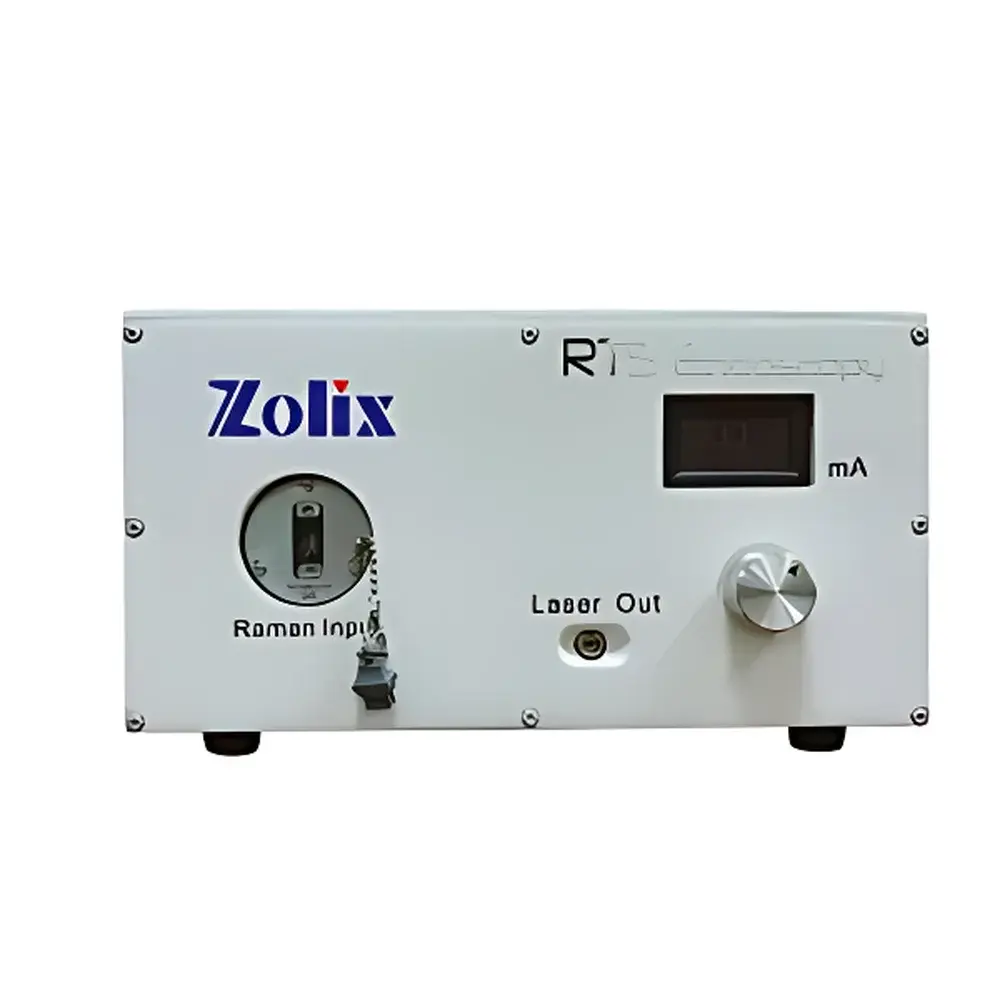
ZOLIX Endoscopic Raman Spectroscopy System
| Brand | ZOLIX |
|---|---|
| Origin | Beijing, China |
| Manufacturer Type | Authorized Distributor |
| Origin Category | Domestic (China) |
| Model | Endoscopic Raman Spectroscopy System |
| Pricing | Upon Request |
Overview
The ZOLIX Endoscopic Raman Spectroscopy System is a clinically oriented, fiber-coupled Raman detection platform engineered for real-time, in vivo molecular characterization during minimally invasive surgical procedures. It operates on the principle of inelastic light scattering—where monochromatic excitation (typically at 532 nm or 785 nm) induces vibrational mode shifts in biological tissues, generating signature Raman spectra that reflect biochemical composition (e.g., lipid/protein/nucleic acid ratios, collagen conformation, metabolic intermediates). Unlike conventional histopathology requiring tissue excision and processing delays, this system enables label-free, non-destructive spectral acquisition directly through standard endoscopic biopsy channels. Its core optical architecture integrates a high-throughput transmissive VPH grating spectrometer (Omni-iSpecT series), deep-cooled back-illuminated CCD detector, and medical-grade sterile Raman probes—optimized for signal fidelity under low-light, motion-prone intraoperative conditions.
Key Features
- Transmissive VPH grating spectrometer with F/2.3 aperture and >90% diffraction efficiency at both 532 nm and 785 nm excitation wavelengths
- Deep-cooled (-60°C) scientific-grade CCD sensor with high quantum efficiency (>85% in visible–NIR range) and low dark current (<0.001 e⁻/pix/s)
- Medical-grade sterile Raman probe options: standard 2.1 mm OD rigid probe (6.5 mm tip length), customizable 1.65 mm and 0.9 mm ultra-thin variants for intravascular or neurosurgical access
- Integrated large-F-number micro-lens (500 µm focal length) at probe tip for efficient light collection from confined anatomical sites
- Pre-aligned, vibration-insensitive optical module with hermetically sealed optics—designed for transport stability and long-term field deployment
- Dual-mode capability: simultaneous Raman + auxiliary optical spectroscopy via two additional fibers (spontaneous fluorescence spectroscopy or diffuse reflectance spectroscopy)
Sample Compatibility & Compliance
The system supports direct in vivo interrogation of epithelial, neural, and vascular tissues without exogenous contrast agents. Probe designs comply with ISO 13485 medical device quality management standards and meet biocompatibility requirements per ISO 10993-5 (cytotoxicity) and ISO 10993-10 (irritation/sensitization). The 2.1 mm probe is compatible with standard 2.8 mm biopsy channels in gastroscopes and colonoscopes; ultra-thin variants accommodate neuroendoscopic and intracoronary catheter integration. All fiber assemblies use medical-grade nylon jacketing and stainless-steel distal housings rated for autoclave sterilization (134°C, 3 bar). Data acquisition workflows support audit trails and electronic signatures aligned with FDA 21 CFR Part 11 requirements when deployed in GLP/GMP-regulated clinical validation studies.
Software & Data Management
Control and spectral analysis are performed using ZOLIX SpectraView Pro—a modular software suite supporting real-time background subtraction (fluorescence removal via polynomial fitting or asymmetric least squares), cosmic ray rejection, spectral averaging, and multivariate statistical processing (PCA, LDA, PLS-DA). Raw spectral data are stored in HDF5 format with embedded metadata (excitation wavelength, integration time, probe ID, patient anonymization tag). The platform exports calibrated spectra compliant with ASTM E1840-22 (Standard Practice for Raman Spectroscopy Data Exchange) and supports DICOM-SR integration for PACS linkage in hospital IT environments. Remote diagnostics and firmware updates are enabled via secure TLS-encrypted Ethernet interface.
Applications
- Intraoperative margin assessment during gastrointestinal tumor resection—differentiating adenocarcinoma, dysplasia, and normal mucosa based on spectral biomarkers (e.g., 1003 cm⁻¹ phenylalanine, 1445 cm⁻¹ CH₂ bending, 1655 cm⁻¹ amide I)
- Real-time identification of glioma infiltration zones during craniotomy—leveraging lipid-to-protein ratio shifts and nucleic acid band intensity changes
- Endovascular thrombus characterization—distinguishing platelet-rich vs. fibrin-rich clots via β-sheet/amide III ratio analysis
- Cutaneous melanoma screening during dermatoscopic examination using the external multifunctional probe
- Oral squamous cell carcinoma detection during laryngoscopy or buccal mucosa inspection
FAQ
What excitation wavelengths are supported?
The system is optimized for 532 nm and 785 nm laser sources—selected to balance Raman cross-section sensitivity and tissue autofluorescence suppression.
Is the probe reusable or single-use?
Probes are designed for multi-patient reuse following validated sterilization protocols (autoclaving or hydrogen peroxide plasma); disposable sterile sleeves are available for enhanced infection control.
Can the system be integrated with existing endoscopy towers?
Yes—the fiber-optic interface uses standardized SMA 905 connectors and requires only DC power and Gigabit Ethernet; no proprietary video or control bus integration is needed.
Does the software support regulatory submission-ready reporting?
SpectraView Pro includes configurable report templates compliant with ISO/IEC 17025 documentation requirements and supports PDF/A-2 export with embedded digital signatures.
What is the typical acquisition time per spectrum during endoscopy?
With 100–500 ms integration time and 5–10× signal averaging, a diagnostically usable spectrum can be acquired in <2 seconds under standard illumination and motion-stabilized conditions.
Related Products






