
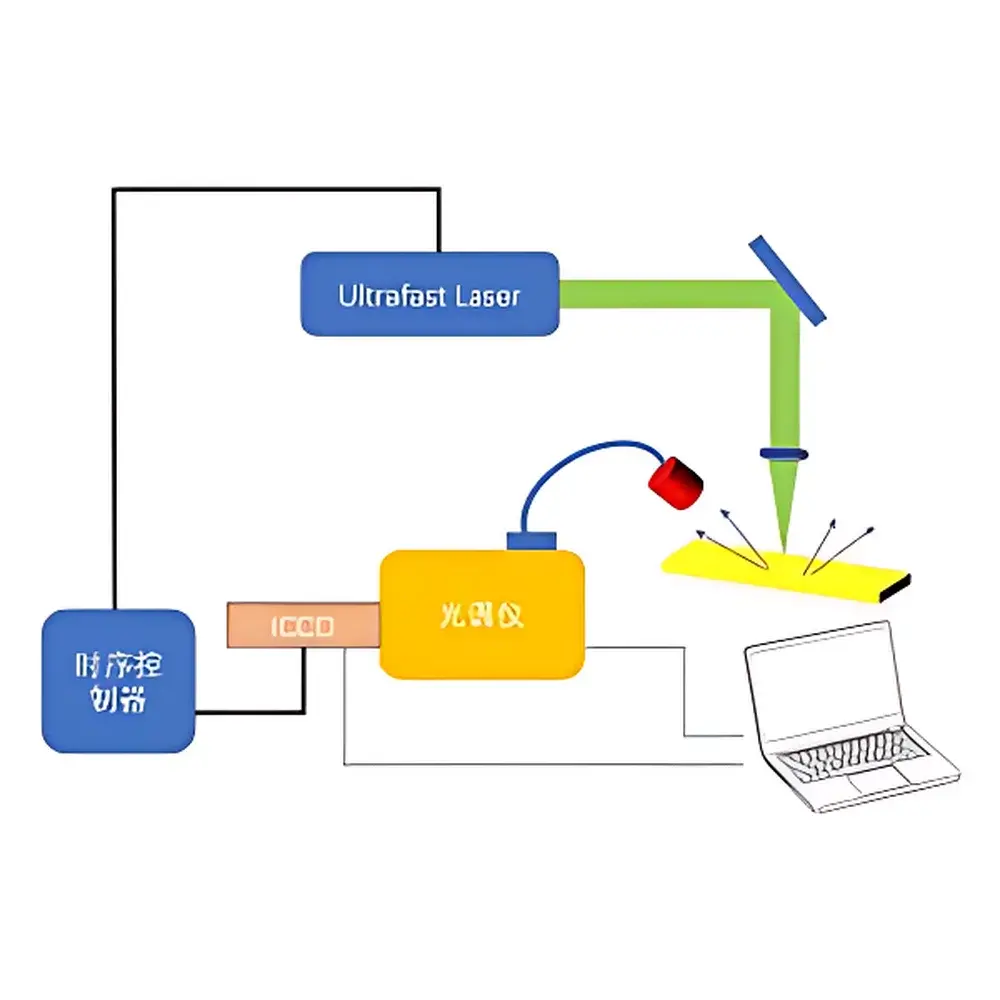
ZOLIX Omni-LIBS Integrated Laser-Induced Breakdown Spectroscopy System
| Brand | ZOLIX |
|---|---|
| Origin | Beijing, China |
| Model | Omni-LIBS Series |
| Spectrometer Architecture | Czerny-Turner (C-T) |
| Focal Length Options | 200 mm / 320 mm / 500 mm / 750 mm |
| Grating Options | up to 1200 grooves/mm |
| Spectral Resolution | down to 0.03 nm (at 750 mm focal length with 1200 g/mm grating) |
| Detection Compatibility | ICCD, sCMOS, CCD, PMT |
| Input Interface | SMA905 fiber-coupled |
| Output Interface | Standard C-mount or F-mount for detector integration |
| Laser Compatibility | Nanosecond (532 nm / 1064 nm) and femtosecond pulsed lasers |
| Timing Control | External TTL synchronization support for laser–detector delay (ns–µs range) |
| Software Platform | ZOLIX SpectraMaster™ v4.2 with spectral calibration, peak identification (NIST database), and semi-quantitative analysis modules |
| Compliance | ASTM E2926-21 (Standard Practice for LIBS Analysis), ISO/IEC 17025:2017 compatible workflow architecture |
Overview
The ZOLIX Omni-LIBS Integrated Laser-Induced Breakdown Spectroscopy System is a turnkey analytical platform engineered for elemental composition analysis across solid, liquid, and aerosol samples. Based on the fundamental principle of laser-induced plasma emission spectroscopy, the system utilizes high-energy pulsed laser irradiation to generate transient microplasmas on the sample surface. The emitted atomic and ionic line spectra—spanning UV–VIS–NIR (190–1000 nm)—are collected, dispersed by a high-throughput Czerny-Turner spectrometer, and resolved using time-gated detection. Unlike conventional laboratory-based LIBS setups requiring custom optical alignment, the Omni-LIBS integrates optomechanical stability, thermal management, and synchronized timing control into a single compact chassis. Its design prioritizes reproducibility in plasma initiation, spectral fidelity in dispersion, and temporal precision in signal gating—critical parameters for transitioning from qualitative screening to semi-quantitative and method-validated applications in regulated environments.
Key Features
- Modular C-T spectrometer architecture with interchangeable focal lengths (200 mm to 750 mm) and grating options (300–2400 g/mm), enabling application-specific optimization of resolution, spectral coverage, and light throughput.
- Sub-0.03 nm spectral resolution achievable at 750 mm focal length with 1200 g/mm holographic grating—sufficient to resolve adjacent Fe I (238.204 nm) and Cr I (238.213 nm) lines under ambient conditions.
- Fiber-optic coupling (SMA905 interface) ensures flexible integration with diverse laser sources (ns Nd:YAG, fs Ti:Sapphire) and sample chambers—including vacuum, controlled-atmosphere, and open-air configurations.
- Native support for time-resolved detection via external TTL triggering: precise delay (10 ns–10 µs) and gate width (10 ns–10 ms) control between laser pulse and detector activation, minimizing continuum background and enhancing signal-to-background ratio.
- Multi-detector compatibility: validated integration paths for intensified CCD (ICCD), scientific CMOS (sCMOS), back-illuminated CCD, and photomultiplier tube (PMT) arrays—enabling trade-off evaluation between quantum efficiency, dynamic range, and temporal response.
- ZOLIX SpectraMaster™ v4.2 software includes NIST Atomic Spectra Database (ASD) cross-referencing, automated wavelength calibration (Hg/Ne/Ar lamp or laser-induced plasma reference lines), and matrix-matched calibration curve generation for certified reference materials (CRMs).
Sample Compatibility & Compliance
The Omni-LIBS system accommodates heterogeneous sample geometries without destructive preparation: bulk metals, geological cores, botanical tissues (e.g., Codonopsis pilosula roots), ceramic glazes, and thin-film coatings. Sample introduction is compatible with XYZ motorized stages (optional), atmospheric pressure, low-pressure (<10 mbar), or inert gas (Ar, He) purge environments—critical for suppressing air-induced CN molecular bands and enhancing alkali metal line intensity. From a regulatory standpoint, the system’s hardware timestamping, audit-trail-enabled software logging, and user-access-level controls align with GLP-compliant data integrity requirements. While not pre-certified for FDA 21 CFR Part 11, its architecture supports validation protocols per ASTM E2926-21 and ISO/IEC 17025:2017 for method development, uncertainty estimation, and inter-laboratory comparability studies.
Software & Data Management
SpectraMaster™ v4.2 provides a deterministic data acquisition and processing environment. Raw spectra are stored in HDF5 format with embedded metadata (laser energy, delay/gate settings, grating position, calibration coefficients). Peak identification employs iterative least-squares fitting against NIST ASD v2023.0, with configurable tolerance windows (±0.05 nm) and interference flagging for overlapping multiplets. Quantitative workflows include internal standard normalization (e.g., Ca II 393.366 nm for soil matrices), univariate calibration using CRMs, and optional partial least squares (PLS) regression for multi-element modeling. All processing steps are scriptable via Python API, enabling integration into automated QA/QC pipelines. Audit trails record operator ID, timestamp, parameter modifications, and file export events—meeting traceability requirements for ISO/IEC 17025 accreditation.
Applications
- Metallurgical Process Control: Real-time alloy grade verification (e.g., distinguishing 304 vs. 316 stainless steel via Mo/Cr/Ni ratios) during scrap sorting or melt monitoring.
- Cultural Heritage Science: Non-invasive pigment identification in frescoes and ink analysis in historical manuscripts, preserving sub-micron surface integrity through low-fluence ns-laser ablation.
- Pharmaceutical & Botanical QA: Screening for heavy metal contaminants (Pb, Cd, As) in herbal raw materials per USP and Chinese Pharmacopoeia guidelines.
- Environmental Geochemistry: In-field soil mapping of trace elements (Cu, Zn, Mn) using portable laser excitation coupled to 320 mm focal length spectrometer for rapid surveying.
- Nuclear Safeguards: Isotopic ratio estimation (e.g., 235U/238U) via high-resolution 750 mm configuration with echelle-grade gratings—validated against IAEA reference spectra.
FAQ
What laser specifications are recommended for optimal Omni-LIBS performance?
Nanosecond Nd:YAG lasers operating at 1064 nm (pulse energy 10–100 mJ, 5–10 ns FWHM) are standard; 532 nm harmonics improve ablation efficiency on dielectrics. Femtosecond systems (≤500 fs) require beam delivery recalibration but reduce thermal effects in biological tissues.
Can the system perform depth profiling?
Yes—via sequential laser shots at fixed XY coordinates with controlled ablation crater depth (typically 0.1–1 µm/pulse). Depth resolution depends on material removal rate, which is calibrated using profilometry or cross-sectional SEM.
Is spectral calibration stable over extended operation?
The monolithic aluminum spectrometer housing and kinematic grating mount minimize thermal drift. Wavelength stability is maintained within ±0.005 nm over 8 hours at constant ambient temperature (20 ± 1 °C), verified by periodic Hg/Ne lamp checks.
How does the C-T design compare to echelle spectrometers for LIBS?
C-T systems offer higher étendue and superior photon throughput—advantageous for weak plasma signals—while echelle instruments provide broader simultaneous coverage at lower resolution. Omni-LIBS prioritizes signal-to-noise in targeted element lines rather than full-spectrum capture.
What validation documentation is provided?
Each unit ships with factory spectral calibration report (NIST-traceable Hg/Ne/Ar lines), resolution verification certificate (using Fe/Ar plasma lines), and software validation summary compliant with ASTM E2926 Annex A2.
Related Products





