
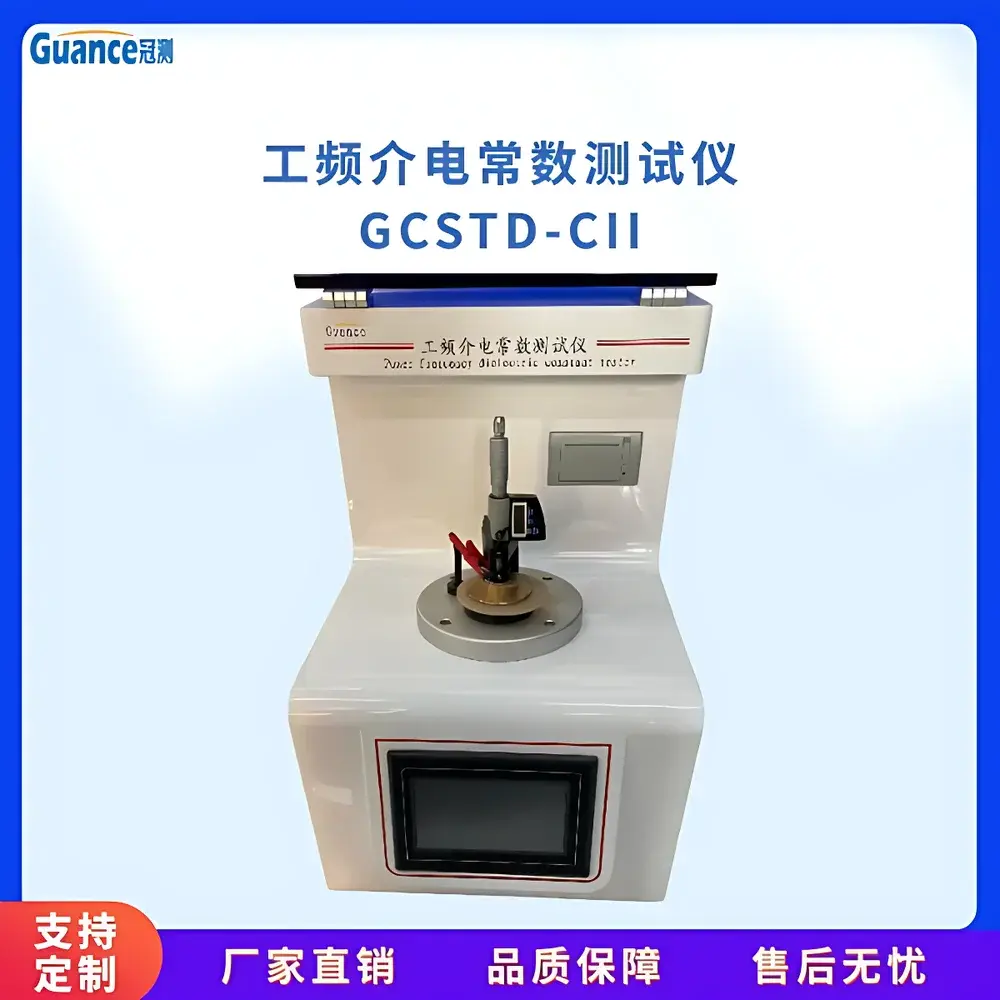
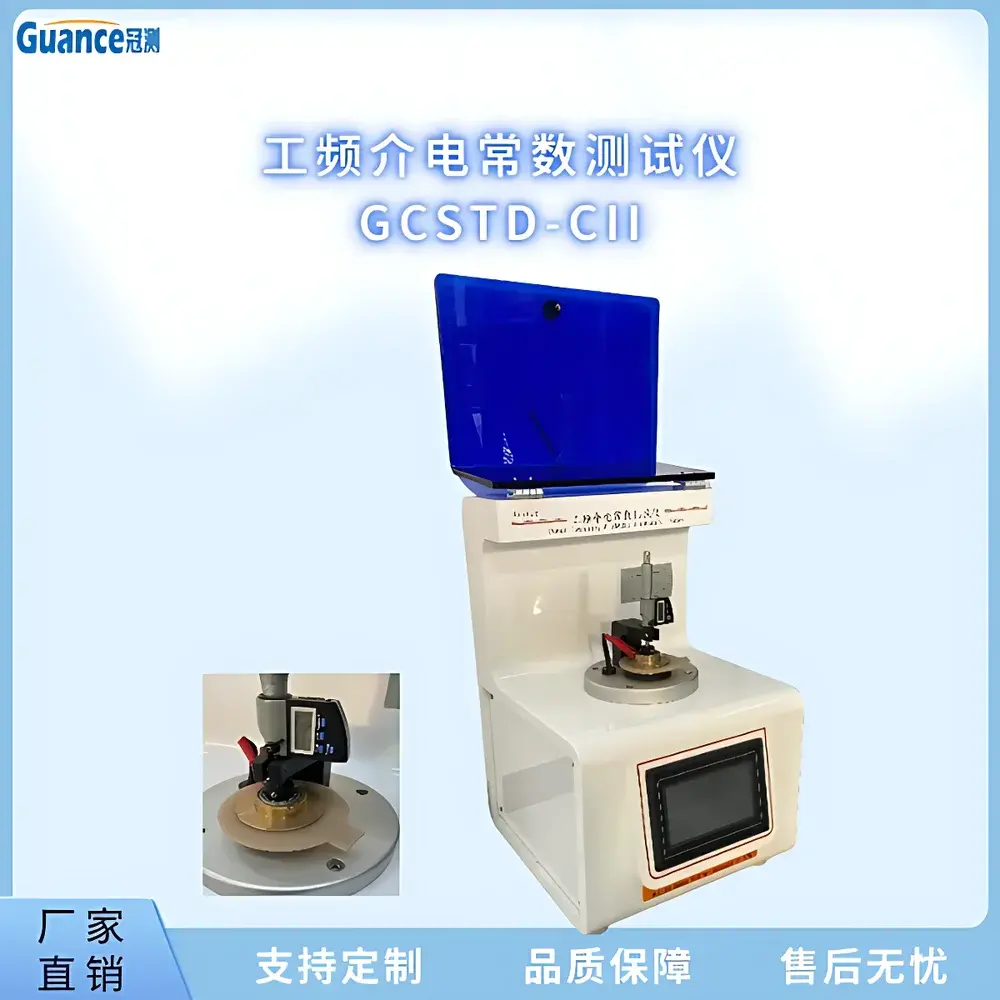
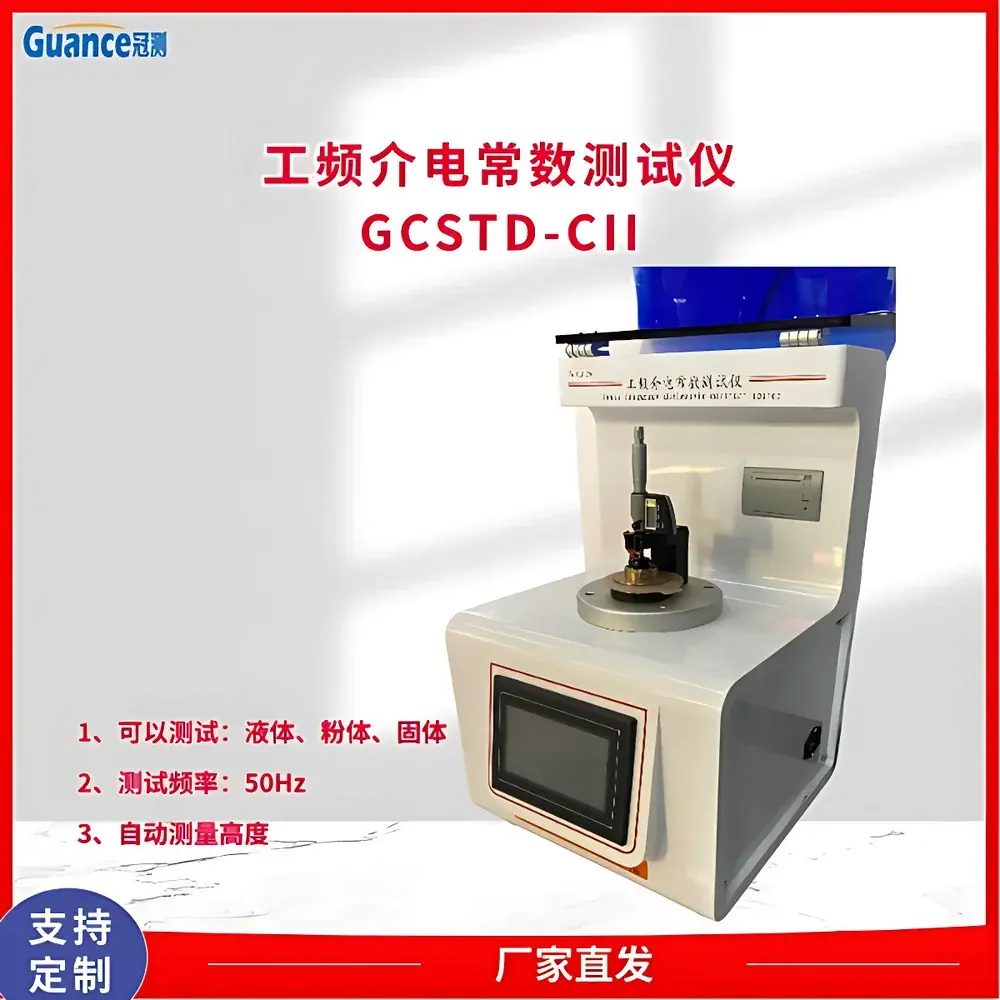
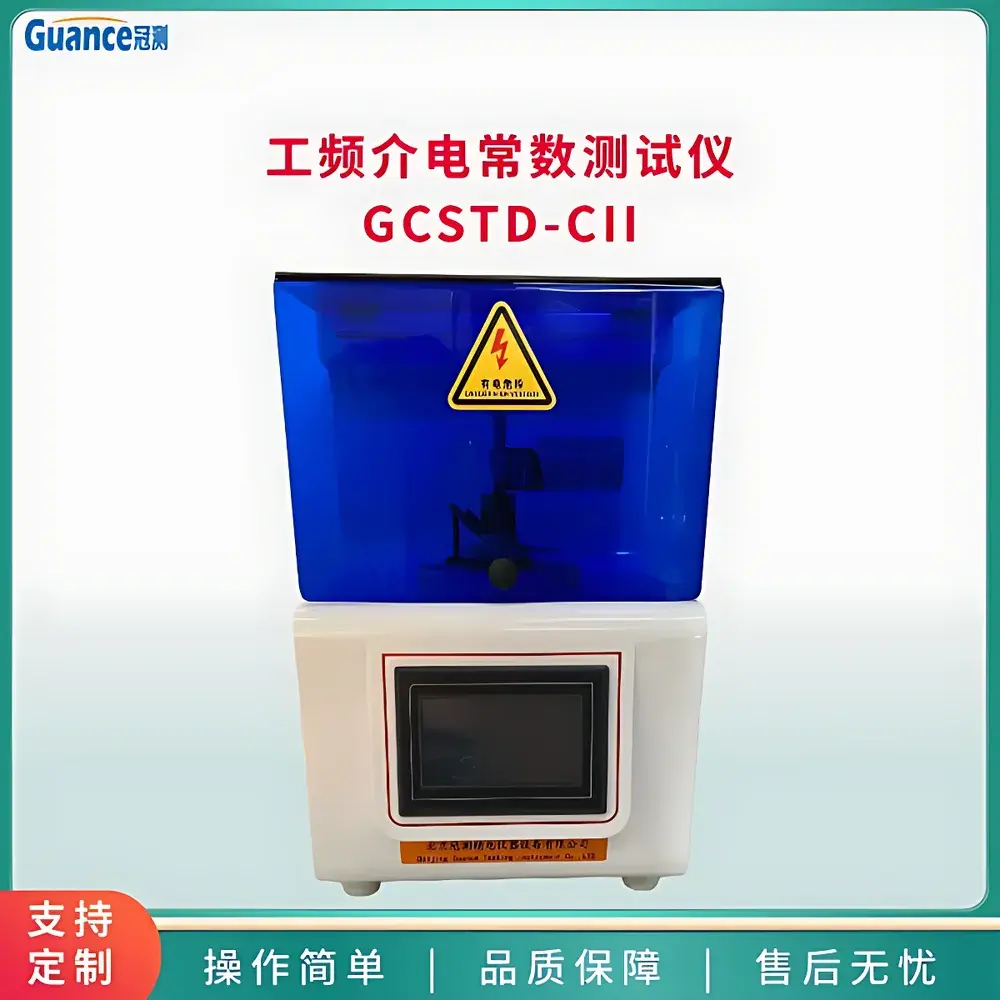
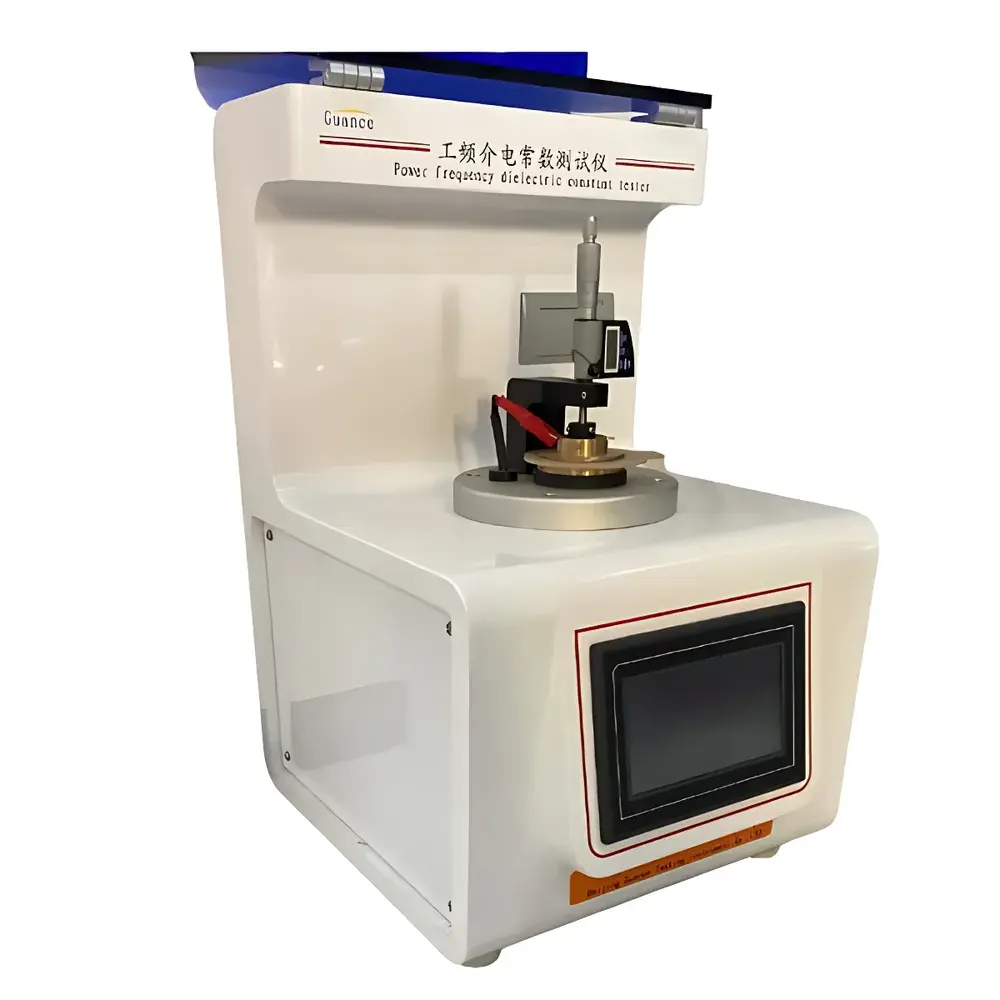
GuanCe Instruments GCSTD-CII4 Power Frequency Dielectric Constant and Dissipation Factor Analyzer
| Brand | GuanCe Instruments |
|---|---|
| Origin | Beijing, China |
| Manufacturer Type | Authorized Distributor |
| Product Category | Domestic |
| Model | GCSTD-CII4 |
| Price | USD 1,250 (FOB Beijing) |
| Operating Frequency | 45–65 Hz (Auto-Tuned to 50/60 Hz) |
| Measurement Principle | Schering Bridge with Digital Phase-Sensitive Detection |
| Display | 320×240 Dot-Matrix LCD with Chinese GUI |
| Input Power | 220 V ±10%, 50/60 Hz |
| Dimensions (L×W×H) | 470 × 320 × 360 mm |
| Weight | 16 kg |
| Output Power | 1.5 kVA |
| Voltage Range | 2.5 kV / 5 kV / 10 kV (Selectable, RMS) |
| Test Modes | Direct Connection, Reverse Connection, External HV Source Mode |
| tgδ Range | 0.00%–99.9%, Resolution: 0.01%, Accuracy: ±(1% of reading + 0.09%) |
| Cx Range | 30 pF–0.3 µF (internal HV), Resolution: 0.1 pF, Accuracy: ±(1.5% of reading + 1 pF) |
| Sample Electrode Diameters Supported | 38 mm, 50 mm, 100 mm |
| Environmental Operating Range | 10–30 °C, 20–80% RH |
| Compliance | GB/T 1409–2006, GB/T 5654–2007, GB/T 21216–2007, GB/T 1693–2007, GB/T 5594.4–1985 |
Overview
The GuanCe Instruments GCSTD-CII4 Power Frequency Dielectric Constant and Dissipation Factor Analyzer is a precision Schering bridge-based instrument engineered for the standardized determination of relative permittivity (εr) and dielectric loss tangent (tan δ, or tgδ) in solid, liquid, and composite insulating materials under power frequency conditions (45–65 Hz). It implements digital phase-sensitive detection (PSD) and auto-tuned frequency synthesis to isolate the fundamental 50/60 Hz component—enabling high-fidelity measurement even in electrically noisy substations, transformer yards, or industrial laboratories where ambient electromagnetic interference exceeds 40 dB. Unlike broadband impedance analyzers, the GCSTD-CII4 operates exclusively within the low-frequency domain mandated by IEC 60270, ASTM D150, and national standards including GB/T 1409–2006 and GB/T 5654–2007, ensuring metrological traceability for quality control, type testing, and routine maintenance of high-voltage assets.
Key Features
- Integrated high-voltage generator (2.5 kV / 5 kV / 10 kV RMS, five-step regulation) and precision measurement unit housed in a single compact chassis—eliminating external HV cabling and grounding loops that introduce measurement uncertainty.
- Adaptive frequency-locking circuitry suppresses 50/60 Hz harmonics and common-mode noise via real-time spectral filtering, achieving stable tgδ readings down to 0.05% in environments with >100 V/m field strength.
- Dual-connection topology supports direct (grounded specimen), reverse (floating specimen), and externally excited test configurations—enabling compliance with GB/T 5594.4–1985 for ceramic dielectrics and GB/T 1693–2007 for vulcanized rubber.
- Onboard reference capacitor (class 0.05, NIST-traceable calibration chain) and temperature-compensated A/D converter (24-bit resolution, internal 6-digit processing) ensure long-term repeatability (<0.1% RSD over 8 h).
- Self-diagnostic firmware verifies bridge balance, signal-to-noise ratio, and HV insulation integrity prior to each measurement cycle—preventing erroneous data capture during partial discharge events or surface flashover.
Sample Compatibility & Compliance
The GCSTD-CII4 accommodates standard electrode geometries per GB/T 5654–2007 and IEC 60247: parallel-plate cells with 38 mm, 50 mm, and 100 mm diameters—compatible with ASTM D924 oil cups, IEC 60695-10-2 solid-disk fixtures, and custom-designed high-temperature test chambers (up to 120 °C, with optional thermal shield kit). It supports liquid dielectrics (mineral oil, silicone fluid, ester-based insulating oils), solid sheets (polyimide, epoxy resin, pressboard), elastomers (EPDM, silicone rubber), and ceramic substrates (Al2O3, AlN). All measurements adhere to the uncertainty budgeting framework defined in ISO/IEC 17025:2017, with documented calibration certificates available per CNAS-CL01 requirements. The instrument’s electrical safety architecture conforms to GB 4793.1–2007 (equivalent to IEC 61010-1) and includes dual-stage overcurrent protection, arc-quenching HV relays, and automatic discharge sequencing (<5 s post-test).
Software & Data Management
While the GCSTD-CII4 operates as a stand-alone benchtop analyzer with embedded Chinese-language menu navigation, it supports optional RS232/USB data export for integration into laboratory information management systems (LIMS). Exported CSV files include timestamp, test voltage, tgδ, Cx, test mode, ambient temperature/humidity, and operator ID—structured to align with FDA 21 CFR Part 11 audit trail requirements when paired with validated third-party software. Firmware updates are delivered via secure USB key with SHA-256 signature verification. Internal memory retains ≥500 test records with cyclic overwrite; no cloud connectivity or remote access functionality is implemented—preserving data sovereignty per ISO 27001 policies.
Applications
- Quality assurance of transformer insulating oil per GB/T 5654–2007 and IEEE C57.106–2015: rapid screening of oxidation-induced polar compound accumulation.
- Type testing of polymeric cable insulation (XLPE, EPR) per GB/T 12706.2–2020: evaluation of water treeing resistance via tan δ vs. voltage ramp profiles.
- Routine diagnostics of bushings, current transformers, and GIS spacers using reverse connection mode to isolate grading capacitor integrity.
- Development and qualification of high-k dielectric ceramics for RF substrates, per GB/T 5594.4–1985 and IPC-TM-650 2.5.2.
- Accelerated aging studies of impregnated paper and pressboard under controlled humidity and temperature per IEC 60505.
FAQ
Does the GCSTD-CII4 comply with international standards such as IEC 60270 or ASTM D150?
Yes—it implements the Schering bridge method specified in IEC 60270 Annex B and ASTM D150 Section 7, with measurement bandwidth limited to 45–65 Hz to meet standard-defined power frequency conditions.
Can the instrument measure samples at elevated temperatures?
The base unit operates at ambient temperatures of 10–30 °C. For elevated-temperature testing, external heated electrode cells (e.g., HT-50 series) may be connected via shielded coaxial interface; temperature feedback is not internally monitored.
Is calibration traceable to national metrology institutes?
Factory calibration uses reference standards certified by the National Institute of Metrology (NIM), China, with full uncertainty budgets provided in the certificate of calibration (ISO/IEC 17025 accredited).
What safety certifications does the instrument hold?
It carries CE marking per EMC Directive 2014/30/EU and Low Voltage Directive 2014/35/EU, and complies with GB 4793.1–2007 for electrical safety in measurement equipment.
How is data integrity ensured during long-term deployment?
All measurements include embedded environmental metadata (T, RH), operator ID, and system self-test logs. Optional LIMS integration enables electronic signatures and change-controlled report generation per GLP/GMP Annex 11.



