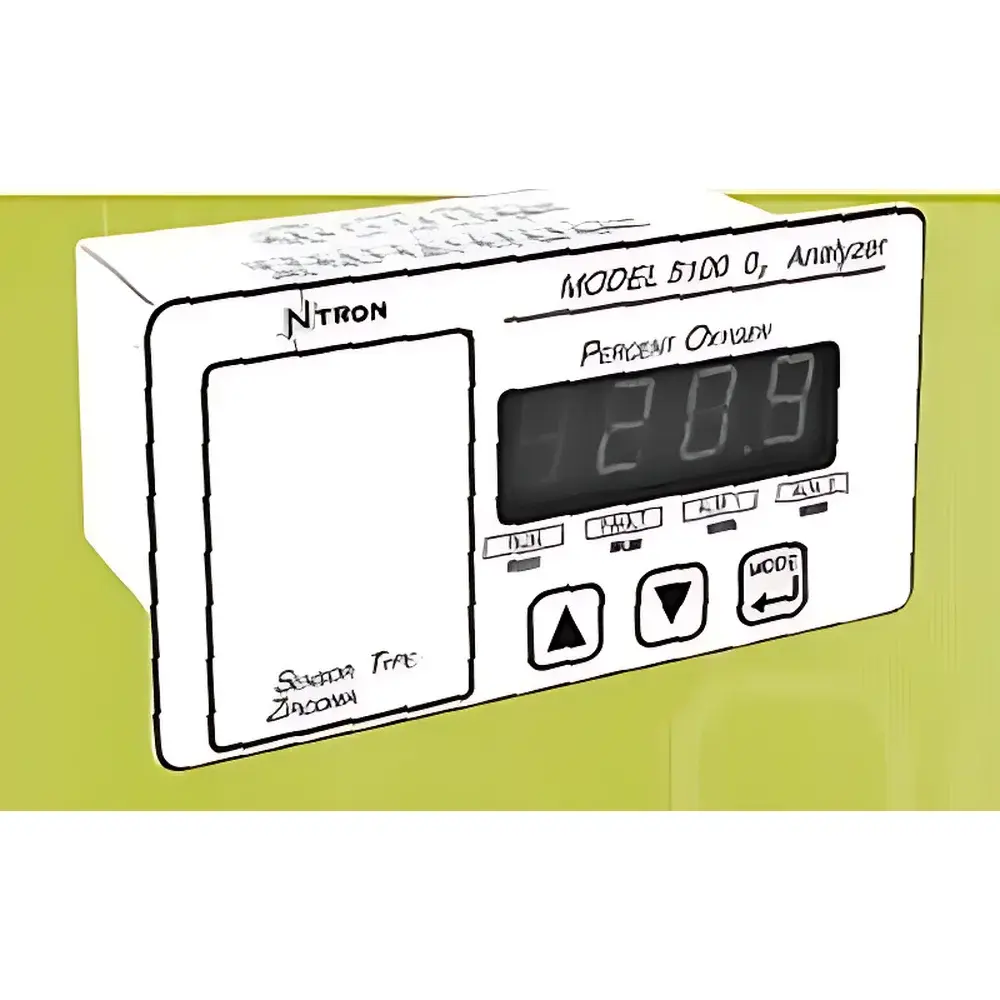
Neutonics 5100 Oxygen Analyzer
| Brand | Neutronics |
|---|---|
| Origin | USA |
| Model | 5100 |
| Sensor Type | Electrochemical (Zirconia-based) |
| Measurement Range | 0–1%, 0–10%, 0–25%, 0–50%, or 0–100% O₂ (auto-ranging or fixed-range selectable) |
| Display | 0.75" (19.05 mm) high-brightness LED numeric display with status LEDs (green = normal operation, yellow = system fault, red = alarm 1 or 2) |
| Response Time (t₉₀) | <15 s |
| Accuracy | ±2% FS at constant temperature |
| Operating Temperature | 5–45 °C |
| Output Signals | 4–20 mA, 0–10 VDC (also supports 0–1 VDC and 0–5 VDC), RS-232 serial interface |
| Alarm Outputs | Two configurable relay outputs |
| Sample Connection | 1/8" NPT female port |
| Power Supply | 115/230 VAC, 50/60 Hz, 10 W or 12–30 VDC |
| Enclosure Rating | Front panel — IP66 (MEWA4) |
| Weight | <0.9 kg |
| Warranty | 12 months from shipment date under normal operating conditions |
| Compliance | Designed for industrial process environments |
Overview
The Neutonics 5100 Oxygen Analyzer is a precision-engineered, zirconia-based electrochemical analyzer designed for continuous, real-time oxygen concentration monitoring in demanding industrial process control applications. Unlike paramagnetic or optical sensors, the 5100 utilizes a stabilized thimble-type zirconium dioxide (ZrO₂) sensor operating on the principle of oxygen ion conduction across a heated ceramic electrolyte—enabling robust, drift-resistant measurement across wide concentration ranges without cross-sensitivity to CO, CO₂, NOₓ, or other acidic gas species. Its compact form factor (under 0.9 kg) and front-panel mounting capability support rapid integration into skids, control cabinets, and OEM systems where space, reliability, and long-term stability are critical. The instrument is optimized for ambient-temperature process streams and operates within a certified environmental envelope of 5–45 °C, making it suitable for boiler flue gas monitoring, inerting systems, fermentation off-gas analysis, heat-treatment atmospheres, and modified-atmosphere packaging (MAP) line verification.
Key Features
- Zirconia electrochemical sensing technology with inherent immunity to acidic gases (CO, CO₂, NOₓ), eliminating need for costly gas conditioning or scrubbing stages
- Multi-range capability: user-selectable full-scale spans including 0–1%, 0–10%, 0–25%, 0–50%, and 0–100% O₂—either as fixed ranges or auto-ranging for dynamic process adaptation
- High-visibility 0.75″ LED numeric display with dedicated status indicators: green (operational readiness), yellow (system diagnostic alert), and dual red LEDs (independent alarm activation)
- Fast response performance: t₉₀ ≤ 15 seconds ensures timely detection of oxygen excursions during purge cycles or leak events
- Dual programmable relay outputs supporting fail-safe shutdown, vent activation, or PLC interlock signaling per user-defined thresholds
- Flexible power architecture: accepts both AC (115/230 VAC, 50/60 Hz) and DC (12–30 VDC) inputs—ideal for hybrid plant infrastructure or mobile/mobile-mounted deployments
- IP66-rated front panel housing meets NEMA 4X equivalency for dust-tight, water-jet resistant operation in washdown or outdoor control room environments
Sample Compatibility & Compliance
The Neutonics 5100 is engineered for direct sampling of dry or moderately humid process gases at near-ambient pressure. Its 1/8″ NPT inlet accommodates standard stainless steel or PTFE-lined sample lines, and optional internal sampling pump modules enable low-flow or negative-pressure stream acquisition. The zirconia sensor exhibits no chemical degradation in presence of CO, CO₂, SO₂, or NOₓ—critical for combustion exhaust, syngas, or biogas applications where traditional galvanic cells would fail prematurely. While not intrinsically safe or ATEX-certified, the analyzer complies with IEC 61000-6-2 (immunity) and IEC 61000-6-4 (emissions) standards for industrial electromagnetic compatibility. It supports traceable calibration via certified zero (N₂) and span (air or known O₂ standard) gases and maintains measurement integrity over a 5-year typical sensor service life under routine maintenance protocols.
Software & Data Management
Although the 5100 operates as a standalone analog transmitter, its RS-232 serial interface enables bidirectional communication with supervisory systems for configuration, diagnostics, and event logging. Supported commands include range selection, alarm setpoint adjustment, calibration initiation, and real-time status polling. When integrated into SCADA or DCS platforms, the 4–20 mA output provides primary process variable transmission with HART-compatible smart device functionality (via optional firmware upgrade). All configuration changes and alarm triggers are timestamped and retained in non-volatile memory, facilitating audit-ready records for GLP/GMP-aligned operations. The unit does not require FDA 21 CFR Part 11-compliant electronic signatures but supports manual logbook correlation through synchronized UTC timestamps and event codes.
Applications
- Combustion efficiency optimization in fired heaters, boilers, and thermal oxidizers
- Inert gas blanketing and purge validation in chemical reactors, storage tanks, and pharmaceutical isolators
- Fermentation and cell-culture bioreactor headspace O₂ monitoring
- Heat-treating furnace atmosphere control (e.g., annealing, sintering, brazing)
- Modified-atmosphere packaging (MAP) line verification and leak detection
- Landfill and anaerobic digester biogas quality assurance
- Post-combustion emissions monitoring where regulatory compliance requires continuous O₂ reference data
FAQ
What sensor technology does the Neutonics 5100 employ?
It uses a high-stability, thimble-type zirconium dioxide (ZrO₂) electrochemical sensor operating at elevated temperature (~700 °C) to generate a Nernst potential proportional to oxygen partial pressure.
Can the 5100 measure oxygen in corrosive gas matrices such as flue gas?
Yes—the zirconia sensor is chemically inert to CO, CO₂, NOₓ, and SO₂, enabling direct measurement without pre-conditioning or catalytic scrubbers.
Is field calibration supported?
Yes; two-point calibration (zero and span) can be performed in situ using certified gases, with accuracy verified to ±1% FS when calibrated at the actual sample point.
Does the unit support hazardous area installation?
No—it is rated for non-hazardous locations only (IEC 60079-0 general requirements); explosion-proof enclosures or remote sensor configurations must be used in classified zones.
What is the expected service life of the sensor?
Under normal operating conditions and periodic verification, the zirconia element delivers ≥5 years of functional service before replacement is recommended.