
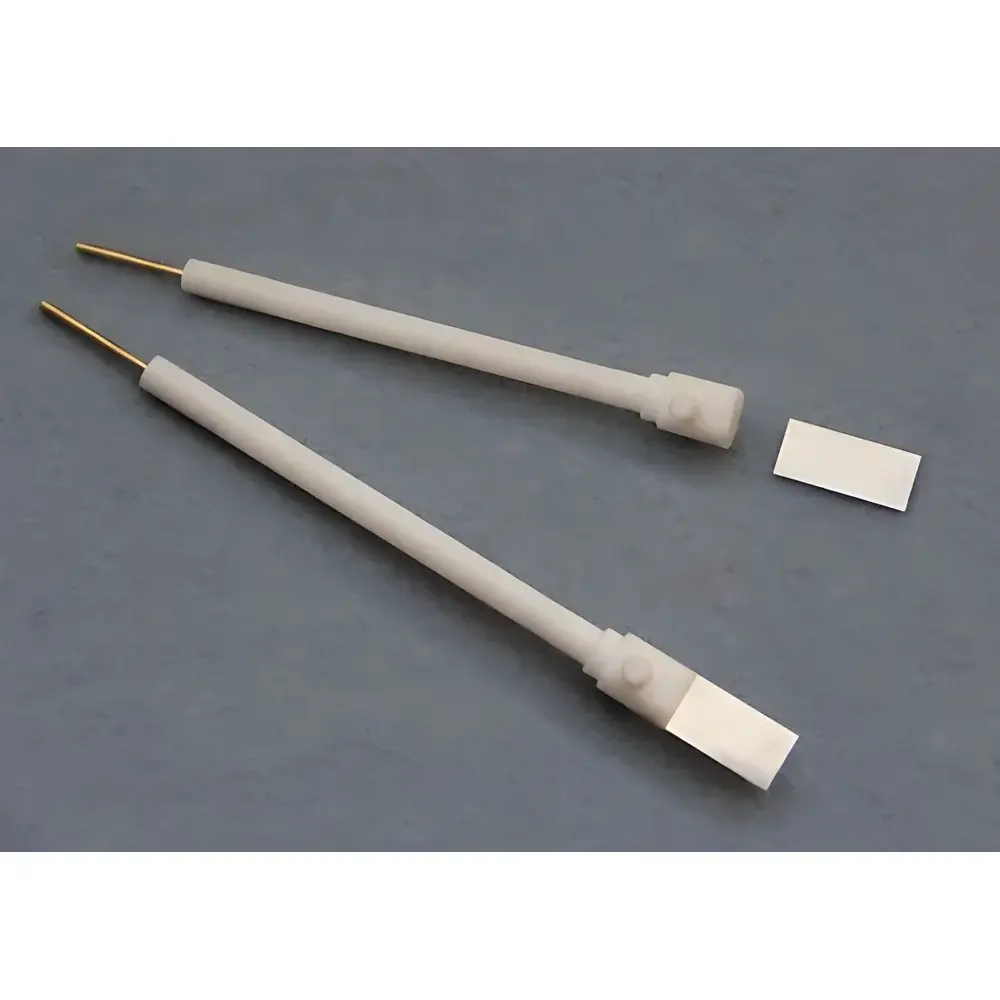
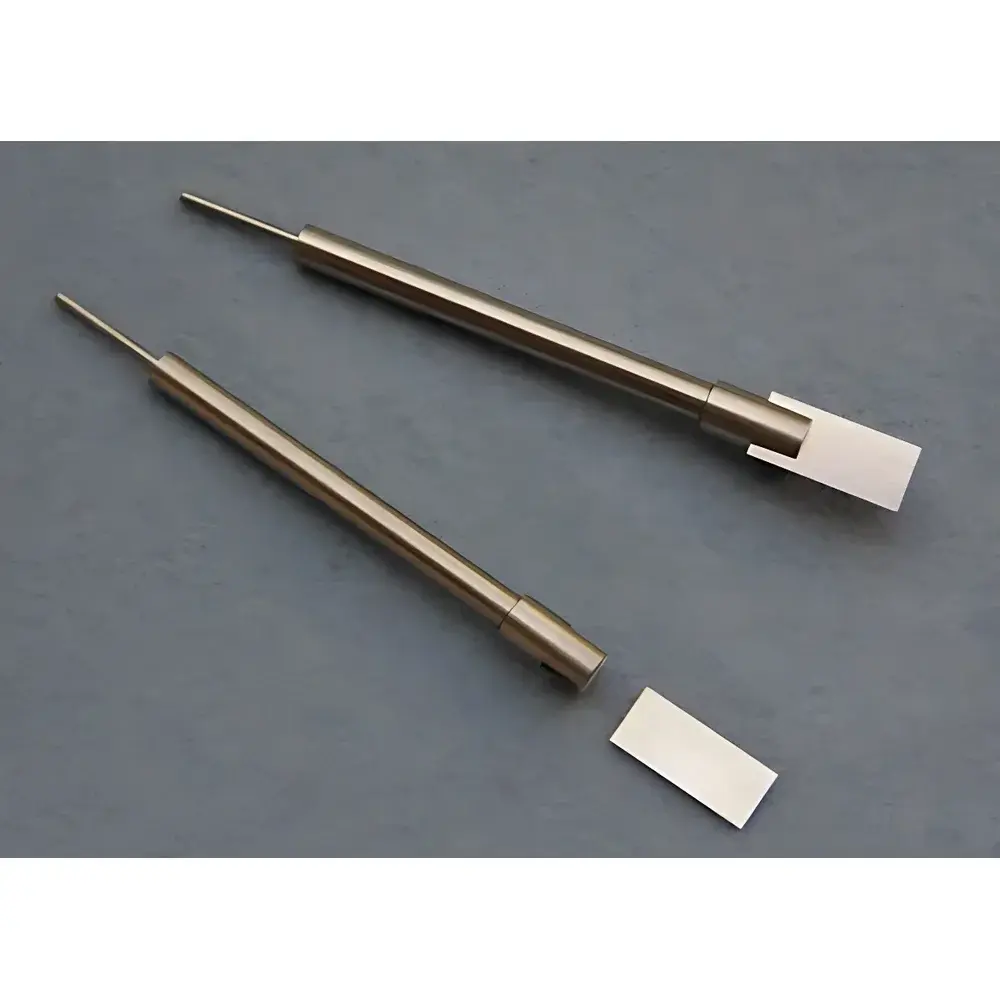
Platinum & Stainless Steel Electrode Holder for Optical Light Sources
| Origin | Beijing, China |
|---|---|
| Manufacturer Type | Distributor |
| Origin Category | Domestic |
| Model | JJ110 (Pt), JJ120 (Stainless Steel) |
| Price Range | USD 420 – 690 |
| Light Source Type | Other (Compatible with Xenon & Mercury Lamps) |
| Irradiation Mode | Internal Illumination |
| Electrode Material | Pure Platinum (JJ110) / High-Grade Stainless Steel (JJ120) |
| Housing Material | Polytetrafluoroethylene (PTFE) |
| Operating Temperature | Ambient (20–25 °C recommended) |
| Electrode Exchange | Tool-Free, Quick-Release Mechanism |
Overview
The Platinum & Stainless Steel Electrode Holder for Optical Light Sources is a precision-engineered mechanical interface designed to secure and electrically connect electrodes within photochemical, photocatalytic, and optoelectrochemical reaction cells—particularly those integrated with high-intensity internal illumination systems such as xenon arc lamps and mercury vapor lamps. Unlike generic clamping solutions, this holder implements a coaxial, low-resistance electrical pathway optimized for stable current delivery under UV–visible irradiation. Its dual-model architecture (JJ110 for high-fidelity electrochemical applications; JJ120 for robust, cost-sensitive routine testing) ensures compatibility across research-grade photoreactors, custom-built quartz cells, and standardized optical cuvette assemblies. The device operates on the principle of mechanical compression coupling: electrode shanks are gripped via spring-loaded PTFE-insulated collets, eliminating soldering or crimping while maintaining galvanic isolation between working and counter electrodes where required.
Key Features
- Pure platinum electrode variant (JJ110) delivers ultra-low contact resistance (< 5 mΩ) and exceptional electrochemical inertness—critical for quantitative photoelectrocatalysis studies involving water splitting or CO₂ reduction.
- Stainless steel variant (JJ120) utilizes AISI 316-grade alloy with passivated surface finish, offering superior mechanical durability and corrosion resistance in neutral-to-mildly acidic electrolytes (pH 3–9).
- PTFE housing (ASTM D4894-compliant) provides full dielectric isolation, thermal stability up to 260 °C, and immunity to halogenated solvents, ozone, and UV-induced degradation.
- Tool-free, snap-in electrode exchange mechanism enables sub-10-second replacement of electrode plates without disassembling the cell—minimizing experimental downtime and cross-contamination risk.
- Internal illumination compatibility ensures unobstructed optical access: the holder’s low-profile design (max height 22 mm) avoids shadowing of lamp output and maintains uniform photon flux distribution across the electrode surface.
- Modular mounting geometry supports standard 1/4″-28 UNC threaded ports and Ø12.7 mm optical rail interfaces for integration into multi-axis optical benches and automated photoreactor platforms.
Sample Compatibility & Compliance
These holders accommodate planar electrode substrates ranging from 5 × 5 mm to 20 × 20 mm (thickness: 0.1–2.0 mm), including FTO/ITO glass, carbon cloth, Ni foam, and metal foil specimens. All PTFE components comply with USP Class VI biocompatibility standards and meet RoHS Directive 2011/65/EU restrictions on hazardous substances. Electrical safety conforms to IEC 61010-1:2010 for laboratory equipment, with reinforced creepage distances (>4 mm) and rated insulation voltage of 500 VAC. While not certified for explosion-proof environments, the design excludes spark-prone contacts and adheres to GLP documentation requirements for traceable electrode handling logs.
Software & Data Management
As a passive hardware interface, the electrode holder does not incorporate embedded electronics or firmware. However, it is fully interoperable with industry-standard electrochemical workstations (e.g., BioLogic SP-300, Metrohm Autolab PGSTAT302N) and optical power meters (Thorlabs PM100D, Newport 1936-C). When used in automated photoreactor systems, its mechanical repeatability (< ±2 µm positional deviation over 500 cycles) ensures consistent alignment for time-series quantum yield measurements. Audit trails for electrode usage—including model number, installation date, and cumulative irradiation dose—can be logged manually or via LIMS integration using configurable metadata fields in LabArchives or Benchling.
Applications
- Photoelectrochemical water oxidation and hydrogen evolution kinetics under simulated solar illumination (AM 1.5G).
- In situ Raman spectroelectrochemistry of semiconductor photoanodes during UV–vis excitation.
- Photocatalytic degradation assays (e.g., methylene blue, phenol) with real-time current monitoring.
- Development of tandem photoelectrodes requiring simultaneous illumination and four-terminal potentiostatic control.
- Calibration of actinometric dosimeters (e.g., potassium ferrioxalate) in closed-circuit photoreactors.
- Teaching laboratories for undergraduate physical chemistry courses covering light–matter interaction and charge-transfer dynamics.
FAQ
Can the JJ110 platinum holder be used in acidic electrolytes (e.g., 0.5 M H₂SO₄)?
Yes—pure platinum exhibits thermodynamic stability across pH 0–14; however, prolonged anodic polarization above +1.2 V vs. RHE may induce surface oxide formation, requiring periodic electrochemical cleaning.
Is PTFE housing resistant to ozone generated by mercury lamps?
Yes—PTFE demonstrates no measurable mass loss or embrittlement after 1,000 hours of continuous exposure to 100 ppm ozone at ambient temperature, per ASTM D573 accelerated aging tests.
Does the holder support three-electrode configuration?
Yes—the modular design allows independent mounting of working, counter, and reference electrodes using optional insulating spacers and shielded feedthroughs.
What is the maximum allowable current load for JJ120 stainless steel version?
Rated for continuous DC current up to 3 A at 25 °C ambient; derating to 2 A is recommended above 40 °C due to resistive heating at the contact interface.
Are custom electrode geometries supported?
Yes—custom-machined electrode inserts (e.g., mesh, rod, or ring configurations) can be accommodated upon submission of dimensional drawings and material certification.






