
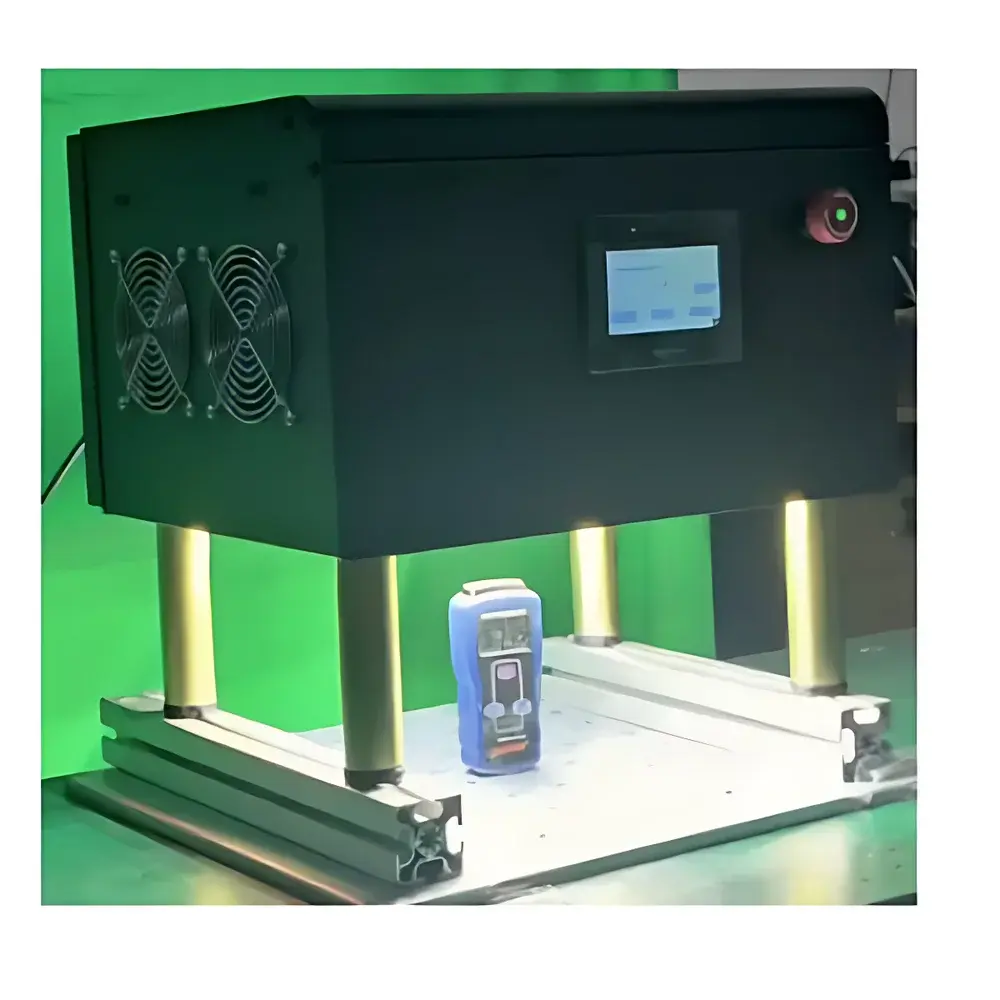
CEL-LED100-3A LED Solar Simulator
| Brand | CEL (China Education Goldsource) |
|---|---|
| Origin | Beijing, China |
| Manufacturer Type | Direct Manufacturer |
| Light Source Type | High-Power Multispectral LED Array |
| Illumination Mode | External Irradiation |
| Effective Irradiation Area | 100×100 mm to 1000×1000 mm (configurable) |
| Spectral Range | 300–1200 nm (standard), up to 1700 nm (optional) |
| Spectral Match | Class A+ (IEC 60904-9:2020, ASTM E927-10, JIS C8912/C8933) |
| Spectral Uniformity | ≤ ±2% (Class A) |
| Temporal Instability | ≤1% (Class A+) |
| Spectral Coverage (SPC) | 100% |
| Spectral Deviation (SPD) | <15% (300–1200 nm) |
| Adjustable Irradiance | 100–1500 W/m² |
| Independent Spectral Band Control | 300–400 nm, 400–750 nm, 750–1200 nm |
| Operating Modes | Continuous or Programmable Pulse (0.1–100 s) |
| Lifetime | ≥10,000 h with <2% output drift |
| Interface | RS485, External TTL Synchronization Port |
Overview
The CEL-LED100-3A LED Solar Simulator is an advanced, digitally controlled broadband light source engineered for high-fidelity solar spectral simulation in photovoltaic characterization, photocatalytic research, and accelerated environmental testing. Unlike conventional xenon- or halogen-based simulators, it employs a modular array of high-efficiency, spectrally tuned LEDs—each individually addressable via embedded microcontroller units—to synthesize a stable, programmable AM1.5G (or AM0) spectrum across 300–1200 nm (extendable to 1700 nm). Its core architecture implements a closed-loop optical feedback system integrated with real-time spectral monitoring algorithms, enabling dynamic compensation for thermal drift and aging effects. Designed to meet the stringent requirements of IEC 60904-9:2020, ASTM E927-10, and JIS C8912/C8933 Class A+ standards, the system delivers A+ spectral match (0.875–1.125), A-class spatial uniformity (≤±2%), and A+ temporal stability (≤1% over 1 hour), making it suitable for calibration-grade PV device testing, multi-junction cell evaluation, and ISO/IEC 17025-accredited laboratory workflows.
Key Features
- Cold-start operation: No warm-up time required; full spectral output achieved within milliseconds—ideal for pulsed IV measurements and rapid test sequencing.
- Three independently controllable spectral bands (UV: 300–400 nm, VIS: 400–750 nm, NIR: 750–1200 nm) enable precise spectral shaping, AM filter emulation, and degradation-study-specific irradiance profiles.
- Modular LED array design allows field-replaceable spectral modules without recalibration—maintaining pre-replacement uniformity and spectral fidelity post-service.
- Digital power regulation with RS485 interface supports integration into automated test benches and LIMS environments; TTL synchronization port enables precise triggering with source meters, lock-in amplifiers, or high-speed cameras.
- Energy-efficient operation: >3× higher wall-plug efficiency than xenon arc lamps; no ozone generation, mercury content, or high-voltage ignition risks—compliant with ISO 14001 lab safety protocols.
- Programmable pulse mode (0.1–100 s duration, arbitrary duty cycle) facilitates transient photoresponse analysis, carrier lifetime mapping, and stress-testing under non-steady-state illumination.
Sample Compatibility & Compliance
The CEL-LED100-3A accommodates planar samples up to 1000 mm × 1000 mm, supporting standard silicon, perovskite, CIGS, GaAs, and organic photovoltaic devices, as well as photocatalytic reactors, climate chamber panels, and automotive interior material exposure trays. All optical performance metrics—including spectral match, spatial uniformity, and temporal stability—are validated per IEC 60904-9:2020 Annex D procedures using NIST-traceable spectroradiometers and calibrated reference cells. The system conforms to GLP-aligned documentation practices, with built-in audit trails for irradiance settings, operational hours, and spectral calibration logs—fully compatible with FDA 21 CFR Part 11-compliant data management systems when paired with validated third-party software.
Software & Data Management
The included CEL-SIMControl software provides a deterministic, scriptable GUI for spectral configuration, irradiance ramping, pulse sequencing, and real-time spectral monitoring. It supports export of irradiance time-series data in CSV and HDF5 formats, with metadata tags compliant with FAIR (Findable, Accessible, Interoperable, Reusable) principles. Remote control via TCP/IP or RS485 enables integration with Python-based automation frameworks (e.g., PyVISA, LabVIEW drivers available upon request). Firmware updates preserve backward compatibility and include cryptographic signature verification to ensure integrity during GxP-regulated deployments.
Applications
- Primary and secondary calibration of reference solar cells and pyranometers in metrology labs.
- Quantum efficiency (QE) and external quantum efficiency (EQE) mapping of multi-junction photovoltaics.
- Accelerated aging studies of encapsulants and anti-reflective coatings under controlled UV-VIS-NIR stress profiles.
- Photocatalytic hydrogen evolution and CO₂ reduction kinetics under spectrally resolved illumination.
- Automotive interior material fade testing per ISO 4892-2 and SAE J2527 protocols.
- Validation of satellite solar array performance under AM0 conditions in thermal vacuum chambers.
FAQ
Does the CEL-LED100-3A require periodic recalibration?
No—its factory-calibrated spectral response and closed-loop intensity stabilization eliminate routine recalibration. Annual verification using a NIST-traceable spectroradiometer is recommended for ISO/IEC 17025 compliance.
Can the system simulate AM0 spectra for space PV testing?
Yes—the spectral engine supports user-defined AM0 templates with adjustable extraterrestrial irradiance levels (up to 1367 W/m²) and optional 1200–1700 nm extension modules.
Is the LED array compatible with Class A+ certification for PV module testing?
Yes—certification reports per IEC 60904-9:2020 are provided with each unit, including full spectral match, uniformity, and stability validation data.
What is the expected maintenance interval for LED modules?
Modules are rated for ≥10,000 hours at nominal output; replacement is only required upon measured output decay exceeding 2%—typically beyond 5 years of continuous operation.
Does the system support synchronized measurement with source-measure units (SMUs)?
Yes—TTL sync output and input ports enable hardware-level triggering with Keysight B2900 series, Keithley 2450/2460, and similar instruments for sub-millisecond timing alignment.




