
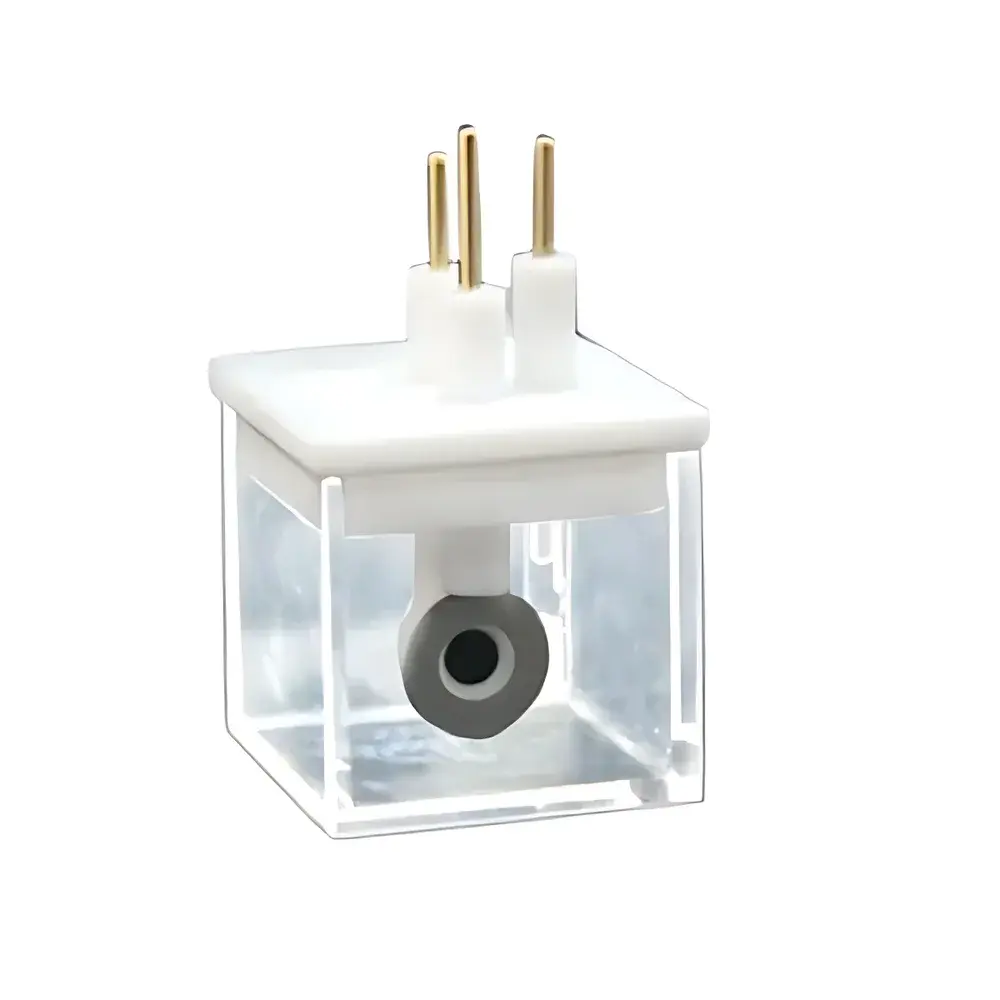
Zhongjiaojinyuan PECK125 Quartz Square Photoelectrochemical Cell
| Brand | Zhongjiaojinyuan |
|---|---|
| Origin | Beijing, China |
| Manufacturer Type | Direct Manufacturer |
| Product Origin | Domestic (China) |
| Model | PECK125 |
| Price | Upon Request |
| Dimensions (L×W×H) | 50 mm × 50 mm × 50 mm |
| Volume | 125 mL |
| Body Material | Fused Quartz |
| Optical Access | Four-side transparent |
| Cap Material | PTFE |
| Standard Electrode Set | Pt wire counter electrode, Ag/AgCl reference electrode, Pt electrode clamp (for working electrode mounting) |
Overview
The Zhongjiaojinyuan PECK125 Quartz Square Photoelectrochemical Cell is an optically optimized, laboratory-grade electrochemical reactor engineered for quantitative photoelectrochemical (PEC) characterization under controlled illumination conditions. Designed around the Couette–Taylor flow principle for uniform mass transport and calibrated optical path geometry, the cell operates on standard three-electrode potentiostatic configurations and supports incident photon-to-current efficiency (IPCE), photocurrent transient, Mott–Schottky, and electrochemical impedance spectroscopy (EIS) measurements. Its fused quartz construction ensures high UV–vis transmission (≥90% from 190 nm to 2,500 nm), enabling compatibility with broadband solar simulators, monochromated light sources, and laser-based excitation systems. The cubic geometry provides symmetrical optical access across all four vertical faces—critical for orthogonal illumination alignment, in situ spectroelectrochemical coupling (e.g., with UV-Vis or Raman spectrometers), and minimizing beam distortion at oblique angles.
Key Features
- Fused quartz body fabricated via high-purity melting process, delivering exceptional thermal stability (up to 800 °C short-term), chemical inertness against strong acids/bases, and minimal autofluorescence background.
- Square cross-section (50 mm × 50 mm × 50 mm) with precisely dimensioned 125 mL internal volume—optimized for consistent diffusion layer thickness and reproducible hydrodynamic boundary conditions during chronoamperometry or linear sweep voltammetry.
- Four-side optical windows with parallelism tolerance < 1 arcmin—enabling dual-beam referencing, collimated illumination from multiple axes, and integration with optical choppers or polarization optics.
- Chemically resistant PTFE cap with integrated O-ring sealing (FKM optional) and standardized 10-32 threaded ports for electrode feedthroughs, gas purging lines, and temperature probe insertion.
- Modular electrode interface: Pt wire counter electrode (0.5 mm diameter, 30 mm active length), Ag/AgCl (3 M KCl) reference electrode with double-junction option, and a precision-machined Pt electrode clamp accommodating rods up to 6 mm diameter and planar substrates with edge-contact configuration.
Sample Compatibility & Compliance
The PECK125 cell accommodates a broad range of working electrode formats—including FTO/ITO/glassy carbon substrates, nanostructured metal oxides (e.g., TiO₂, BiVO₄, Fe₂O₃), perovskite thin films, and molecular catalyst-coated electrodes—without requiring custom machining. Its design conforms to ASTM E2877-22 guidelines for photoelectrochemical test cells and supports GLP-compliant experimental documentation when paired with timestamped potentiostat data logging. All wetted materials meet USP Class VI biocompatibility requirements, and the quartz body complies with ISO 17025 traceable calibration protocols for optical pathlength verification. Optional accessories include gas-tight inlet/outlet valves (Swagelok SS-4-SS), magnetic stirrer-compatible base plates, and thermostatic jacket adapters for temperature-controlled studies (±0.1 °C stability).
Software & Data Management
While the PECK125 is a passive cell, it is fully interoperable with industry-standard electrochemical workstations (e.g., BioLogic SP-300, Metrohm Autolab PGSTAT302N, CH Instruments 760E) and spectral acquisition platforms (Ocean Insight, Avantes). When used with compliant potentiostats, measurement sequences adhere to FDA 21 CFR Part 11 requirements through electronic audit trails, user-access controls, and encrypted raw data export (.mpt, .txt, .csv). Software-defined illumination synchronization (TTL triggering) enables precise time-resolved photocurrent capture with sub-millisecond resolution, supporting transient analysis in accordance with IUPAC recommendations for photoelectrode kinetics reporting.
Applications
- Quantitative evaluation of semiconductor photoanode/cathode performance under AM 1.5G illumination.
- In situ monitoring of interfacial charge transfer kinetics during water splitting or CO₂ reduction reactions.
- Correlation of band-edge positions (via Mott–Schottky analysis) with optical absorption onset (Tauc plot).
- Stability assessment of photoelectrodes under prolonged bias and illumination (e.g., 100-h chronoamperometry at constant potential).
- Coupling with operando UV-Vis absorption or surface-enhanced Raman spectroscopy (SERS) for mechanistic insight into reaction intermediates.
FAQ
Can the PECK125 be used under anaerobic conditions?
Yes—the PTFE cap supports vacuum evacuation and inert gas purging via dual Swagelok ports; optional glovebox-compatible feedthroughs are available.
Is the quartz body compatible with hydrofluoric acid (HF) solutions?
No—fused quartz is etched by HF; alternative PFA-lined cells are recommended for fluoride-containing electrolytes.
What is the maximum recommended operating temperature?
The standard configuration is rated for continuous use up to 120 °C; short-term exposure to 200 °C is permissible with annealed quartz and high-temp O-rings.
Can custom electrode geometries be integrated?
Yes—the open-top design and modular clamp system support user-supplied electrodes, including mesh, rotating disk, or microfabricated arrays—contact engineering support for mechanical interface specifications.
Does Zhongjiaojinyuan provide calibration certificates for optical pathlength?
Yes—NIST-traceable interferometric pathlength verification (±0.02 mm uncertainty) is available upon request with each unit shipment.



