CEL-Jiaoguang CEL-RCCN / CEL-RCCO Single-Crystalline and Polycrystalline Silicon Reference Solar Cells
| Brand | CEL-Jiaoguang |
|---|---|
| Origin | Beijing, China |
| Manufacturer Type | Direct Manufacturer |
| Model | CEL-RCCN (monocrystalline) / CEL-RCCO (polycrystalline) |
| Calibration Traceability | NIM-traceable (National Institute of Metrology, China) |
| Certified Spectral Response Range | 400–1100 nm |
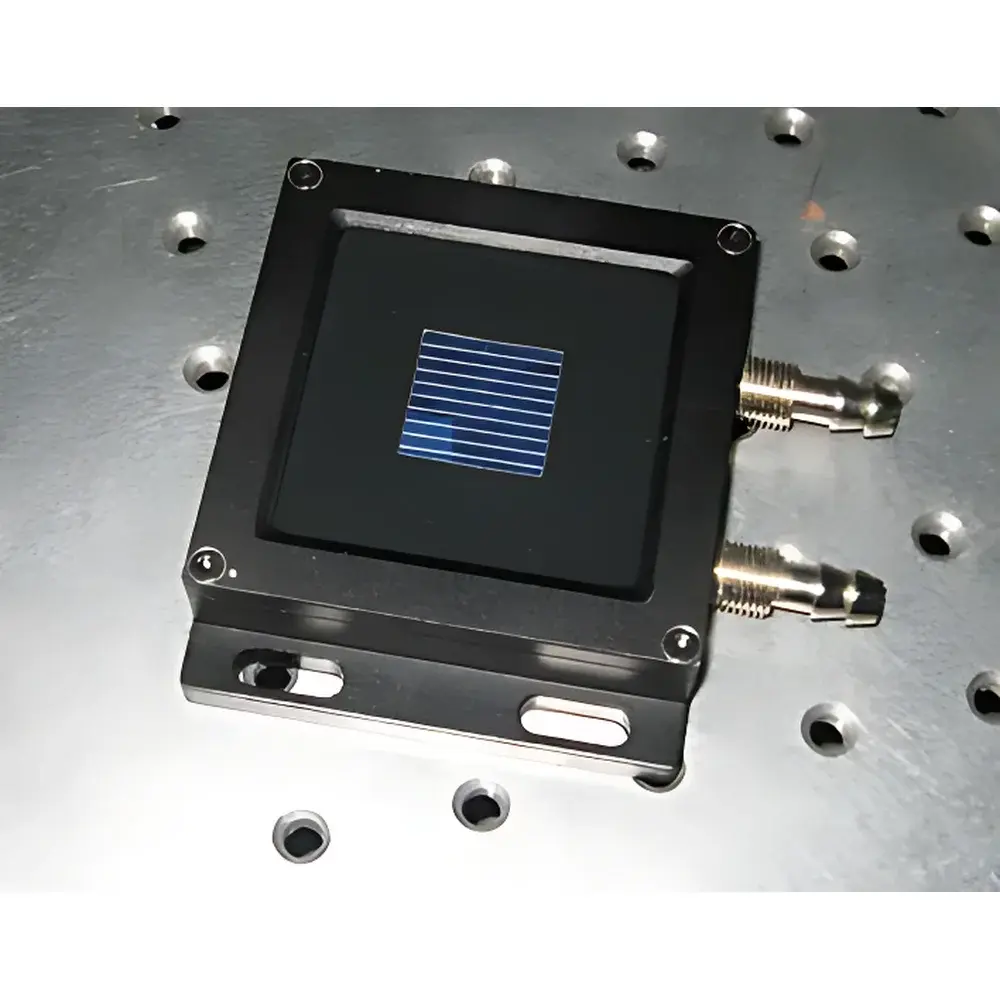
| Active Area | 20 mm × 20 mm |
| Mounting Base | Anodized Aluminum (70 mm × 70 mm × 20 mm) |
| Cover Window | Space-grade radiation-hardened glass with refractive-index-matched optical adhesive |
| Temperature Sensor | Calibrated Pt100 RTD (4-wire Kelvin connection) |
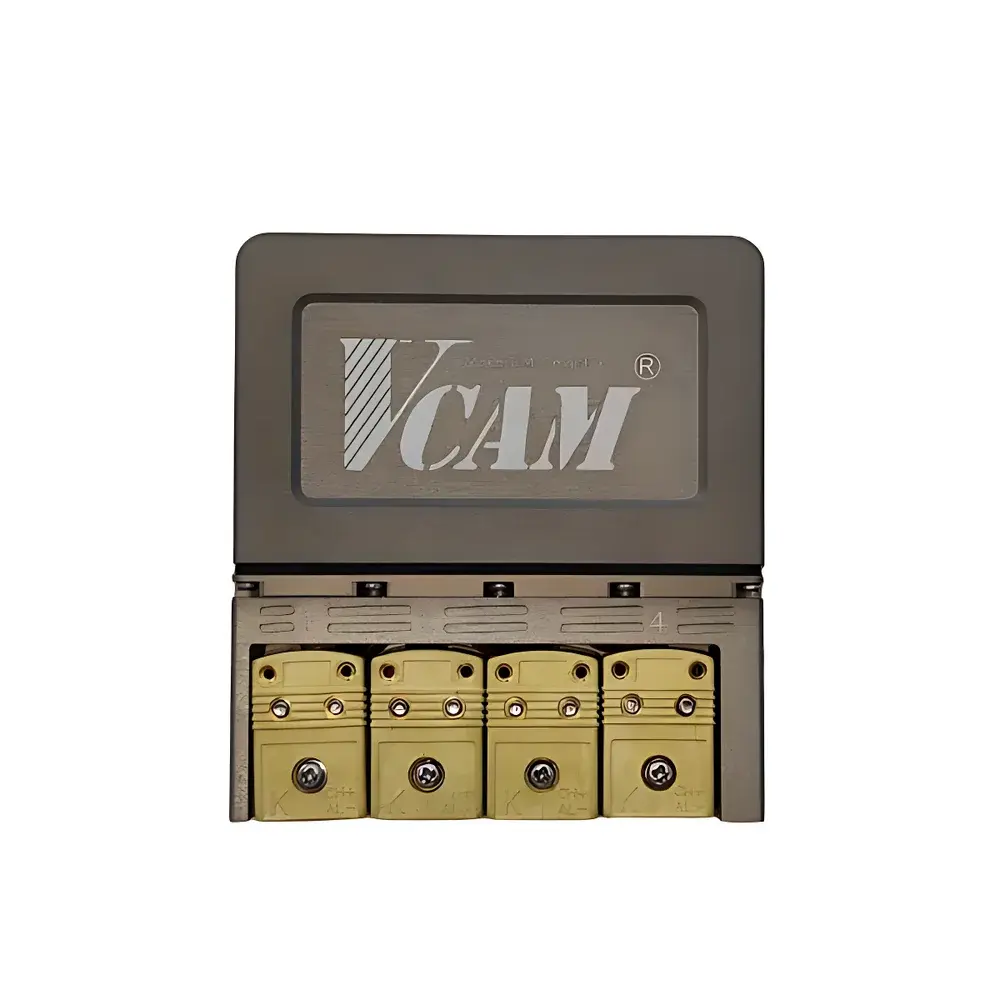
| Electrical Interface | Dual LEMO connectors (Isc/Voc + temperature) |
| STC Conditions | 1000 W/m², AM1.5G spectrum, 25 °C cell temperature |
| CV Value Uncertainty | ≤ ±0.5 % (k=2) |
| Short-Circuit Current Stability | ≤ ±0.5 % over 1,000 h under continuous illumination |
| Operating Temperature Range | 10–40 °C |
| Max Continuous Current | 200 mA |
| Efficiency (STC) | >16 % |
| Fill Factor (FF) | >0.70 |
| Isc Temp Coefficient α | typical −0.05 to −0.08 mA/°C |
| Voc Temp Coefficient β | typical −1.8 to −2.2 mV/°C |
Overview
The CEL-Jiaoguang CEL-RCCN and CEL-RCCO Reference Solar Cells are primary irradiance transfer standards engineered for high-accuracy photometric and radiometric calibration of solar simulators, xenon arc lamps, and other broadband light sources used in PV device testing laboratories. These devices operate on the fundamental principle of photovoltaic current generation under controlled spectral irradiance: when illuminated under Standard Test Conditions (STC — 1000 W/m², AM1.5G spectrum, 25 °C cell temperature), the short-circuit current (Isc) output is linearly proportional to incident irradiance. The calibration factor — defined as the current responsivity CV = Isc / E (in A/(W·m⁻²)) — serves as a traceable bridge between electrical measurement and radiant flux quantification. Each unit is fabricated from space-qualified monocrystalline (CEL-RCCN) or multicrystalline (CEL-RCCO) silicon wafers, subjected to accelerated aging and rigorous stability screening prior to hermetic encapsulation. The active area (20 mm × 20 mm) is centered on a thermally stable anodized aluminum base, enabling precise thermal management during operation.
Key Features
- Primary reference-grade calibration with NIM-traceable uncertainty ≤ ±0.5 % (k = 2), compliant with IEC 60904-2 and ISO 9060:2018 Class A spectral classification criteria
- Integrated, pre-calibrated Pt100 resistance temperature detector (RTD) with 4-wire Kelvin connection for real-time cell temperature monitoring at the junction plane
- Radiation-hardened anti-reflective cover glass bonded with index-matched optical adhesive (n ≈ 1.52), minimizing interfacial reflection losses across 400–1100 nm
- Dual LEMO connector interface: one pair for photogenerated current/voltage (Isc/Voc), second pair for Pt100 signal — eliminating lead resistance errors
- Hermetically sealed aluminum housing (70 mm × 70 mm × 20 mm) with thermal mass optimized for steady-state measurement conditions
- Stability validation per IEC 60904-4: verified ΔIsc ≤ ±0.5 % after 1,000 h of continuous 1-sun illumination at 25 °C
Sample Compatibility & Compliance
These reference cells are compatible with all standard solar simulator classes (Class AAA, AA, A per IEC 60904-9) and broadband arc-based sources emitting within the 400–1100 nm range. Their spectral response aligns closely with crystalline silicon PV devices, making them suitable for calibrating test benches used in R&D, QC, and certification labs. Compliance includes full adherence to IEC 60904-2 (requirements for reference cells), IEC 60904-4 (procedures for calibration), and ISO/IEC 17025:2017 for measurement uncertainty reporting. Each unit ships with a certificate of calibration documenting CV value, spectral responsivity curve, temperature coefficients (α and β), expanded uncertainty budget, and traceability chain to the National Institute of Metrology (NIM), China — satisfying GLP audit requirements and supporting ISO 17025 accreditation documentation.
Software & Data Management
While the CEL-RCCN/RCCO cells operate as passive analog standards, they integrate seamlessly into automated test systems via standard LEMO interfaces. When paired with programmable source meters (e.g., Keysight B2900 series) and temperature-controlled stages, data acquisition can be synchronized using IEEE-488 (GPIB) or USB-TMC protocols. Calibration reports include machine-readable CSV files containing full spectral responsivity datasets (3 nm resolution), temperature coefficient matrices, and uncertainty propagation models. All certificates conform to ISO/IEC 17025 Annex A.3 requirements for statement of conformity and are digitally signed to support FDA 21 CFR Part 11-compliant electronic record retention where required.
Applications
- Primary irradiance calibration of Class AAA solar simulators in PV module and cell characterization labs
- Real-time monitoring of temporal drift in xenon-arc and LED-based light sources during accelerated aging tests
- Validation of spectroradiometer system-level accuracy against a known spatially uniform reference
- Inter-laboratory comparison studies under IEA-PVPS Task 12 and EMRP SolarCal frameworks
- Traceable power density verification for perovskite, tandem, and organic PV device testing setups
- Temperature-compensated irradiance correction in outdoor performance ratio (PR) monitoring systems
FAQ
What is the difference between CEL-RCCN and CEL-RCCO?
CEL-RCCN uses single-crystalline silicon with higher spectral uniformity and lower temperature coefficients; CEL-RCCO employs multicrystalline silicon offering cost-effective traceability for applications where absolute spectral match to mono-Si devices is not critical.
Is the CV value temperature-compensated in real time?
Yes — the integrated Pt100 enables automatic Isc correction using published α coefficients (provided in the calibration certificate), ensuring irradiance accuracy across 10–40 °C operating range.
Can these cells be used outdoors?
No — they are designed for controlled indoor use only. The housing lacks weatherproofing and UV-stabilized gasketing required for field deployment.
How often should recalibration be performed?
Annual recalibration is recommended per IEC 60904-4; however, stability data supports extended intervals up to 24 months for lab environments with stable thermal and irradiance conditions.
Do you provide NIST-traceable calibration?
Calibration is traceable to NIM (China); NIST-traceable equivalents are available through authorized third-party labs upon request, with documented metrological equivalence assessment.