
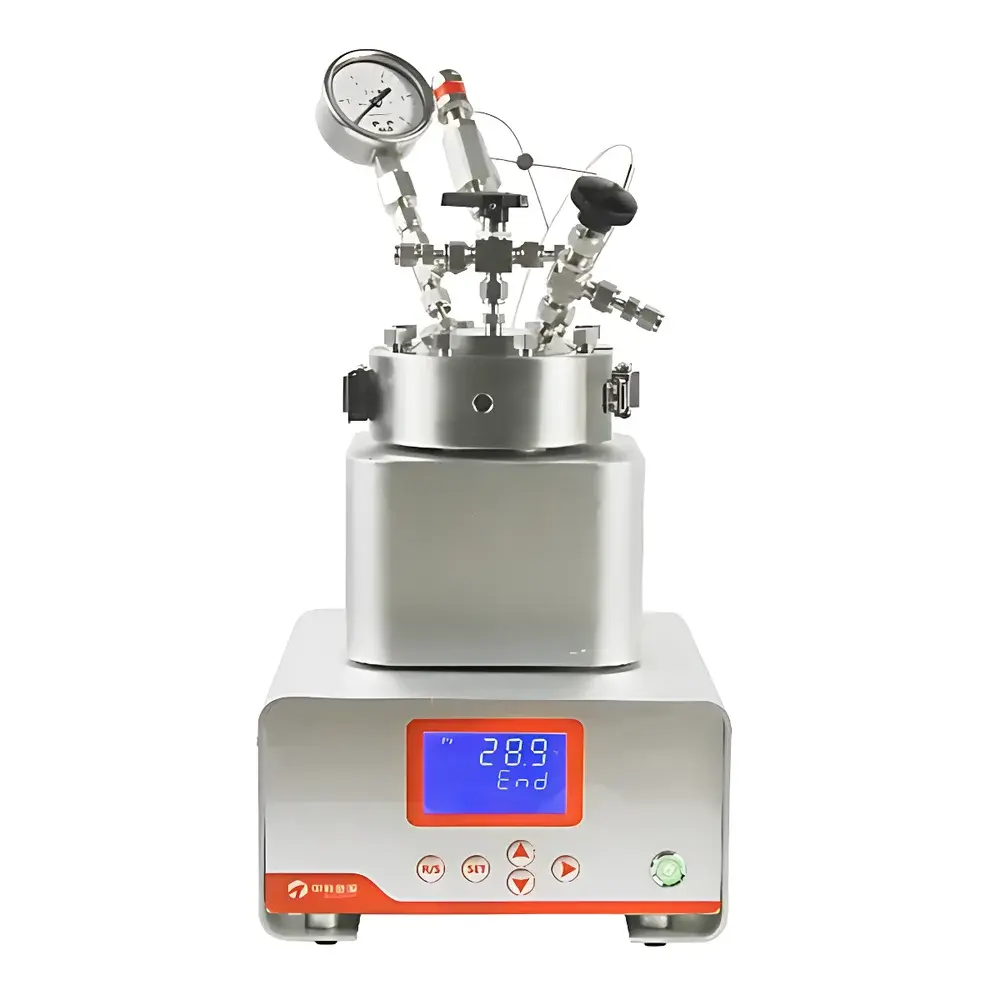
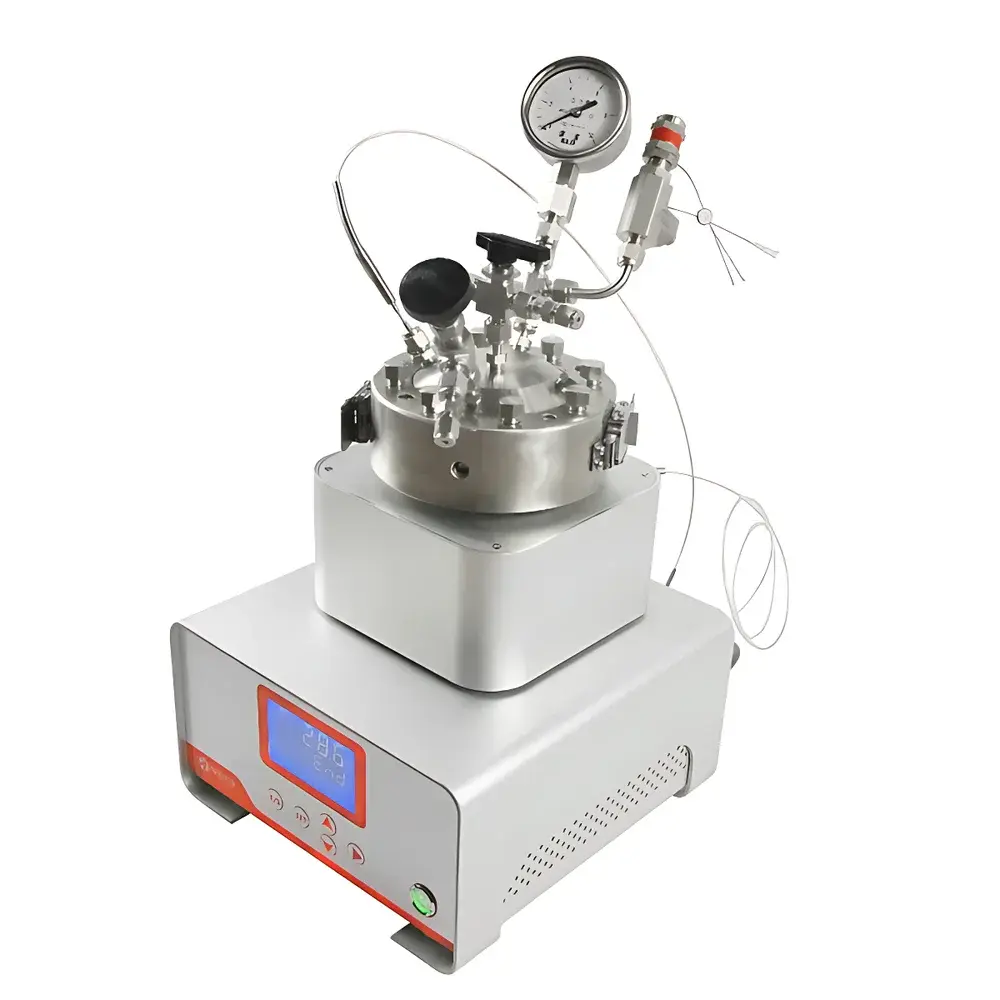
CEL-MPR Micro High-Pressure Reaction Vessel by CEAULIGHT
| Brand | CEAULIGHT |
|---|---|
| Model | CEL-MPR |
| Type | Benchtop Micro Autoclave Reactor |
| Construction | 316 Stainless Steel Body with Optional PTFE/Quartz Liner |
| Max Operating Pressure | 10 MPa (Customizable to 20–30 MPa) |
| Max Operating Temperature | 250 °C |
| Volumes Available | 25 mL, 50 mL, 100 mL, 250 mL, 500 mL |
| Sealing | Dual-Line Graphite Composite Gasket with Flanged半月牙 (Crescent-Type) Clamp Closure |
| Heating Method | External Heated Jacket + Internal Dual-Point Temperature Control (Vessel Wall & Medium) |
| Stirring | Internal Magnetic Coupling Stirrer |
| Vacuum Level | ≤10⁻¹ Pa |
| Pressure Monitoring | Standard Brady Pressure Gauge (Optional Alternate Brands) |
| Safety | Integrated Pressure Relief Valve (Anlok) |
| Gas/Liquid Feed Options | Compatible with GPPCN/GPPCL Mass Flow Controllers and PPS Series Precision Liquid Dispensing Pumps |
| Data Interface | LCD Controller with Real-Time Display of Temperature (±0.1 °C resolution), Stirring Speed, and Dual Thermal Sensors |
Overview
The CEL-MPR Micro High-Pressure Reaction Vessel is an engineered benchtop autoclave system designed for controlled catalytic, synthetic, and materials science investigations under rigorously defined thermal and pressure conditions. Built upon Couette-flow-compatible magnetic stirring architecture and dual-point temperature regulation—monitoring both vessel wall and internal reaction medium—the CEL-MPR enables reproducible kinetic studies in gas–solid, gas–liquid, liquid–solid, and triphasic (gas–liquid–solid) environments. Its operational envelope spans up to 250 °C and 10 MPa, with optional configurations supporting 20 MPa or 30 MPa ratings for advanced hydrothermal, supercritical, or hydrogenation applications. The reactor’s compact volume range (25–500 mL) makes it especially suited for precious catalyst screening, isotopic tracer experiments, limited-availability feedstock evaluation, and high-throughput parameter optimization where material conservation and experimental fidelity are critical.
Key Features
- Double-point temperature control system: Independent sensing and regulation of both external heating jacket and internal reaction zone, minimizing thermal overshoot and ensuring ±1 °C stability (in aqueous media) with 0.1 °C display resolution.
- Dual-line graphite composite sealing assembly integrated into a flanged crescent-clamp closure mechanism—eliminates conventional O-ring failure modes and enables repeatable, leak-tight operation at full rated pressure without torque recalibration.
- Internally mounted magnetic drive stirrer with adjustable speed control, delivering uniform mixing across all phase configurations without compromising pressure integrity or introducing mechanical feedthroughs.
- Modular interface design: Standardized NPT and Swagelok-compatible ports accommodate Anlok-sourced needle valves, three-way ball valves, pressure relief devices, dual Pt100 RTD sensors, and auxiliary gas/liquid injection lines.
- Chemically inert internal surface options: Electropolished 316 stainless steel base, optional factory-applied PTFE coating, or removable quartz or PTFE liners for acid-resistant or ultra-low-contamination workflows.
- Integrated safety architecture: Factory-calibrated pressure relief valve, redundant overpressure monitoring, and fail-safe thermal cutoff prevent uncontrolled exothermic escalation during long-duration runs.
Sample Compatibility & Compliance
The CEL-MPR supports heterogeneous catalysis (e.g., Fischer–Tropsch, ammonia synthesis precursors), polymerization initiation under inert or reducing atmospheres, hydrothermal nanomaterial crystallization (e.g., MOFs, perovskites), oxidative degradation kinetics, and electrocatalyst precursor decomposition—all within GLP-aligned experimental frameworks. Its construction complies with ASME BPVC Section VIII Division 1 design principles for pressure containment. All wetted components meet ASTM A240 and ASTM B637 specifications for corrosion resistance. When equipped with validated firmware and audit-trail-enabled controllers (optional upgrade), the system supports 21 CFR Part 11–compliant data recording for regulated pharmaceutical or contract research applications.
Software & Data Management
The standard LCD controller provides real-time visualization of temperature setpoint, actual vessel and jacket temperatures, magnetic stirrer RPM, and system pressure. Optional USB/RS485 connectivity enables integration with LabVIEW, MATLAB, or custom SCADA platforms for automated ramp-hold sequences, multi-step pressure modulation, and synchronized GC/FID or online FTIR sampling triggers. Data logging intervals are configurable from 0.1 s to 60 min; exported CSV files include timestamps, sensor IDs, and unit-annotated values for traceable post-processing. Firmware updates maintain backward compatibility and support ISO/IEC 17025 calibration certificate mapping for metrological traceability.
Applications
- Catalyst performance benchmarking under industrially relevant P/T conditions (e.g., CO₂ hydrogenation, selective hydrogenolysis)
- High-pressure solvothermal synthesis of battery electrode materials (Li-rich layered oxides, solid-state electrolytes)
- Thermal stability assessment of energetic compounds or pharmaceutical intermediates
- Kinetic modeling of enzyme-catalyzed reactions in compressed CO₂ or subcritical water
- In situ Raman or XRD-compatible reaction cells (with quartz liner and optical access ports—custom order)
- Accelerated aging studies of polymer composites under hydrolytic or oxidative stress
FAQ
What pressure ratings are certified for standard CEL-MPR units?
Standard units are ASME-stamped for 10 MPa maximum allowable working pressure (MAWP) at 250 °C. Custom variants with enhanced bolting, thicker walls, and alternate alloys (e.g., Hastelloy C-276) are available for 20 MPa and 30 MPa service.
Can the CEL-MPR be used for corrosive reagents such as HF or fuming nitric acid?
With quartz or PTFE liners installed and appropriate valve seals (e.g., Kalrez®), the system handles moderately aggressive chemistries. For HF or hot aqua regia, Hastelloy construction with fluoropolymer-sealed fittings is mandatory and requires prior engineering review.
Is remote monitoring and control supported out of the box?
Basic local control is provided via the front-panel LCD. Ethernet- or Wi-Fi–enabled controllers with web-based HMI and REST API endpoints are available as configurable options for centralized lab management systems.
How is temperature uniformity verified across the reaction volume?
Uniformity is characterized per ASTM E220 using calibrated thermocouples at radial and axial positions. Typical deviation is ≤±1.5 °C across the central 70% of the liquid volume at steady state.
Does the system comply with explosion-proof requirements for Class I, Division 1 environments?
The base unit is not intrinsically safe. Explosion-proof enclosures (NEC Class I Div 1, ATEX Zone 1) can be supplied as add-on modules—contact technical sales for hazardous area certification packages.



