
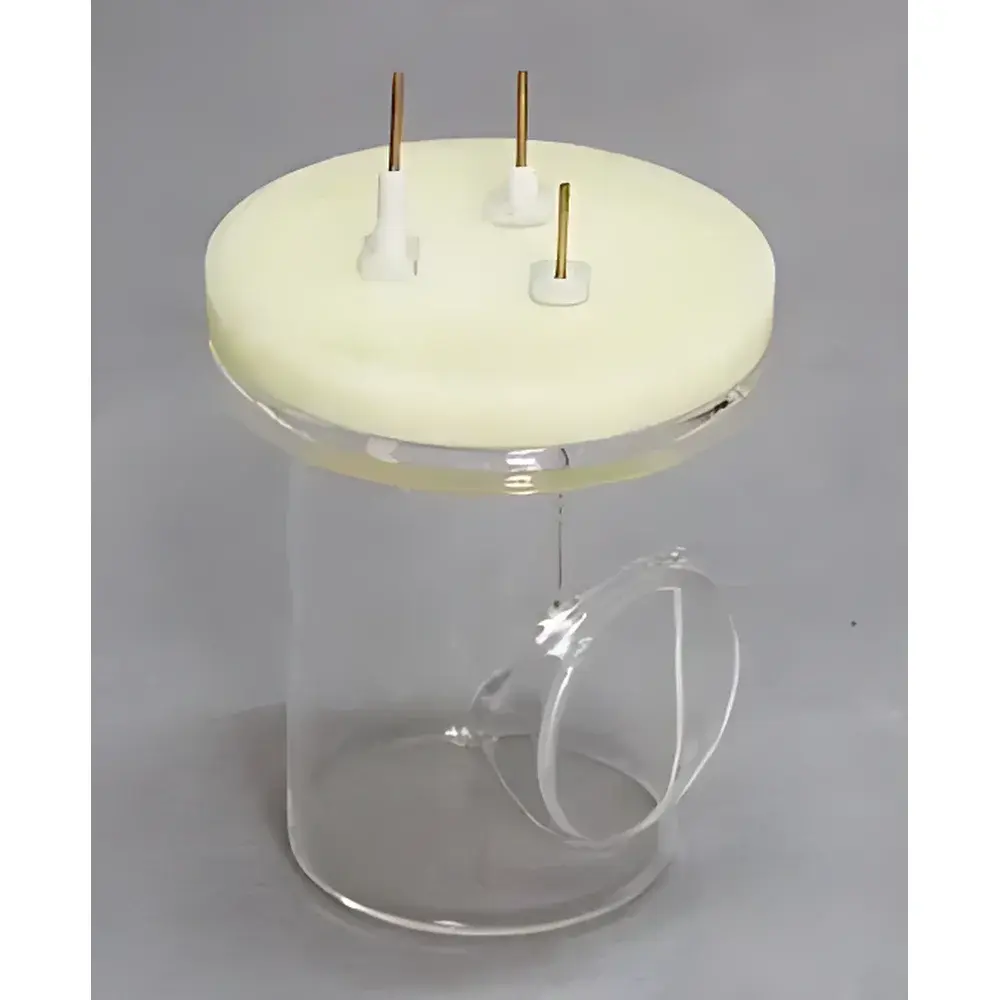
CEL-QPE Quartz Photoelectrochemical Reaction Cell
| Brand | CEAULIGHT (Zhongjiao Jinyuan) |
|---|---|
| Model | CEL-QPE40/60 |
| Construction | Fully sealed flanged quartz cell |
| Sealing Material | PTFE / Nylon / PEEK flange gasket |
| Optical Window | UV-grade fused silica |
| Window Diameter | 40 mm or 60 mm (model-dependent) |
| Cell Volume | 50–500 mL (configurable) |
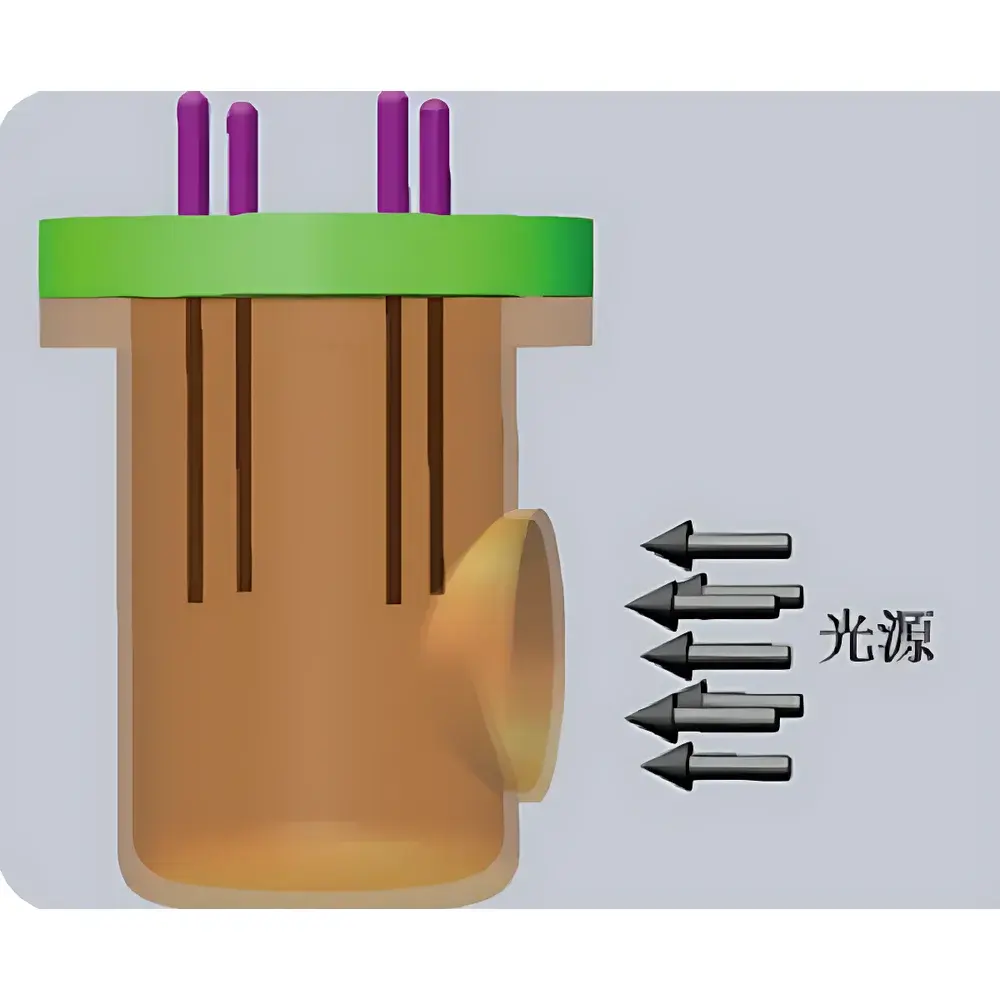
| Optical Path | Side-mounted vertical quartz window |
| Electrode Configuration | Three-electrode compatible (WE/CE/RE) |
| Gas Handling | Optional inlet/outlet ports with vacuum & inert gas purging capability |
| Compliance | Designed for ASTM E2537-21 (IPCE measurement), ISO 12219-2 (photoactive material testing), and GLP-aligned photoelectrochemical research workflows |
| Unit Price | USD 1,680 (FOB Beijing) |
Overview
The CEL-QPE Quartz Photoelectrochemical Reaction Cell is a precision-engineered, fully sealed flanged reactor designed for quantitative photoelectrochemical (PEC) characterization under controlled illumination and electrochemical bias. It operates on the principle of incident photon-to-current efficiency (IPCE) measurement—where monochromatic light is directed through a calibrated quartz optical window onto a working electrode immersed in electrolyte, while simultaneous current–voltage response is recorded via a potentiostat. The cell’s side-illuminated architecture eliminates interference from top-mounted optical components and ensures uniform irradiance distribution across planar photoanodes or photocathodes. Constructed entirely from high-purity UV-transmitting fused silica (≥99.995% SiO₂), the cell maintains spectral transmission >85% from 190 nm to 2.5 µm—enabling reliable operation across deep-UV, visible, and near-IR spectral ranges. Its flanged sealing system—using chemically inert PTFE, hydrolysis-resistant polyamide (Nylon 6/6), or high-temperature, radiation-stable PEEK—eliminates both metallic corrosion (common in stainless-steel alternatives) and brittle fracture risks associated with glass-to-glass compression seals.
Key Features
- Fully sealed, pressure-tight flanged design compliant with ISO 15848-1 for low-leakage gas containment
- Side-mounted UV-grade quartz optical window (diameter: 40 mm or 60 mm) with ≤0.1 nm surface roughness and λ/10 wavefront distortion
- Modular three-electrode compatibility: standardized 6 mm OD × 100 mm L electrode ports with Viton O-ring sealing and ceramic insulator sleeves
- Dual gas management: optional 1/8″ Swagelok®-compatible inlet/outlet ports supporting vacuum evacuation (<10⁻² mbar), N₂/Ar purging, and controlled gas-phase reactant introduction
- Chemically resistant body and lid: all-wetted surfaces constructed from Class A fused silica; non-wetted flange components available in PTFE, black nylon, or medical-grade PEEK per application pH and temperature requirements
- Thermal stability: operational range from −20 °C to +120 °C with minimal thermal expansion mismatch (Δα < 0.5 × 10⁻⁶/K between quartz and PEEK)
Sample Compatibility & Compliance
The CEL-QPE accommodates standard flat-plate photoelectrodes (e.g., FTO/TiO₂, ITO/BiVO₄, NiOₓ/Si), thin-film heterojunctions, and powder-coated conductive substrates up to 25 mm × 25 mm active area. Its 50–500 mL volume variants support both small-volume kinetic studies (e.g., transient photocurrent decay) and bulk electrolyte stability tests (>24 h continuous operation). All configurations meet ASTM E2537-21 Annex A2 for IPCE calibration traceability and are routinely validated in laboratories accredited to ISO/IEC 17025:2017. When used with certified reference photodiodes and NIST-traceable spectroradiometers, the cell enables uncertainty budgets <±2.3% (k=2) for absolute quantum yield determination. It is also compatible with Good Laboratory Practice (GLP) documentation frameworks, supporting full audit trails when integrated with 21 CFR Part 11-compliant potentiostats and data acquisition systems.
Software & Data Management
While the CEL-QPE is a passive reactor (no embedded electronics), it is fully interoperable with industry-standard electrochemical workstations—including BioLogic SP-300, PalmSens EmStat GO, and Metrohm Autolab PGSTAT302N—via standardized BNC and banana-jack interfaces. Its mechanical design includes alignment fiducials for repeatable positioning under collimated beamlines (e.g., Newport Oriel MS260i monochromators) and integrates seamlessly with LabVIEW™- or Python-based automation scripts for wavelength-resolved IPCE mapping. Raw current–time and current–wavelength datasets export in .csv and .mpt formats, preserving metadata such as lamp intensity, filter bandpass, incident power (measured via calibrated Si/Ge photodiode), and temperature logging timestamps.
Applications
- Quantitative IPCE and ABPE (applied bias photon-to-current efficiency) mapping of metal oxide, chalcogenide, and perovskite photoelectrodes
- In situ spectroelectrochemical studies coupling with UV-Vis-NIR transmission/reflection cells
- Photoelectrocatalytic CO₂ reduction and water splitting mechanism validation under AM 1.5G or monochromatic illumination
- Stability assessment of protective overlayers (e.g., NiFeOₓ on Si, TiO₂ on Cu₂O) under prolonged anodic bias and UV exposure
- Development and screening of plasmon-enhanced photocatalysts requiring precise control of local field orientation relative to electrode surface normal
FAQ
Is the CEL-QPE cell compatible with acidic or alkaline electrolytes?
Yes—quartz body and PTFE/Nylon/PEEK sealing materials resist pH 0–14 at temperatures ≤80 °C. For long-term operation above pH 12, PEEK is recommended over standard nylon.
Can the optical window be replaced with custom coatings (e.g., anti-reflection or bandpass filters)?
Yes—the 60 mm diameter window accepts standard 1″ × 1/8″ optics mounts. Custom AR-coated or interference-filtered quartz windows can be supplied upon request with ≤±0.5 nm center wavelength tolerance.
What electrode geometries are supported?
Standard configuration supports disk electrodes (3–10 mm diameter), mesh counter electrodes, and reversible hydrogen or Ag/AgCl reference electrodes. Custom port adapters accommodate wire-grid, interdigitated, or microfabricated electrode arrays.
Does the cell include temperature control options?
No built-in heating/cooling—but external jacketed manifolds (e.g., Huber CC105) can be coupled via inlet/outlet ports. Quartz wall thickness (8 mm) ensures stable thermal conduction during external bath regulation.
How is optical alignment verified during setup?
Each cell includes engraved crosshair marks on the quartz window perimeter and laser-etched reference lines on the flange face—enabling sub-millimeter beam centering using HeNe alignment lasers and CCD-based beam profilers.



