
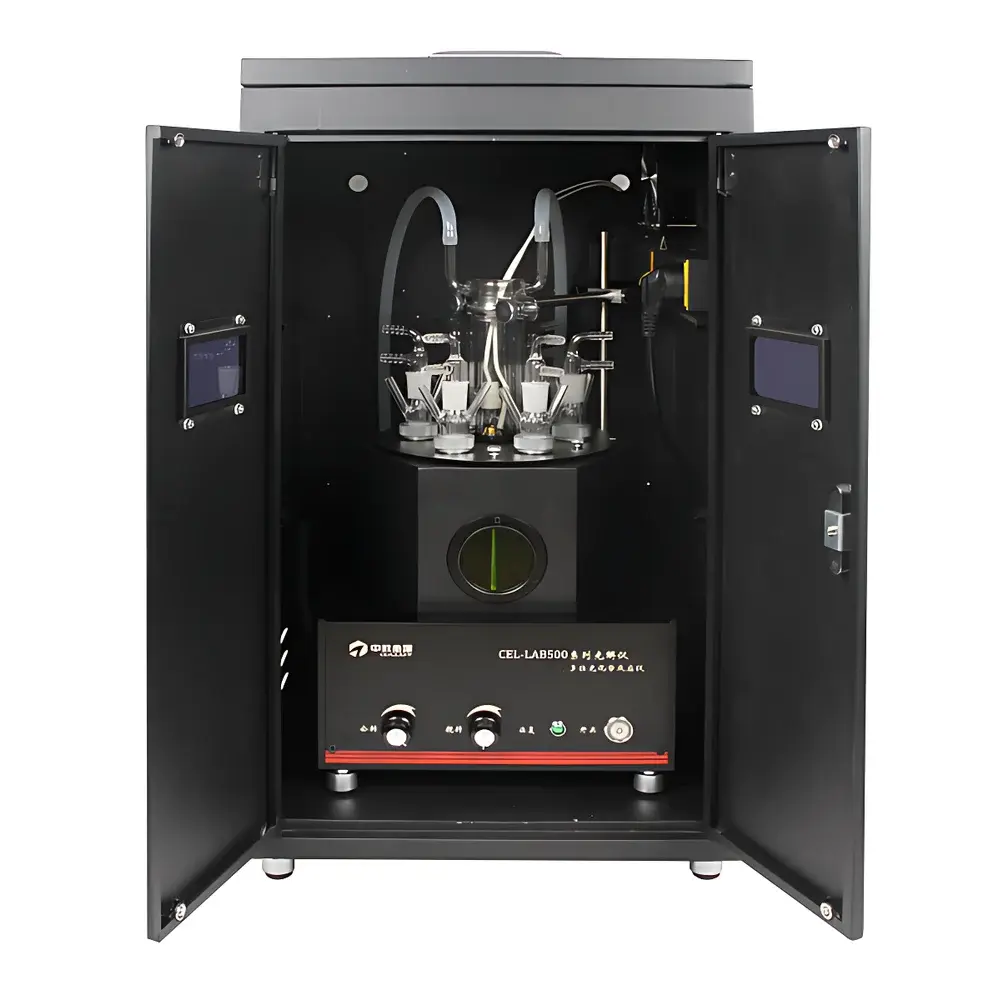
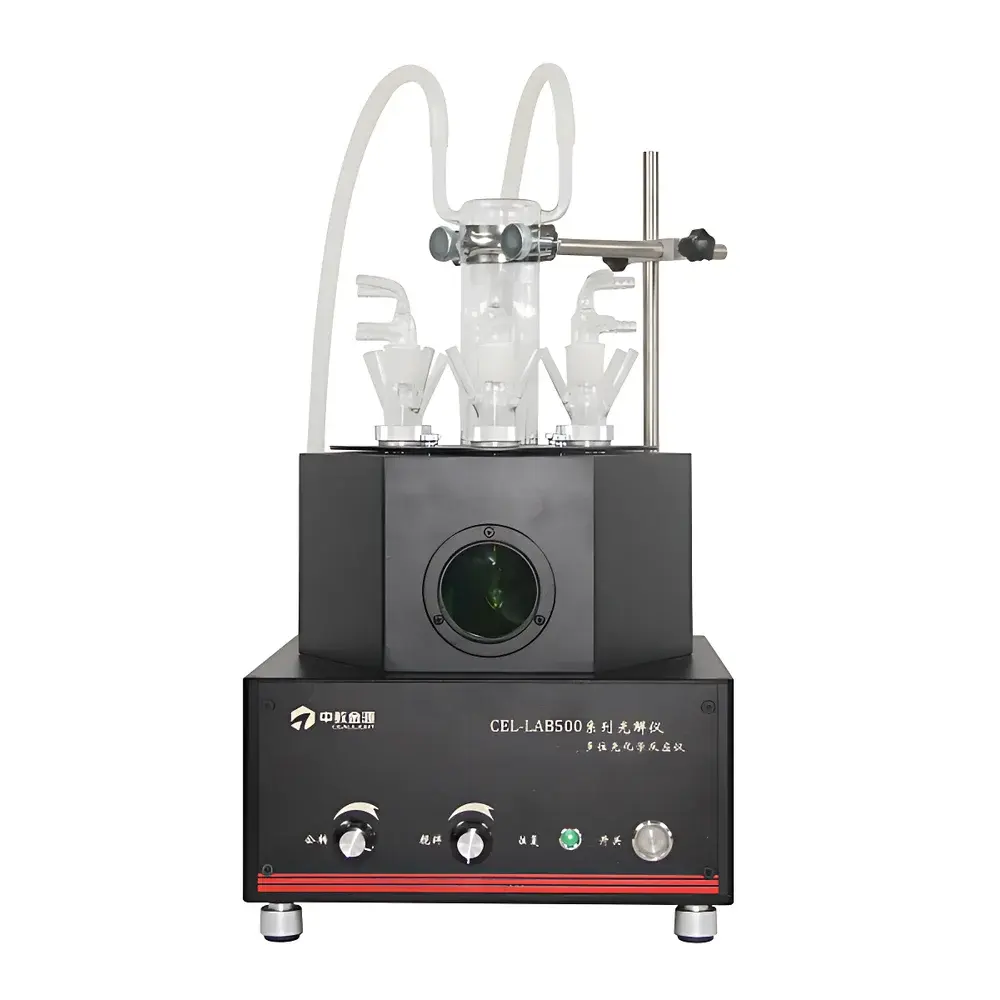
CEL-LAB500 Series Multi-Position Photochemical Reactor (Photolysis Reactor)
| Brand | CEA Lab |
|---|---|
| Origin | Beijing, China |
| Manufacturer Type | Direct Manufacturer |
| Origin Category | Domestic (China) |
| Model | CEL-LAB500, CEL-LAB500E4 |
| Light Source Type | Xenon Lamp |
| Irradiation Mode | Internal Illumination |
| Cooling Method | External Circulating Water Cooling (Recommended) |
| Reaction Positions | 6–12 |
| Stirring Speed | Up to 2500 rpm |
| Observation Window | Dual 50 × 50 mm UV/IR-Blocking Quartz Viewports |
| Chamber Dimensions | 400 × 400 × 700 mm |
| Max Power Consumption | 1000 W |
| Power Supply | AC 220 V |
| Optional Accessories | Temperature-Controlled Circulating Chiller (1000 W), Bandpass Quartz Coated Filters (UV/Vis), Low-Pressure Hg Lamps (10 W, 254 nm / 185 nm) |
Overview
The CEL-LAB500 Series Multi-Position Photochemical Reactor is an engineered platform for controlled, parallel photochemical experimentation under reproducible irradiation conditions. Designed around the principle of internal illumination—where light is delivered directly into the reaction vessel through a coaxial quartz cold trap—the system ensures high photon flux uniformity across multiple samples while minimizing thermal interference. The reactor operates on a dual-axis configuration: the light source remains stationary within a thermally managed chamber, while the sample carousel rotates (CEL-LAB500E4 variant) or maintains fixed positioning (CEL-LAB500 base model), enabling either dynamic exposure homogenization or static comparative analysis. This architecture supports standardized photoreactor operation per ISO 10677:2019 (photocatalytic activity assessment) and aligns with ASTM E2053 guidelines for UV-Vis irradiance calibration in laboratory-scale photochemistry.
Key Features
- Multi-position parallel processing: accommodates 6–12 reaction vessels (10–100 mL capacity) for high-throughput catalyst screening, kinetic comparison, or dose-response studies.
- Internal illumination geometry with double-layer fused quartz cold trap: separates UV/Vis photons from IR radiation, maintaining sample temperature stability during prolonged irradiation.
- Motorized rotation platform (CEL-LAB500E4): 12-position carousel rotates at adjustable speed to enhance radial irradiance uniformity; compatible with magnetic stirring integrated into each well (up to 2500 rpm).
- Dual UV/IR-blocking observation windows (50 × 50 mm): allow real-time visual monitoring without interrupting irradiation or compromising operator safety.
- Modular lamp compatibility: supports xenon (100–1000 W), mercury (100–1000 W), low-pressure Hg (10 W, 254 nm / 185 nm), and metal halide (250–400 W) sources—all with independent current-regulated power supplies for precise intensity control.
- Filter-ready optical interface: accepts interchangeable coated quartz bandpass filters (e.g., UVC 254 nm, UVB 302 nm, UVA 365 nm, visible 400–780 nm) to isolate spectral regions per experimental requirement.
- Robust enclosure with hydraulic-assisted access lid: simplifies routine maintenance, lamp replacement, and sample loading while ensuring mechanical stability and light-tight integrity.
Sample Compatibility & Compliance
The CEL-LAB500 series accommodates standard quartz and borosilicate glass reaction tubes, ensuring compatibility with acidic, basic, and organic media commonly used in photocatalytic water splitting, pollutant degradation (e.g., methylene blue, phenol), CO₂ reduction, and photoinduced C–C bond formation. All wetted components are chemically inert and autoclavable. The system meets CE marking requirements for electrical safety (EN 61000-6-3, EN 61000-6-4) and incorporates fail-safe interlocks for lamp cooling and chamber door closure. When operated with calibrated radiometers and traceable NIST-traceable filters, data generated supports GLP-compliant reporting for environmental testing labs adhering to EPA Method 402 or ISO 14952-2.
Software & Data Management
While the base system operates via analog current regulation and manual timer controls, optional digital integration enables RS-485 or USB communication with third-party DAQ systems (e.g., LabVIEW, MATLAB). Users may log lamp current, elapsed irradiation time, and external chiller setpoint—critical for audit trails under FDA 21 CFR Part 11 when paired with electronic signature-capable software. Filter selection, position indexing, and stirring parameters remain manually configured to preserve operational simplicity and reduce firmware dependency—a design choice prioritizing long-term serviceability over proprietary lock-in.
Applications
- Photocatalyst evaluation (TiO₂, g-C₃N₄, MOFs) under simulated solar or monochromatic irradiation.
- Advanced oxidation process (AOP) development for wastewater treatment and VOC abatement.
- Photochemical synthesis of pharmaceutical intermediates and fine chemicals under controlled wavelength exposure.
- Photobiological studies including UV-induced DNA damage modeling and photosensitizer screening.
- Material science research on photochromic polymers, perovskite precursors, and quantum dot surface ligand exchange kinetics.
FAQ
What light sources are supported out-of-the-box?
The system ships with configurable xenon and mercury lamp modules. Additional lamp types—including low-pressure mercury (254 nm/185 nm) and metal halide—can be installed using compatible socket adapters and dedicated power supplies.
Is temperature control included in the base configuration?
No. A 1000 W external circulating chiller is optional but strongly recommended to maintain sample temperatures below 40 °C during extended irradiation. The reactor includes threaded ports for seamless integration with standard lab chillers.
Can I use custom-made reaction vessels?
Yes—provided they fit within the 12-position carousel’s dimensional envelope (max Ø 35 mm × 150 mm height) and are fabricated from UV-transmitting quartz or high-purity borosilicate glass.
How is irradiance uniformity verified across positions?
Users are advised to perform spatial mapping using a calibrated photodiode array or rotating radiometer probe. Typical deviation across 12 positions is ≤ ±8% under optimized filter and chiller settings.
Does the system support automated wavelength switching?
Not natively. Spectral selection requires manual filter exchange. For sequential multi-wavelength experiments, integration with motorized filter wheels is possible via third-party OEM interfaces.



