
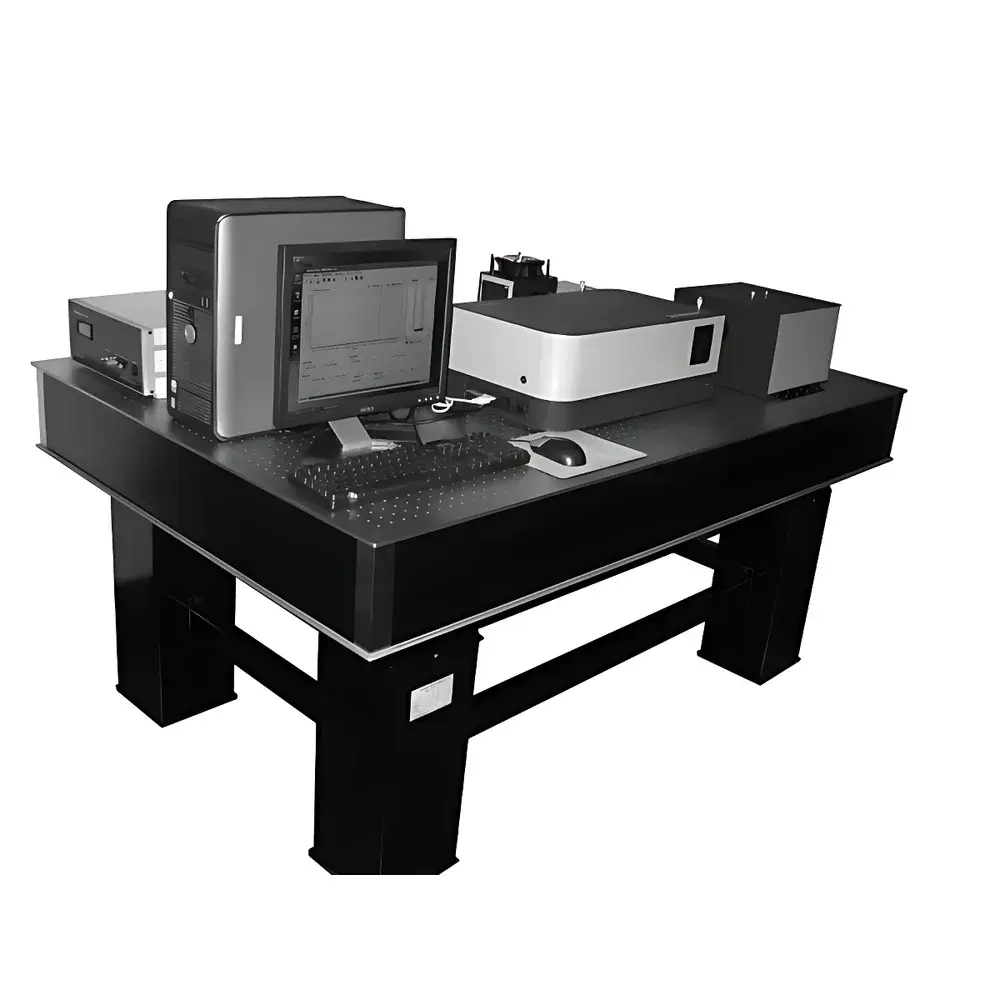
CEL-QPCE2010 Quantum Efficiency / Incident Photon-to-Current Efficiency (QE/IPCE) Measurement System for Silicon Solar Cells
| Brand | CEL (Zhongjiao Jinyuan) |
|---|---|
| Origin | Beijing, China |
| Manufacturer Type | Original Equipment Manufacturer (OEM) |
| Product Category | Domestic Scientific Instrument |
| Model | CEL-QPCE2010 |
| Pricing | Upon Request |
Overview
The CEL-QPCE2010 QE/IPCE Measurement System is a precision optical-electronic instrumentation platform engineered for quantitative spectral characterization of silicon-based photovoltaic devices. It operates on the fundamental principle of monochromatic photocurrent analysis under calibrated illumination, enabling traceable determination of quantum efficiency metrics—specifically External Quantum Efficiency (EQE), Internal Quantum Efficiency (IQE), and Incident Photon-to-Current Efficiency (IPCE)—in accordance with IEC 60904-8, ASTM E1021, and ISO 18530 standards. The system integrates a dual-monochromator architecture (300 mm or 150 mm focal length options), a temperature-stabilized sample stage (5–40 °C, ±0.5 °C), and a lock-in amplifier-based detection scheme to resolve weak photocurrent signals across the full UV–NIR spectral range (200–1100 nm). Its AC-coupled, chopper-synchronized measurement methodology eliminates DC drift and ambient light interference, ensuring high reproducibility (<0.3% relative standard deviation in short-circuit current density, Jsc) and compliance with GLP/GMP data integrity requirements.
Key Features
- Full-spectrum QE/IPCE mapping from 200 nm to 1100 nm with adjustable spectral resolution (≥1 nm step size)
- Lock-in amplifier detection synchronized to chopper frequency (5–1000 Hz), delivering enhanced signal-to-noise ratio (S/N) for low-current photodiodes and thin-film devices
- Automated software-controlled scanning, background subtraction, and calibration correction routines
- Integrated temperature-regulated sample stage (5–40 °C, ±0.5 °C) for thermal stability during extended spectral scans
- Modular optical configuration supporting optional accessories: integrating sphere for absolute reflectance, bias light source (up to two independent channels), and calibrated reference detectors traceable to NIST standards
- Compliant with FDA 21 CFR Part 11 requirements for electronic records and signatures when configured with audit-trail-enabled software
Sample Compatibility & Compliance
The CEL-QPCE2010 is validated for monocrystalline and multicrystalline silicon solar cells, as well as other semiconductor photovoltaic materials including Si heterojunctions (HJT), PERC, and thin-film absorbers compatible with front-side illumination geometry. Reflectance and transmittance modules enable full optical loss analysis per IEC 60904-8 Annex A. All calibration procedures adhere to ISO/IEC 17025 guidelines for testing laboratories, and spectral irradiance references are traceable to national metrology institutes (e.g., NIM, China; PTB, Germany). The system supports IQE derivation via concurrent EQE and absolute reflectance measurements—eliminating reliance on empirical approximations.
Software & Data Management
The proprietary control and analysis software provides a Windows-based GUI with real-time spectral visualization, batch processing, and export in CSV, TXT, and HDF5 formats. Data files include embedded metadata: wavelength stamps, detector responsivity coefficients, chopper frequency, integration time, temperature logs, and operator ID. Audit trail functionality records all parameter changes, calibration events, and file modifications in tamper-evident format—meeting ALCOA+ principles (Attributable, Legible, Contemporaneous, Original, Accurate, Complete, Consistent, Enduring, Available) for regulatory submissions. Raw lock-in output (X, Y, R, θ) and phase-compensated photocurrent values are stored separately to support third-party reprocessing.
Applications
- Quantitative evaluation of spectral response uniformity across wafer-level and module-level silicon PV devices
- Root-cause analysis of optical losses (reflection, parasitic absorption, transmission) in anti-reflection coating development
- Validation of spectral mismatch corrections in PV performance certification (IEC 61215, UL 1703)
- Characterization of tandem cell sub-cell contributions via selective bias illumination
- Research-grade IPCE profiling for emerging silicon-based photoelectrochemical and hybrid perovskite–Si architectures
- Calibration transfer between reference cells and production-line sensors in manufacturing QA/QC environments
FAQ
What spectral range does the CEL-QPCE2010 cover, and how is wavelength accuracy ensured?
The system operates from 200 nm to 1100 nm. Wavelength calibration is performed using Hg/Ar emission line standards before each measurement session, with residual error < ±0.2 nm across the range.
Can the system measure both EQE and IQE without manual intervention?
Yes—when equipped with the integrating sphere reflectance module and enabled in software, IQE is calculated in real time by applying the measured absolute reflectance to the EQE dataset.
Is temperature control mandatory for routine QE testing?
While not strictly mandatory, temperature stabilization (±0.5 °C) is recommended for Jsc-normalized comparisons and long-term repeatability, especially for temperature-sensitive passivation layers.
Does the system comply with international photovoltaic testing standards?
Yes—it implements measurement protocols aligned with IEC 60904-8 (2021), ASTM E1021-22, and ISO 18530:2020 for spectral responsivity determination.
How is stray light suppressed in the monochromator path?
The dual-monochromator design (optionally cascaded) reduces stray light to < 1×10⁻⁵ of peak intensity at ±50 nm offset, verified per ISO 10110-7 specifications.
Related Products



