
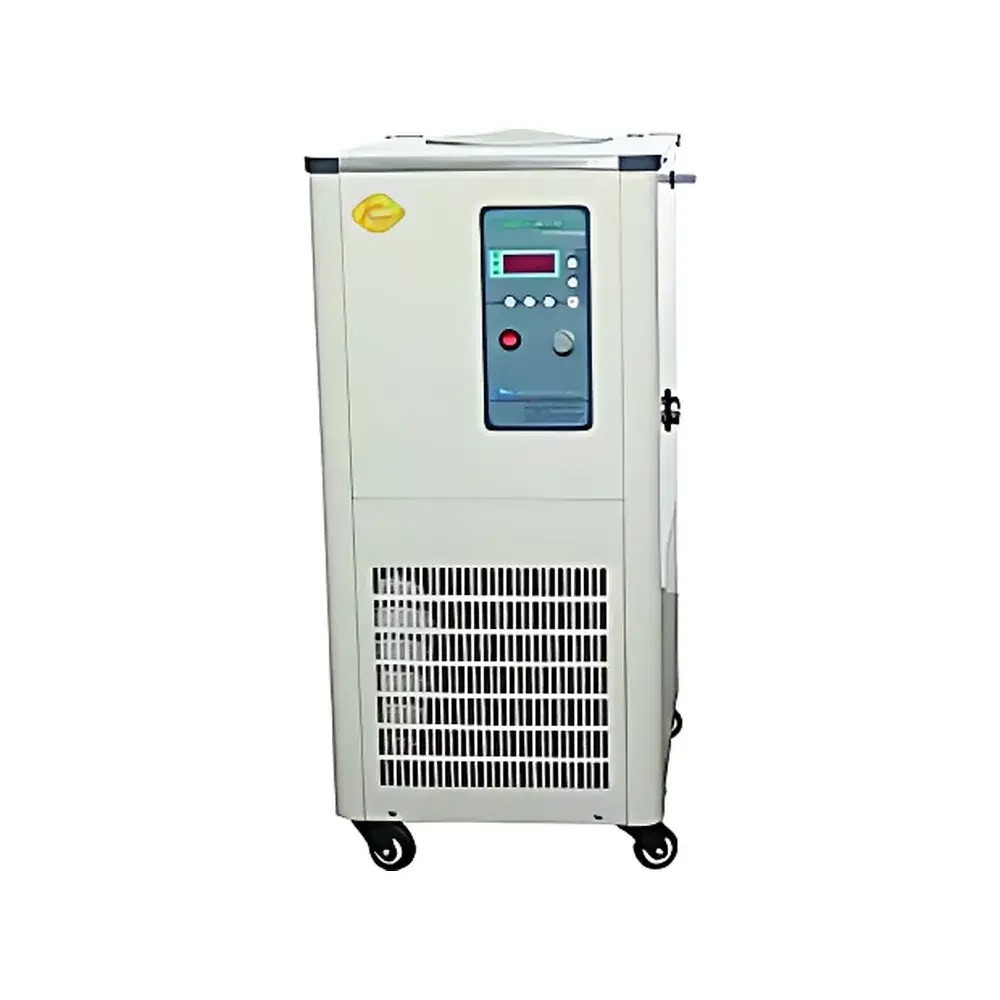
DLSB Series Low-Temperature Circulating Chillers
| Brand | Zolix |
|---|---|
| Model | DLSB-5/80 |
| Temperature Range | −80 °C to Ambient |
| Temperature Stability | ±2 °C |
| Cooling Capacity | 260 W at −40 °C, 110 W at −60 °C, 40 W at −80 °C |
| Flow Rate | 12 L/min |
| Head | 5–7 m |
| Bath Volume | 5 L |
| Opening Diameter × Depth | Ø210 mm × 130 mm |
| Recommended Ambient Temperature | 5–25 °C |
| Power Supply | 220 V / 50 Hz |
| Total Power Consumption | 1300 W |
| Housing Material | Cold-Rolled Steel with Electrostatic Powder Coating |
| Dimensions (L×W×H) | 515 mm × 450 mm × 930 mm |
| Net Weight | 110 kg |
| Construction | ANSI 304 & 316 Stainless Steel + Chemically Resistant Polymer Components in Fluid Path |
Overview
The DLSB Series Low-Temperature Circulating Chillers are precision-engineered refrigerated circulation systems designed for laboratory-scale thermal management under demanding cryogenic conditions. Utilizing a cascade vapor-compression refrigeration cycle with dual-stage compressors, these units deliver stable, controllable low-temperature liquid circulation down to −80 °C. Unlike single-stage chillers limited to −40 °C or higher, the DLSB-5/80 achieves deep-cold operation through optimized refrigerant staging and high-efficiency heat exchangers—enabling direct cooling of reaction vessels, condenser jackets, and analytical instrument components. The system functions both as a self-contained low-temperature bath and as an external coolant source via insulated, pressure-rated fluid lines. Its integrated open-bath design supports immersion-based cooling while maintaining compatibility with auxiliary equipment such as rotary evaporators, vacuum freeze dryers, and cold-trap assemblies.
Key Features
- Cascade refrigeration architecture with imported compressors (U.S., German, and French OEM-sourced), delivering enhanced reliability and extended service life under continuous low-temperature duty cycles.
- Dual-mode operation: 5 L open stainless-steel bath (Ø210 mm × 130 mm depth) serves as a cryogenic immersion reservoir; simultaneously, closed-loop external circulation delivers conditioned coolant at up to 12 L/min flow rate and 7 m head pressure.
- Precision digital temperature control with ±2 °C stability across the full −80 °C to ambient range, featuring PID algorithm tuning and real-time display of setpoint and actual bath temperature.
- Fluid-path materials engineered for chemical and cryogenic integrity: wetted surfaces constructed from ASTM A240 304 and 316 stainless steel, complemented by fluoropolymer-lined pumps and high-molecular-weight corrosion-resistant polymers resistant to methanol, ethanol, ethylene glycol/water mixtures, and other common low-temperature heat transfer fluids.
- Rugged industrial enclosure: electrostatically powder-coated cold-rolled steel housing (515 × 450 × 930 mm), IP20-rated, with vibration-dampened compressor mounting and thermal insulation minimizing ambient heat ingress.
Sample Compatibility & Compliance
The DLSB-5/80 is compatible with standard laboratory glassware (e.g., 50–1000 mL jacketed reactors, condensers, and Schlenk lines) and interfaces seamlessly with third-party instrumentation requiring external coolant input—including Buchi, IKA, and LabTech rotary evaporators; Edwards and KNF vacuum systems; and SP Scientific and Millrock freeze dryers. All electrical components comply with IEC 61010-1:2010 for laboratory equipment safety. The unit operates within Class II, Division 1 hazardous location guidelines when used with non-flammable heat transfer media. While not certified to UL or CE for standalone medical or pharmaceutical manufacturing use, it meets foundational requirements for GLP-compliant thermal control environments and supports traceable temperature logging when integrated with validated data acquisition systems.
Software & Data Management
The chiller operates via an embedded microcontroller with local keypad interface and LED display—no proprietary software or PC dependency required for basic operation. For integration into automated workflows, optional RS485 Modbus RTU communication enables bidirectional parameter control (setpoint adjustment, on/off command, fault status polling) and real-time telemetry (actual temperature, flow status, compressor runtime, overtemperature alerts). When connected to a SCADA or LIMS platform compliant with FDA 21 CFR Part 11, audit trails for temperature setpoints and operational events can be generated and archived—supporting IQ/OQ validation protocols in regulated QC laboratories.
Applications
- Low-temperature synthetic chemistry: exothermic Grignard, lithiation, and Diels–Alder reactions requiring precise sub-zero thermal control.
- Cryopreservation support: stabilization of enzyme solutions, monoclonal antibodies, and mRNA-lipid nanoparticles during formulation and fill-finish preparation.
- Instrument cooling: thermal regulation of CCD detectors, FTIR beam paths, and NMR probe preamplifiers where ambient drift compromises signal-to-noise ratio.
- Vacuum system enhancement: condensation trapping for solvent recovery in rotary evaporation and cold-finger integration in high-vacuum distillation setups.
- Materials testing: controlled thermal cycling of polymer samples, battery electrolyte characterization, and low-temperature rheology sample conditioning.
FAQ
What heat transfer fluids are recommended for operation below −60 °C?
Ethanol/methanol blends or specialized low-temperature silicone oils (e.g., DC-704) are preferred. Water-glycol mixtures are unsuitable below −20 °C due to freezing and viscosity-induced pump cavitation.
Can the DLSB-5/80 maintain −80 °C continuously with external load?
Yes—provided ambient temperature remains ≤25 °C, ventilation clearance ≥150 mm is maintained, and external loop resistance does not exceed 7 m head. At −80 °C, cooling capacity is 40 W; total thermal load must remain within this limit.
Is the bath volume sufficient for immersion of a 1 L jacketed reactor?
The 5 L bath accommodates standard 1 L double-wall reactors with adequate fluid coverage above the reaction zone; however, optimal heat transfer requires matching jacket volume to circulator capacity—consult reactor manufacturer’s coolant volume specifications.
Does the unit include remote start/stop capability?
Standard configuration includes dry-contact terminals for external relay control; optional 0–10 V analog input is available for proportional setpoint modulation in feedback-controlled processes.
What maintenance intervals are recommended for long-term reliability?
Compressor oil inspection every 12 months; refrigerant leak check annually; bath fluid replacement and system flush every 6 months when using organic solvents; filter element replacement per 2000 operating hours or sooner if particulate contamination is observed.



