
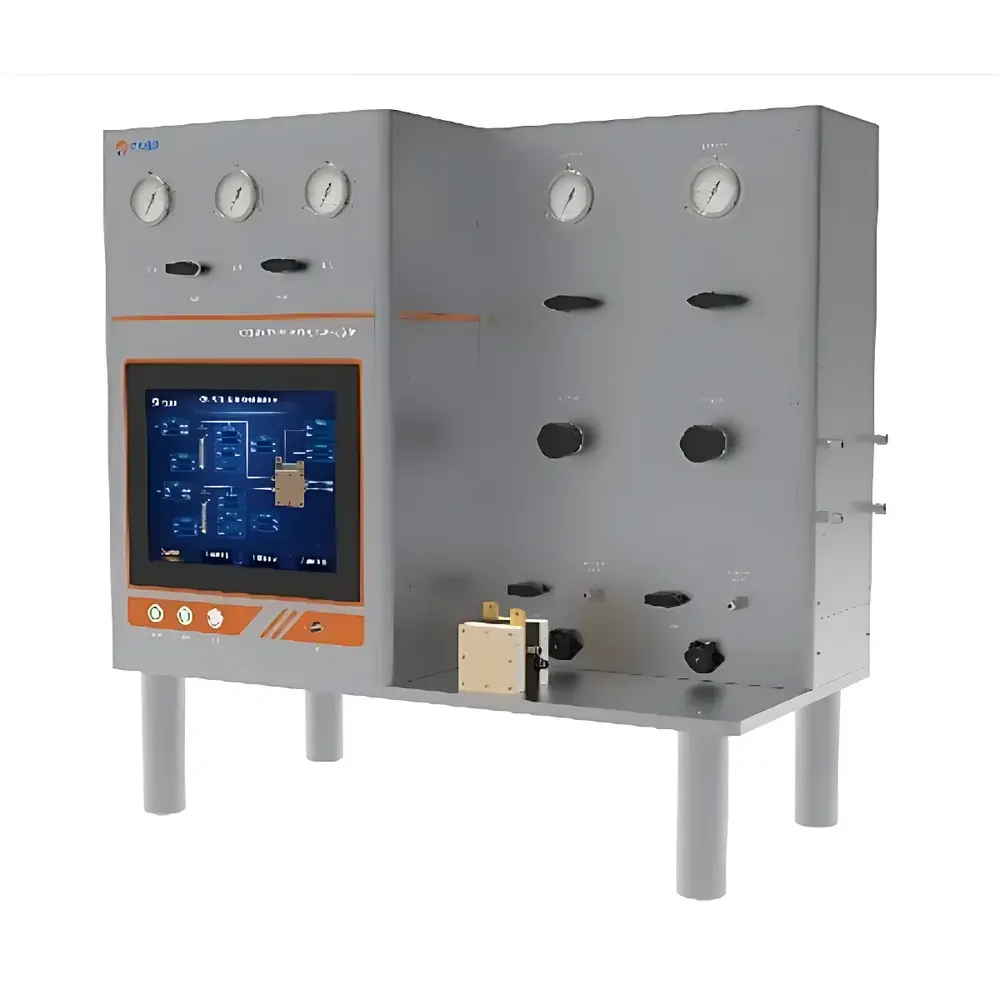
CEL-FCTS50 Fuel Cell Testing System
| Brand | CEA (Zhongjiaojinyuan) |
|---|---|
| Origin | Beijing, China |
| Manufacturer Type | Direct Manufacturer |
| Product Category | Domestic |
| Model | CEL-FCTS50 |
| Light Source Type | N/A (Not a light source — misclassified in input) |
| Illumination Mode | N/A |
| Rated Power | ≤50 W |
| Gas Pressure Range | 0–3 bar |
| Anode Flow Rate | 0–300 mL/min |
| Cathode Flow Rate | 0–1000 mL/min |
| Temperature Control Range | Ambient to 95 °C (±1 °C) |
| Humidification Method & Range | Bubble-type humidification, 0–100 % RH |
| Dry/Wet Mode Switching | Manual |
| Safety Features | H₂ leakage alarm (ppm-level), over-temperature/over-pressure audible alert, real-time status monitoring |
| Operating Modes | Constant Current, Constant Voltage, Constant Power, Current Sweep, Voltage Sweep |
| Software | Proprietary FC control suite with lifetime license, audit-ready event logging, user-configurable alarms and parameter sets |
| Compliance Support | GLP-compliant data traceability, configurable audit trail (meets FDA 21 CFR Part 11 readiness requirements for lab documentation) |
Overview
The CEL-FCTS50 Fuel Cell Testing System is a purpose-built, bench-scale electrochemical test platform engineered for the characterization and performance evaluation of proton exchange membrane (PEM) fuel cells operating under hydrogen–air feed conditions. Unlike optical instruments or light sources—into which it has been erroneously categorized—the CEL-FCTS50 is a fully integrated electrochemical measurement system combining precision gas delivery, thermal management, humidification control, electrical load regulation, and synchronized data acquisition. Its core architecture implements potentiostatic/galvanostatic control principles compliant with ASTM D6866, ISO 8528-10, and IEC 62282-2 standards for stationary fuel cell performance testing. Designed for laboratory-scale R&D and academic instruction, the system supports steady-state and dynamic operation up to 50 W nominal output, enabling reproducible acquisition of polarization curves (I–V), electrochemical impedance spectra (EIS), linear sweep voltammograms (LSV) for hydrogen crossover quantification, and cyclic voltammetry for electrochemical surface area (ECSA) determination.
Key Features
- Triple-gas manifold with independent mass flow controllers (MFCs) for H₂, air, and inert purge gases—enabling seamless switching between feed streams without cross-contamination
- Bubble-type humidification system with dual-path design: fully decoupled anode/cathode humidification channels, supporting independent RH control from 0–100 % at each electrode
- Zero-dead-volume dry/wet mode transition via manual three-way valve actuation—eliminating residual condensate retention and ensuring repeatable hydration state initialization
- Backpressure regulation capability across 0–3 bar range, allowing controlled cathode stoichiometry and membrane water management studies
- Integrated safety architecture: catalytic H₂ sensor (detection limit <50 ppm), thermocouple-based over-temperature cutoff (±0.5 °C resolution), pressure transducer interlock, and latching audible alarm with timestamped event logging
- Multi-mode electrochemical operation: constant current, constant voltage, constant power, current ramp, and voltage sweep—with programmable slew rates and hold periods
- Modular hardware interface compatible with third-party potentiostats (e.g., BioLogic SP-300, Gamry Interface 5000E) for advanced EIS and transient analysis
Sample Compatibility & Compliance
The CEL-FCTS50 accommodates single-cell PEM assemblies with active areas ranging from 5 cm² to 100 cm², including membrane electrode assemblies (MEAs) with Nafion® 115/117/212, Gore-Select®, or Sustainion® membranes. It supports both serpentine and parallel flow-field configurations and is mechanically compatible with standard graphite or stainless-steel bipolar plates. All operational parameters—including gas flow, temperature, humidity, backpressure, and electrical loading—are logged with millisecond timestamp resolution and stored in HDF5 format for long-term archival. The system’s software enforces ALCOA+ data integrity principles (Attributable, Legible, Contemporaneous, Original, Accurate, Complete, Consistent, Enduring, Available) and supports configuration-controlled audit trails aligned with GLP and GMP documentation requirements. While not certified as 21 CFR Part 11 compliant out-of-the-box, its logging architecture meets foundational technical criteria for validation under FDA-regulated environments when deployed with appropriate procedural controls.
Software & Data Management
The proprietary FC-Control Suite provides a deterministic, deterministic real-time operating environment built on Qt/C++ with deterministic thread scheduling. It features a tabbed GUI with dedicated modules for experiment sequencing, live parameter visualization (including dual-axis I–V overlays), alarm configuration, and post-run analysis. All user-defined protocols—including multi-step gas composition ramps, temperature gradients, and variable-load profiles—are saved as XML-based method files with digital signature support. Data export options include CSV (for Excel/Origin), MATLAB .mat, and standardized EC-Lab-compatible formats. Event logs record every alarm trigger—including time, severity level, measured value, setpoint deviation, and operator ID—facilitating root-cause analysis during failure investigations. Software updates are delivered via secure HTTPS channel with SHA-256 hash verification; no subscription fee applies—lifetime usage rights are granted upon system commissioning.
Applications
- Academic laboratory instruction in electrochemical engineering, chemical process control, and sustainable energy systems—validated for undergraduate and graduate curricula per ACS and AIChE learning outcome frameworks
- Quantitative assessment of catalyst degradation mechanisms via accelerated stress tests (ASTs), including potential cycling for Pt dissolution kinetics and OCV hold for carbon corrosion rate estimation
- Parametric optimization of operating conditions: systematic variation of stoichiometry, relative humidity, and temperature to map performance envelopes and identify optimal operating points
- Hydrogen crossover evaluation using LSV under nitrogen-purged cathode conditions, enabling calculation of permeability coefficients and membrane thickness correlation
- Dynamic load response characterization for grid-support applications—measuring voltage recovery time, overshoot magnitude, and impedance phase shift under transient current steps
- Validation of computational models (e.g., COMSOL Multiphysics® fuel cell modules) through benchmarking against experimental polarization and EIS datasets
FAQ
Is the CEL-FCTS50 classified as an optical instrument?
No. Despite erroneous categorization in some distribution channels, the CEL-FCTS50 is a dedicated electrochemical test station—not a light source, spectrometer, or optical device. Its function centers on galvanostatic/potentiostatic control, gas-phase reactant delivery, and thermal-hygric management.
Can the system operate with non-Pt catalysts such as Fe–N–C or Co–N–C cathodes?
Yes. The open architecture supports wide-voltage-range operation (±10 V) and low-current sensitivity (down to 10 µA), making it suitable for high-impedance non-precious metal catalyst evaluation.
Does the software support automated compliance reporting for ISO/IEC 17025 accreditation?
While the base software does not auto-generate ISO/IEC 17025 reports, it exports structured metadata (instrument ID, calibration dates, uncertainty budgets, environmental logs) required for accredited lab documentation workflows.
What is the maximum allowable stack height or number of cells supported?
The mechanical fixture is rated for single-cell testing only. Multi-cell stacks require custom mounting solutions and external manifold integration—available as OEM engineering services.
Is remote monitoring possible via Ethernet or Wi-Fi?
Yes. The system includes a 10/100BASE-TX Ethernet port with Modbus TCP and OPC UA server support, enabling integration into SCADA environments and remote supervision via TLS-secured connections.







