
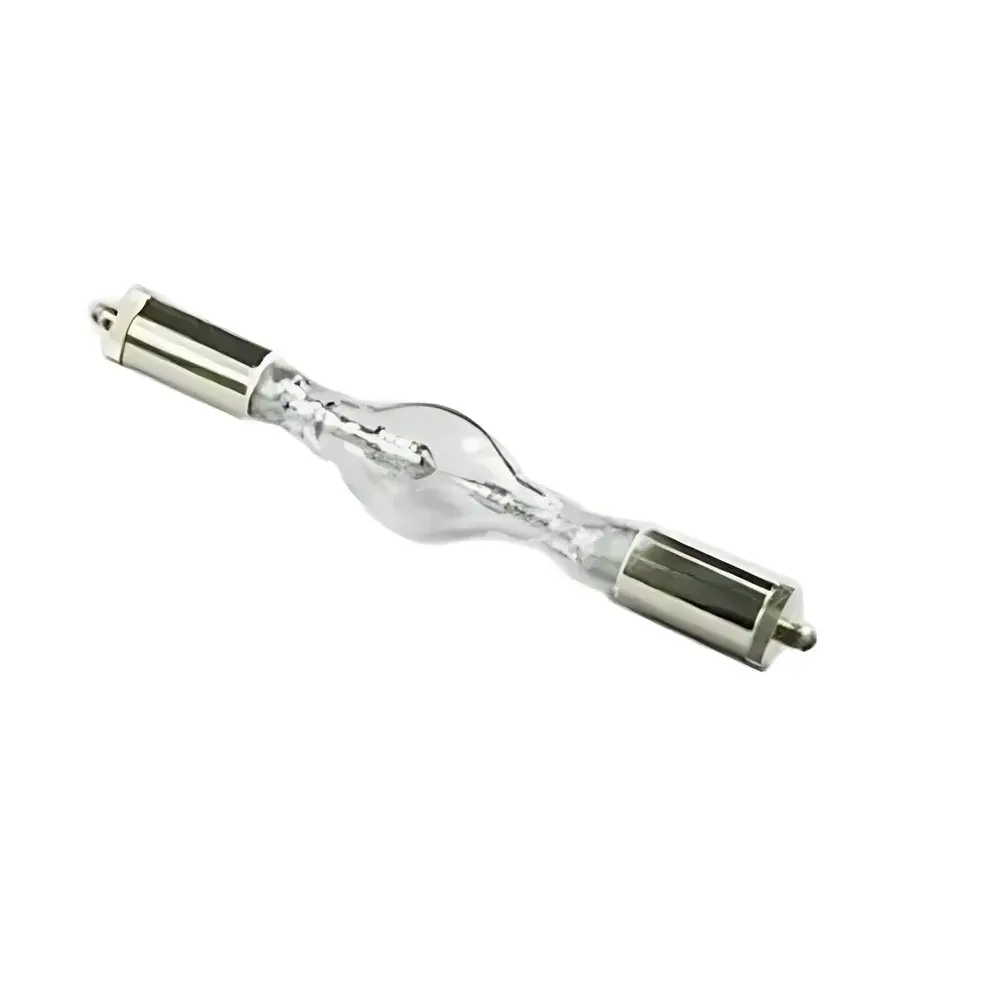
Mercury Arc Lamp Bulb – Spherical Quartz Envelope, 150W/350W/500W
| Brand | CEL |
|---|---|
| Origin | Beijing, China |
| Manufacturer Type | OEM/ODM Producer |
| Product Category | Optical Component |
| Power Ratings | 150 W |
| Envelope Material | Fused Silica (UV-Grade Quartz) |
| Arc Geometry | Spherical |
| Operating Mode | DC or AC Stable Arc Discharge |
| UV Output Range | 254 nm, 365 nm, 405 nm, 436 nm, 546 nm, 578 nm prominent lines |
| Cooling Requirement | Forced Air or Water-Cooled Base Mounting |
| Lifetime | ≥1,000 h (at rated power, proper thermal management) |
| Compliance | RoHS-compliant materials |
| Electrical Interface | Standard Biaxial Ceramic Base (e.g., G12 or PG12 per IEC 60061) |
Overview
The Mercury Arc Lamp Bulb – Spherical Quartz Envelope is a high-intensity, broadband ultraviolet–visible (UV–Vis) light source engineered for precision optical laboratory applications requiring stable spectral output and reproducible irradiance. Based on the principle of mercury vapor arc discharge within a fused silica envelope, this lamp generates discrete spectral emission lines characteristic of atomic mercury transitions—most notably at 254 nm (UVC), 365 nm (UVA), 405 nm (violet), 436 nm (blue), 546 nm (green), and 578 nm (yellow). Its spherical geometry ensures isotropic radiation distribution and optimized coupling into ellipsoidal reflectors, monochromators, or fiber-optic light guides. Designed for integration into spectrophotometers, fluorescence microscopes, photolithography test benches, and UV curing validation systems, the lamp operates under regulated DC or low-ripple AC current to minimize arc wander and intensity flicker. Thermal management—via forced-air convection or water-cooled base mounting—is integral to maintaining arc stability, spectral fidelity, and rated service life.
Key Features
- Spherical fused silica envelope with high UV transmission (>90% at 254 nm, >95% at 365 nm) and thermal shock resistance up to 1,200 °C
- Three standardized power ratings (150 W, 350 W, 500 W) enabling scalable irradiance output while preserving line-to-continuum ratio integrity
- Precision-matched electrode alignment and mercury dosing for repeatable ignition voltage (< 15 kV), warm-up time (< 5 min to 95% output), and arc centering tolerance (±0.2 mm)
- Biaxial ceramic base (G12 / PG12 compliant) ensuring mechanical rigidity, electrical insulation, and compatibility with industry-standard lamp housings (e.g., Oriel, Newport, Thorlabs)
- RoHS-compliant construction with trace-metal-free quartz and low-outgassing internal components suitable for cleanroom and GLP-aligned environments
- Integrated thermal cutoff and overcurrent protection circuitry support in external ballast units (not included), aligning with IEC 61000-3-2 harmonic emission standards
Sample Compatibility & Compliance
This lamp is compatible with standard mercury lamp power supplies meeting ANSI C78.377A specifications for starting voltage, current regulation, and open-circuit protection. It is routinely deployed in setups requiring traceable UV irradiance calibration—such as those referenced in ASTM E2588 (Standard Practice for Calibration of UV Light Sources Used in Photostability Testing) and ISO 11664-3 (Colorimetry — Part 3: Spectral matching). The fused silica envelope meets USP requirements for UV transmittance in pharmaceutical photostability chambers. While not classified as a medical device, its spectral stability and lifetime consistency support FDA 21 CFR Part 11–compliant data acquisition when paired with validated spectroradiometric measurement systems.
Software & Data Management
The lamp itself is a passive optical component and does not incorporate embedded firmware or digital interfaces. However, it is fully interoperable with third-party instrument control platforms—including LabVIEW-based DAQ systems, MATLAB Instrument Control Toolbox, and Python-controlled spectroradiometers (e.g., Ocean Insight USB2000+, Avantes AvaSpec-ULS2048CL-EVO)—when integrated into calibrated optical chains. Users may log operational parameters (on-time, cumulative hours, supply voltage/current) via external PLCs or SCADA nodes to support preventive maintenance scheduling and GLP audit trails. No proprietary drivers or cloud connectivity are required or provided.
Applications
- UV-Vis spectrophotometer wavelength calibration (NIST-traceable line sources for 254 nm, 365 nm, 436 nm, 546 nm, and 578 nm)
- Fluorescence excitation profiling in life science imaging and flow cytometry validation
- Photocatalytic reactor illumination in materials science research (e.g., TiO₂ degradation studies)
- Accelerated aging and photostability testing per ICH Q1B guidelines
- Mask alignment and exposure system characterization in microfabrication R&D
- Calibration of radiometric sensors and UV index meters in environmental monitoring labs
FAQ
What is the recommended warm-up time before spectral measurements?
Minimum 5 minutes at nominal current to achieve thermal equilibrium and stabilize line intensities within ±2% variation.
Can this lamp be operated in vertical or horizontal orientation?
Yes—both orientations are supported; however, horizontal mounting requires strict adherence to manufacturer-specified airflow direction and minimum clearance (≥25 mm) around the envelope to prevent localized overheating.
Is ozone generation a concern during operation?
Ozone is produced below 240 nm; lamps with uncoated fused silica envelopes emit weakly at 185 nm. Use in ventilated enclosures or with ozone-scrubbing filters is advised for prolonged operation in confined spaces.
How is lifetime defined, and what factors accelerate degradation?
Lifetime is defined as time to 50% radiant flux decay at 365 nm under specified cooling and current conditions. Frequent on/off cycling, inadequate heat dissipation, and voltage spikes reduce service life significantly.
Does the lamp include a safety interlock interface?
No—the bulb is a standalone component. Interlocks must be implemented at the housing or power supply level per IEC 60825-1 (laser and lamp safety) and local occupational health regulations.



