
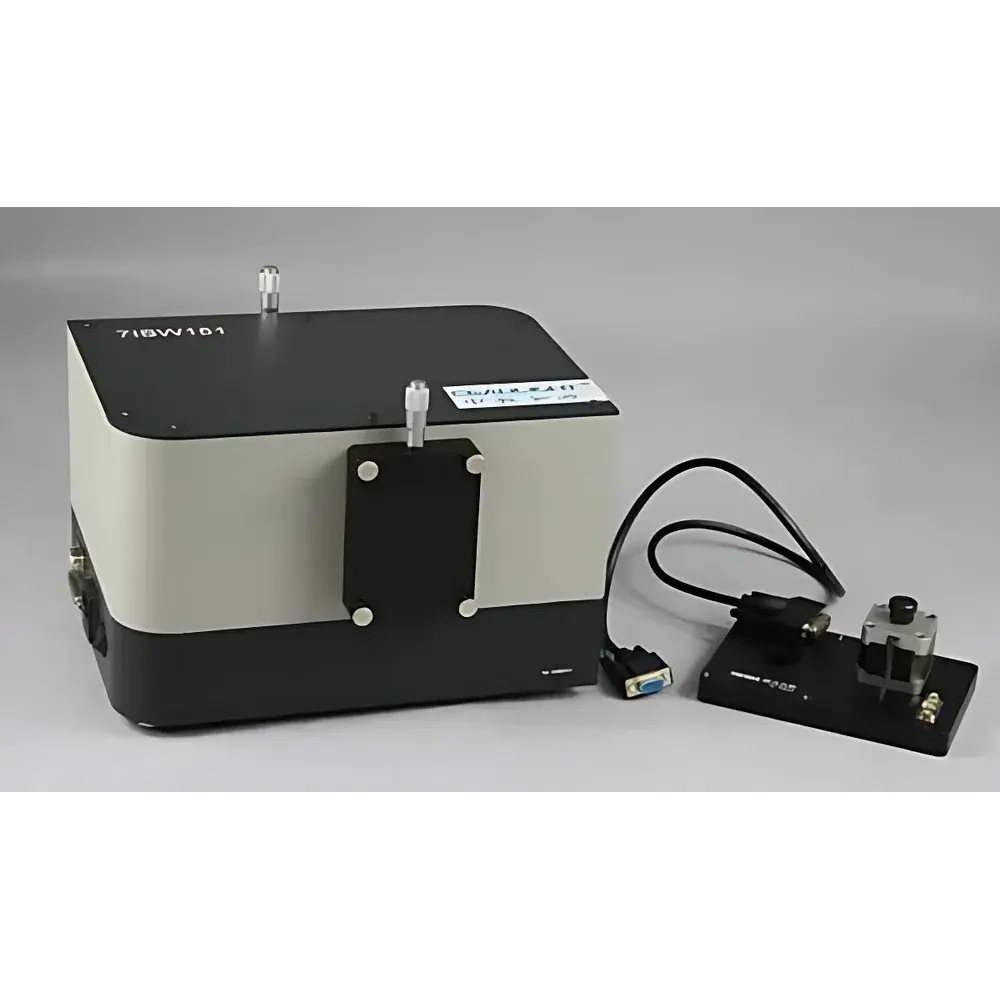
CEL-IS151 Dual-Grating Scanning Monochromator / Spectrometer
| Brand | CEL (China Education Goldsource) |
|---|---|
| Model | CEL-IS151 |
| Focal Length | 150 mm |
| f-number | f/4.5 |
| Stray Light | ≤5×10⁻⁴ |
| Minimum Wavelength Step | 0.0045 nm |
| Grating Dimensions | 30 mm × 30 mm |
| Standard Gratings | 7OG1200-300 (1200 grooves/mm, λₚ = 300 nm) & 7OG600-1000 (600 grooves/mm, λₚ = 1000 nm) |
| Slit Width Range | 10 μm – 3 mm (motorized, 10 μm knife-edge protected) |
| Slit Height | 5 mm |
| Housing Dimensions | 298 mm × 200 mm × 185 mm |
| Optical Center Height | 140 mm (±5 mm adjustable) |
| Weight | 10 kg |
| Filter Wheel | 6-position, motorized, Φ18 mm × 2 mm capacity, auto-zeroing on activation |
| Optical Layout | Exit and entrance ports orthogonal |
Overview
The CEL-IS151 Dual-Grating Scanning Monochromator/Spectrometer is a precision optical instrument engineered for high-resolution wavelength selection and spectral analysis in research-grade photonic laboratories. Based on the Czerny–Turner optical configuration with orthogonal input/output port geometry, it employs two interchangeable plane diffraction gratings mounted on a shared rotation stage to enable seamless spectral range coverage from deep UV (190 nm) to near-infrared (1100 nm). Its 150 mm focal length and f/4.5 aperture balance throughput and resolution, while the optimized mechanical design minimizes optical aberrations and ensures repeatable wavelength calibration. The monochromator operates via stepper-motor-driven grating rotation and slit actuation, delivering a minimum resolvable wavelength increment of 0.0045 nm—sufficient for narrowband excitation in fluorescence spectroscopy, laser line cleanup, and monochromatic irradiation studies in photochemistry and photocatalysis.
Key Features
- Dual-grating turret mechanism with automatic recognition and software-assisted switching between 1200 g/mm (UV–VIS optimized) and 600 g/mm (VIS–NIR extended range) holographic gratings.
- Motorized, computer-controlled entrance and exit slits: width continuously adjustable from 10 µm to 3 mm with integrated 10 µm knife-edge protection to prevent mechanical damage during fine-tuning.
- 6-position motorized filter wheel compatible with standard Ø18 mm × 2 mm optical filters; supports programmable auto-alignment and zero-reference positioning prior to spectral scans.
- Orthogonal optical layout isolates source coupling from detection path, reducing stray light coupling and simplifying integration with lamps, lasers, or fiber-coupled sources.
- Adjustable optical center height (140 mm ±5 mm) enables ergonomic alignment with common optical tables, spectrometer detectors, and sample chambers without beam realignment hardware.
- Robust aluminum alloy housing (298 × 200 × 185 mm, 10 kg) provides thermal and mechanical stability for long-duration scans under ambient lab conditions.
Sample Compatibility & Compliance
The CEL-IS151 is designed for free-space optical integration and does not interface directly with samples; rather, it serves as a tunable wavelength selector upstream of sample illumination or downstream of emission collection. It is compatible with standard 1/4″ and 1/2″ optical mounts, kinematic mirror holders, and fiber-optic couplers (e.g., SMA905 or FC/PC adapters via optional collimating optics). While not certified to ISO/IEC 17025 or CE for metrological traceability out-of-the-box, its mechanical repeatability (≤±0.01 nm over 1000 scan cycles) and stray light performance (≤5×10⁻⁴) align with typical requirements for academic and industrial R&D environments conducting ASTM E275, ISO 13468, or USP compliant optical characterization. Calibration verification is supported using NIST-traceable Hg/Ne spectral lamps.
Software & Data Management
The instrument is controlled via Windows-based native software (CEL-SpectraControl v3.x), providing full automation of grating selection, slit width adjustment, filter wheel indexing, and wavelength scanning. Scan protocols support linear, step-scan, and custom-defined wavelength sequences with user-defined dwell times per point. Raw wavelength–intensity data are exported in ASCII (.txt) or CSV format, preserving metadata including grating ID, slit settings, filter position, and timestamp. The software architecture supports audit trail logging (user actions, parameter changes, execution timestamps) suitable for GLP-compliant documentation. No native FDA 21 CFR Part 11 compliance is embedded; however, system logs and export files may be incorporated into validated third-party LIMS or ELN platforms.
Applications
- Monochromatic irradiation in photocatalytic reaction studies (e.g., TiO₂ bandgap excitation at 365 nm or selective dye sensitization).
- Spectral calibration reference for CCD/CMOS array spectrometers and photomultiplier tube (PMT)-based detection systems.
- Laser line purification and suppression of amplified spontaneous emission (ASE) in tunable laser cavities.
- Fluorescence excitation profiling where narrow bandwidth (<1 nm) and high wavelength accuracy are required.
- Optical component characterization—including transmittance, reflectance, and quantum efficiency measurements—when paired with calibrated broadband sources and lock-in detection.
- Educational laboratory instruction in physical optics, spectroscopic instrumentation, and diffraction theory.
FAQ
What is the typical wavelength reproducibility of the CEL-IS151 over repeated scans?
Wavelength reproducibility is ≤±0.01 nm under stable thermal conditions (23 ±1 °C) after 30-minute warm-up, verified using mercury lamp emission lines.
Can the CEL-IS151 be synchronized with external detectors or data acquisition systems?
Yes—TTL-compatible trigger outputs are provided for frame synchronization with gated detectors, oscilloscopes, or DAQ cards supporting external start/stop signals.
Is vacuum or purged operation supported for UV applications below 200 nm?
No—the optical path is air-filled and not sealed; operation below 190 nm requires external nitrogen purging or vacuum coupling via custom flanged interfaces (not supplied).
Are grating calibration files included with each unit?
Yes—each delivered grating includes a factory-measured groove density deviation report and polynomial calibration coefficients for wavelength-to-step conversion.
Does the system support remote command-line control (e.g., via RS232 or USB-VCP)?
Yes—full SCPI-like ASCII command set is documented in the technical manual, enabling integration with Python, LabVIEW, or MATLAB via virtual COM port emulation.




