
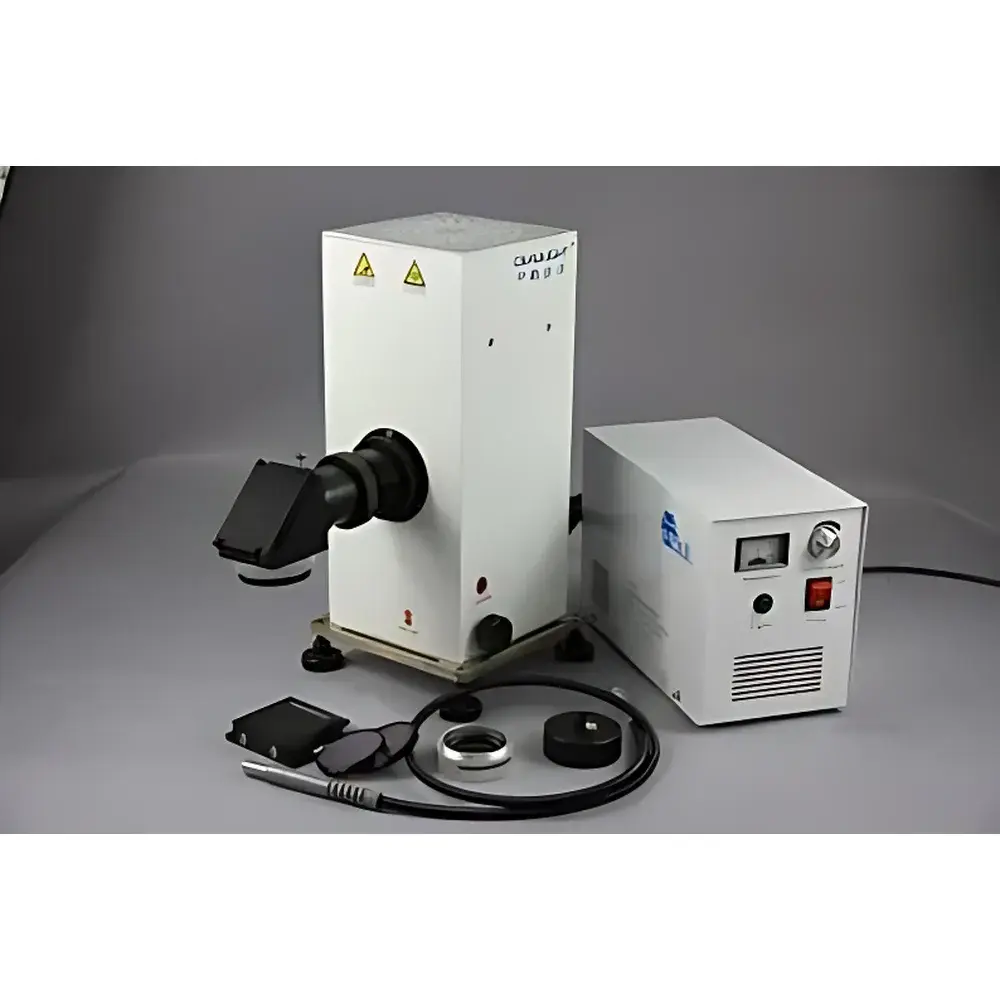
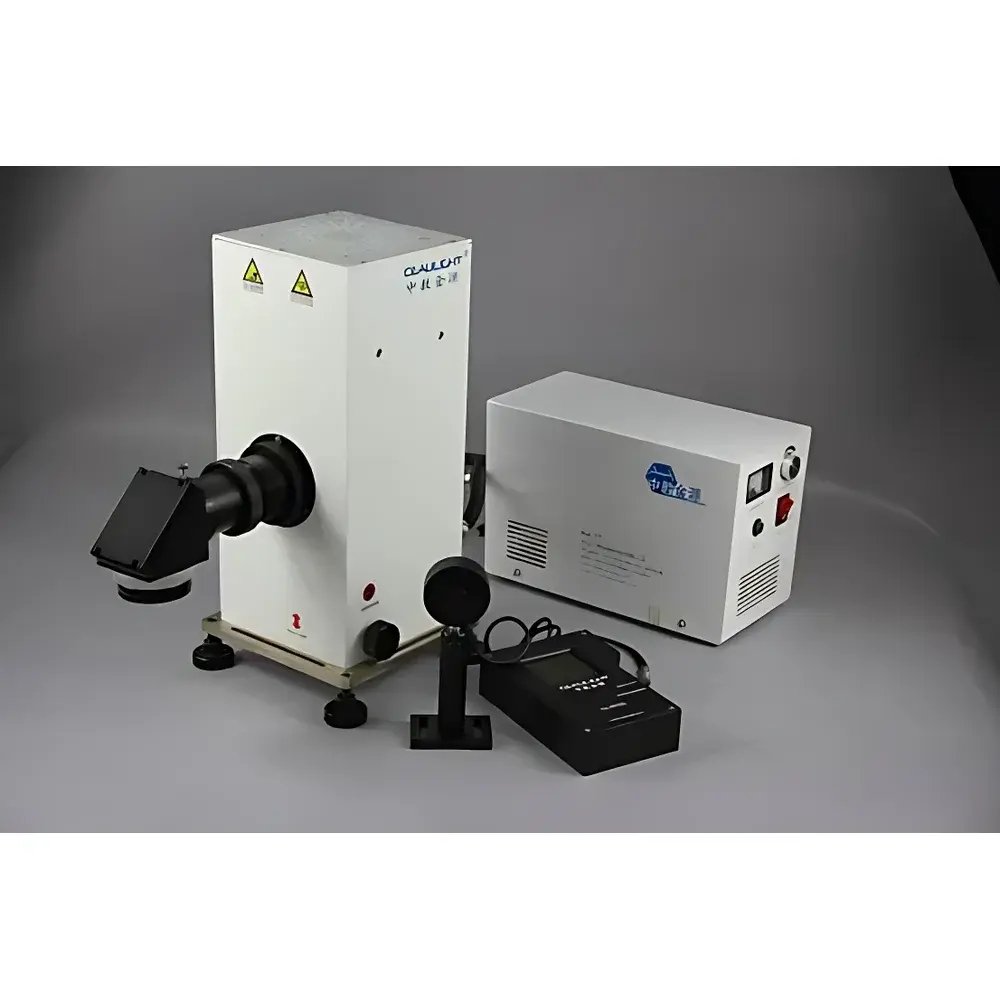
CEL-MXL500 Mercury-Xenon Arc Lamp Light Source System
| Brand | CEA (China Education AuLight) |
|---|---|
| Origin | Beijing, China |
| Manufacturer Type | OEM/ODM Manufacturer |
| Origin Category | Domestic (PRC) |
| Model | CEL-MXL500 |
| Light Source Type | High-Pressure Short-Arc Hg–Xe Lamp |
| Illumination Mode | External Irradiation |
| Input Power | 500 W (max) |
| Radiant Output | 15 W |
| Spectral Range | 350–1100 nm |
| Color Temperature | 6000 K |
| AM1.5G Spectral Match | Compliant |
| Stability | ≤1.0% (rms, over 8 h) |
| Lamp Lifetime | >800 h |
| Cooling Method | Forced-air convection |
| Beam Diameter (adjustable) | 3–60 mm |
| Spot Output Diameter | 2–3 mm |
| Current Regulation Range | 15–25 A |
| Optical Mount Compatibility | 25.4 mm, 50.8 mm, M52, M62 |
| Optional Accessories | AM1.5G filter, collimating lens set, fiber-coupling adapter, beam expander, reflector mirror, quartz interference filters (UV-grade fused silica), K9 glass filters |
Overview
The CEL-MXL500 Mercury-Xenon Arc Lamp Light Source System is a high-intensity, broadband external illumination source engineered for precision optical and photoelectrochemical research. It employs a 500 W high-pressure short-arc mercury-xenon lamp, which generates a stable, spatially compact arc plasma under high-frequency, high-voltage excitation. This configuration yields a near-point-source emission geometry with exceptional radiometric stability (≤1.0% RMS over 8 hours) and broad spectral coverage from 350 nm to 1100 nm—spanning the UV-A, visible, and near-infrared bands. With a correlated color temperature of 6000 K and rigorous spectral conformity to the ASTM G173-03 AM1.5G reference solar irradiance spectrum, the CEL-MXL500 serves as a laboratory-grade solar simulator for photovoltaic device characterization, quantum efficiency mapping, and photocatalytic reaction kinetics studies. Its optical architecture integrates UV-fused silica condenser lenses and a rear-facing elliptical reflector to maximize photon collection efficiency (>75% coupling into target plane), minimizing thermal load while preserving spectral fidelity.
Key Features
- High-stability 500 W Hg–Xe short-arc lamp with <2.5 mm effective arc length, enabling tight focus and high irradiance density (0.5–2 Sun, calibrated via traceable CEL-NP2000 radiometer)
- Integrated high-voltage igniter housed within the lamp chamber—eliminating external HV cabling and reducing electrical hazard risk during operation
- Optimized thermal management via dual-stage forced-air convection: primary airflow cools the lamp envelope; secondary path dissipates heat from optical mounts and housing
- Modular optical interface supporting standard mounting threads (M52, M62) and kinematic lens holders (25.4 mm and 50.8 mm diameter)
- Adjustable output beam: collimated parallel light (via optional CEL-HX-compatible collimator set), focused spot (2–3 mm Ø), or uniform irradiance field (3–60 mm Ø, with diffuser or homogenizer)
- Full spectral compatibility with UV-grade fused silica, BK7, and K9 optical components—including bandpass, longpass, and AM1.5G-matched interference filters
Sample Compatibility & Compliance
The CEL-MXL500 is designed for integration into ISO/IEC 17025-accredited laboratories and GLP-compliant photoreactor setups. Its spectral output meets the Class AAA requirements per IEC 60904-9:2020 for spatial non-uniformity (<2%), temporal instability (<1%), and spectral match error ( 500 MW/cm² at 355 nm, pulsed). Electrical safety conforms to IEC 61010-1:2010 (Measurement Category II, Pollution Degree 2), and EMC performance satisfies CISPR 11 Group 1, Class B limits.
Software & Data Management
While the CEL-MXL500 operates as a stand-alone analog-controlled source, it is fully compatible with third-party digital control ecosystems. Analog voltage inputs (0–10 V) enable closed-loop intensity regulation synchronized with spectroradiometers (e.g., Ocean Insight QE Pro), lock-in amplifiers (e.g., Zurich Instruments HF2LI), or data acquisition systems (NI PXIe-6363). Optional RS-232/USB interface modules support remote power ramping, lamp runtime logging, and fault-code reporting. All operational parameters—including current setpoint, fan speed, and internal temperature—are logged with timestamped metadata in CSV format for audit-ready recordkeeping compliant with FDA 21 CFR Part 11 Annex 11 requirements when deployed in regulated QC/QA workflows.
Applications
- Photovoltaic testing: J–V curve measurement, EQE/IPCE analysis, degradation studies under controlled AM1.5G illumination
- Photoelectrochemistry: In-situ surface photovoltage spectroscopy (SPS), transient absorption spectroscopy pump-probe excitation
- Heterogeneous photocatalysis: Kinetic quantification of pollutant degradation (e.g., methylene blue, phenol) under simulated solar flux
- Biophotonic stimulation: Controlled UV–vis exposure for circadian rhythm assays, microbial inactivation, and optogenetic probe activation
- Materials defect characterization: Photoluminescence excitation mapping, deep-level transient spectroscopy (DLTS) bias illumination
- Fiber-optic sensor calibration: Broadband source for spectral responsivity verification of UV–NIR photodetectors and spectrometers
FAQ
What is the recommended lamp replacement interval?
Lamp lifetime is rated at >800 hours at nominal current (20 A); actual service life depends on thermal cycling frequency and operating current. For metrology-critical applications, we recommend scheduled replacement after 600 hours or upon observed spectral drift >3% in the 365 nm Hg line intensity.
Can the CEL-MXL500 be coupled to optical fibers?
Yes—using the optional fiber-coupling adapter (FC-508-SMA), the system delivers up to 8.2 W optical power into a 600 µm core multimode fiber (NA 0.22) with minimal modal dispersion in the 400–800 nm range.
Is AM1.5G spectral filtering mandatory for solar simulation?
No—it is application-dependent. The bare lamp output approximates natural sunlight but exhibits enhanced Hg lines at 365 nm and 405 nm. For photovoltaic certification, the AM1.5G filter (included in optional kit #AM15G-CEL) is required to meet IEC 60904-9 spectral match criteria.
How is beam uniformity verified?
Uniformity is validated using a calibrated CCD-based imaging radiometer (e.g., Gigahertz-Optik X1-1) with NIST-traceable responsivity. Spatial non-uniformity is measured across a 50 mm × 50 mm plane at working distance and reported in the Certificate of Conformance shipped with each unit.





