
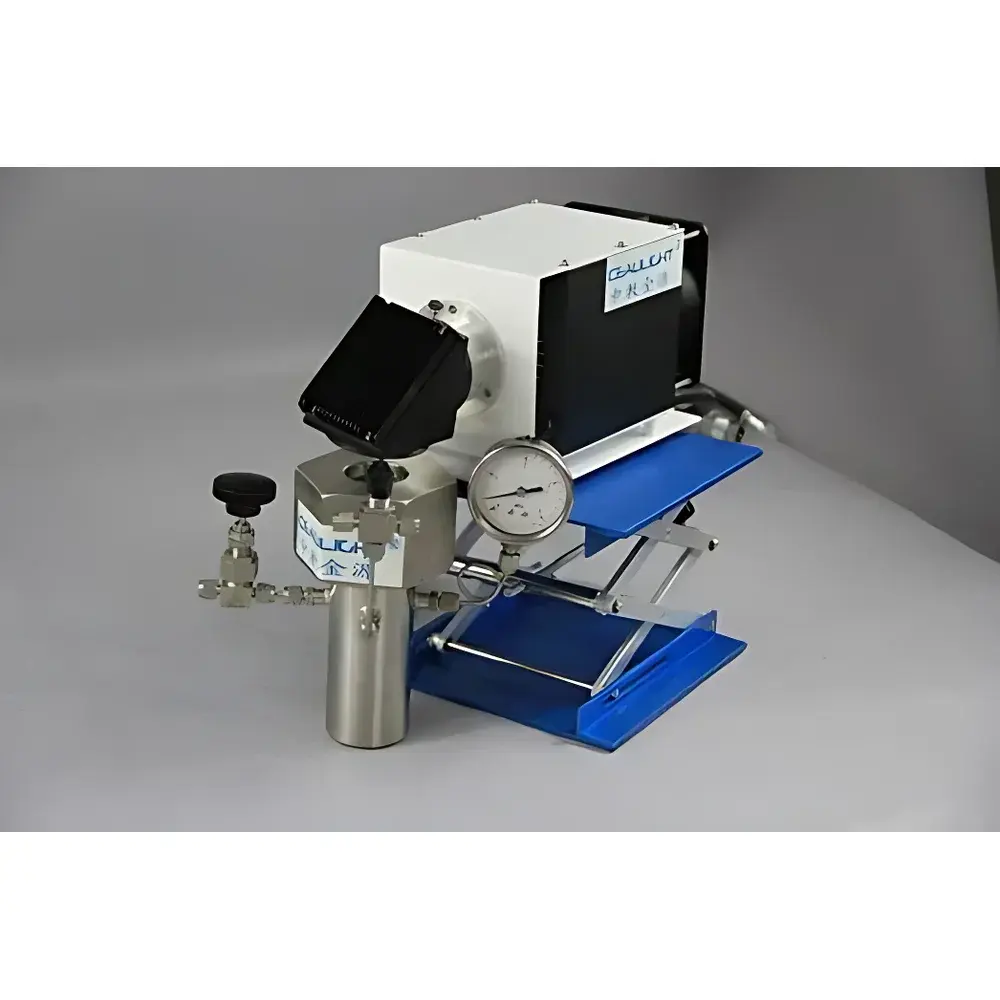
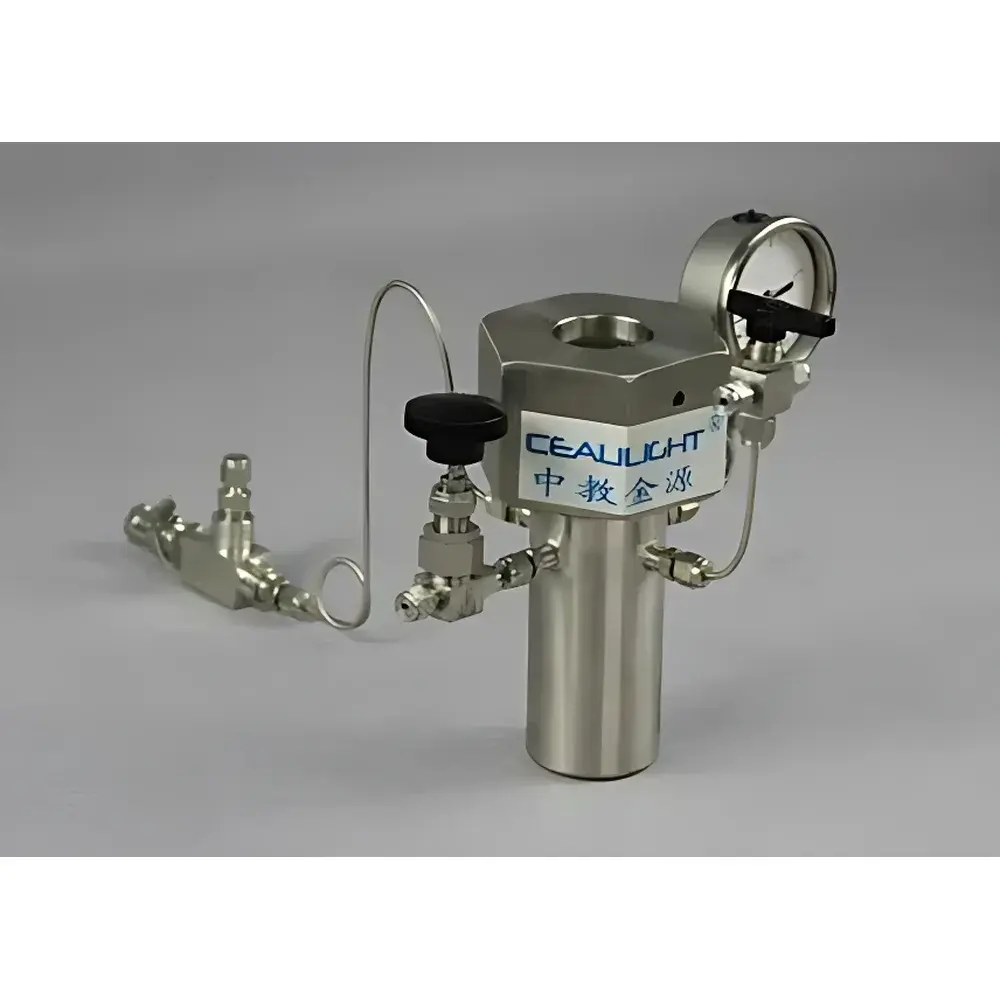
Ciltech CEL-HPR100 Photochemical High-Pressure Reactor
| Brand | Ciltech |
|---|---|
| Origin | Beijing, China |
| Manufacturer Type | Direct Manufacturer |
| Product Origin | Domestic (China) |
| Model | CEL-HPR100 |
| Capacity | 100 mL |
| Working Pressure | Up to 3.0 MPa |
| Material | Stainless Steel with PTFE Coating |
| Optical Window Material | Synthetic Fused Quartz (180–1100 nm transmission) |
| Sealing Type | Threaded Seal |
| Heating/Cooling | Integrated Embedded Heater + External Jacket Compatibility |
| Stirring | Magnetic Coupling Drive |
| Vacuum Level | ≤ 6.5 × 10⁻³ Pa (standard), optional down to 3.5 × 10⁻³ Pa |
| Interface Options | 4–8 Standard High-Pressure Ports (e.g., Swagelok® 1/4″ VCR) |
Overview
The Ciltech CEL-HPR100 Photochemical High-Pressure Reactor is an engineered platform for conducting controlled photochemical reactions under elevated pressure and inert or reactive gas atmospheres. It operates on the principle of simultaneous photon irradiation and pressurized reaction kinetics—enabling precise investigation of photocatalytic pathways where gas-phase reactants (e.g., CO₂, NOₓ, CH₄, H₂) interact with solid catalysts or liquid-phase substrates under UV–Vis–NIR illumination (180–1100 nm). Designed for laboratory-scale mechanistic studies and process screening, the reactor supports quantitative gas–liquid–solid triphasic reactions with real-time thermal regulation, making it especially suited for emerging applications in solar fuel synthesis, environmental remediation, and high-value fine chemical production. Its robust stainless steel construction, PTFE-coated internal surface, and threaded sealing architecture ensure long-term integrity at sustained pressures up to 3.0 MPa, while maintaining compatibility with GLP-compliant experimental workflows.
Key Features
- Threaded mechanical seal design ensures rapid, tool-free assembly/disassembly with repeatable leak-tight performance under cyclic pressure loading.
- Four standard high-pressure ports (expandable to eight) accommodate simultaneous gas dosing, in-situ gas sampling, liquid phase extraction, thermocouple insertion, and pressure transduction—all without breaking vacuum or interrupting reaction continuity.
- Optical window fabricated from synthetic fused quartz delivers broadband spectral transmission (180–1100 nm) with exceptional mechanical strength and thermal shock resistance—critical for focused irradiation and laser coupling applications.
- Integrated embedded heating element enables precise temperature control (±0.5 °C stability) during photoreaction; external jacket interface allows integration with circulatory chillers or heating baths for extended thermal range (-20 to 200 °C).
- Magnetic coupling stirrer maintains homogeneous mixing under high-pressure conditions without dynamic seals—eliminating contamination risk and enabling continuous 24-hour operation.
- Configurable gas delivery system supports programmable, time-resolved injection of multiple gases (e.g., CO₂/H₂ mixtures), synchronized with light-on/off cycles for kinetic profiling.
Sample Compatibility & Compliance
The CEL-HPR100 accommodates heterogeneous photocatalysts (e.g., TiO₂, g-C₃N₄, MOFs), suspended nanoparticle dispersions, and low-volume liquid substrates (<50 mL working volume). Its PTFE-coated interior resists corrosion from acidic, basic, or halogenated media commonly encountered in CO₂ reduction or VOC degradation chemistry. The reactor conforms to ASME B31.3 process piping design guidelines for pressure containment and meets ISO 10297:2014 requirements for portable gas cylinder valve interfaces when used with certified gas manifolds. All pressure-bearing components are hydrostatically tested to 1.5× maximum allowable working pressure (MAWP) and documented per manufacturer QA protocols. Optional explosion-proof membrane kits satisfy IEC 60079-0 hazardous area classification prerequisites for use in Class I, Division 1 environments.
Software & Data Management
While the base unit operates via analog instrumentation (mechanical pressure gauges, calibrated thermocouples), digital upgrade paths include integrated pressure sensors (0–5 MPa, ±0.25% FS) and Pt100 RTD probes linked to USB/RS485 data loggers. These enable time-stamped acquisition of T/P/gas composition traces—exportable as CSV for kinetic modeling in MATLAB®, Python (SciPy), or OriginLab®. When paired with validated third-party gas chromatography (GC-TCD/FID) or FTIR gas analyzers, the system supports full 21 CFR Part 11–compliant audit trails—including user authentication, electronic signatures, and immutable raw data archiving—required for regulatory submissions in pharmaceutical or industrial catalysis R&D.
Applications
- Photocatalytic CO₂ hydrogenation to CH₃OH, CH₄, or C₂₊ hydrocarbons under tunable pCO₂/pH₂ partial pressures.
- NOₓ abatement via visible-light-driven reduction using plasmonic Ag/TiO₂ or defect-engineered BiVO₄.
- High-pressure photolytic degradation of formaldehyde and other indoor air pollutants in aqueous suspension.
- Kinetic isotope effect (KIE) studies using D₂O or ¹³CO₂ tracers under controlled illumination and pressure regimes.
- Screening of novel photocatalyst formulations under industrially relevant conditions (T = 25–120 °C, P = 0.5–3.0 MPa).
FAQ
What spectral range is transmitted through the optical window?
The synthetic fused quartz viewport provides ≥90% transmittance across 180–1100 nm, covering deep UV (excimer lamps), near-UV (mercury lines), visible (LED arrays), and NIR (tungsten-halogen sources).
Can the reactor be operated under vacuum prior to gas pressurization?
Yes—the system achieves base vacuum levels of ≤6.5 × 10⁻³ Pa using standard turbomolecular pumping; optional upgrades reach ≤3.5 × 10⁻³ Pa for ultra-trace impurity exclusion.
Is magnetic stirring effective at 3.0 MPa?
Yes—magnetic coupling torque transmission remains stable up to 3.0 MPa due to optimized stator-rotor gap geometry and high-coercivity NdFeB magnets rated for >200 °C continuous operation.
Are custom port configurations available?
Yes—Ciltech offers OEM engineering support for non-standard flange types (CF, KF, ANSI), specialized sensor integration (pH, DO, IR absorption cells), and reactor manifold assemblies compliant with client-specific automation protocols.
Related Products



