
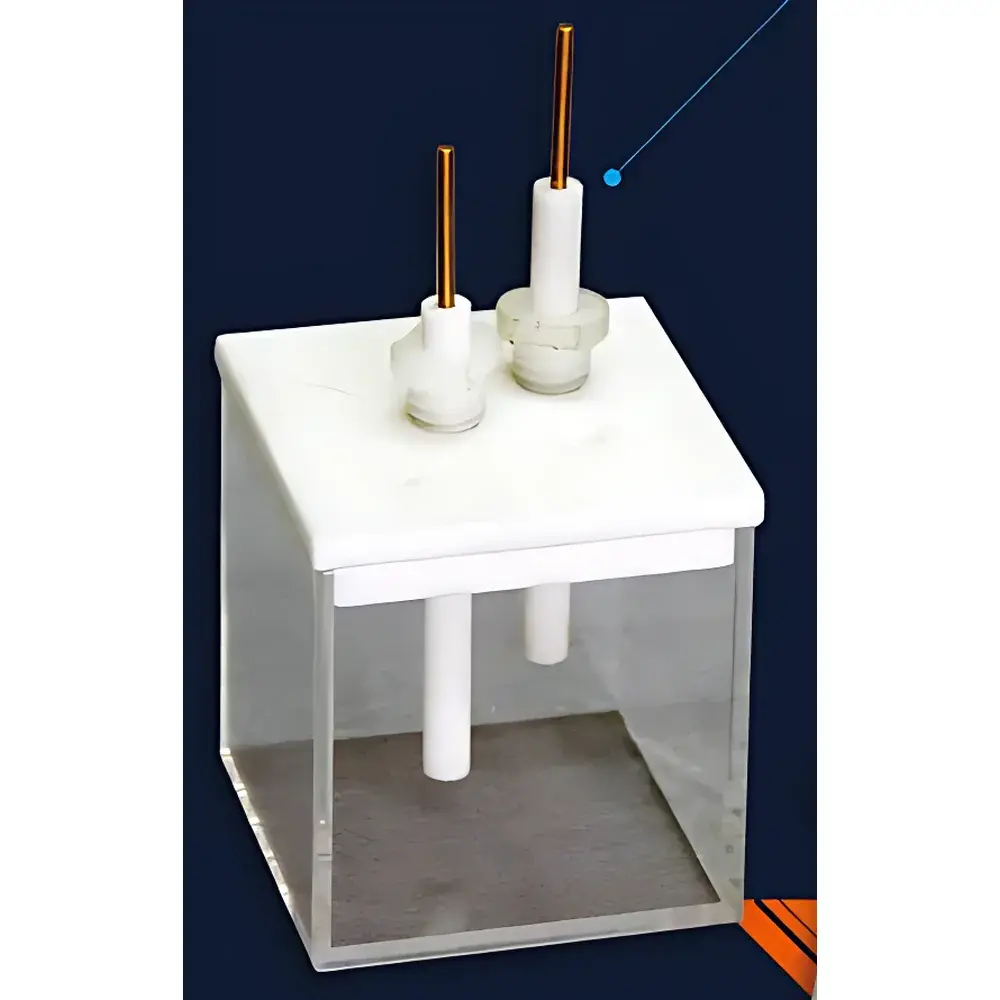
CEL-CPE50 Quartz Photoelectrochemical Reaction Cell
| Brand | CEL (Zhongjiao Jinyuan) |
|---|---|
| Origin | Beijing, China |
| Manufacturer Type | OEM Producer |
| Origin Category | Domestic (China) |
| Model | CEL-CPE50 |
| Price | USD 845 (converted from ¥5976 at 1 USD ≈ ¥7.07) |
| Body Material | UV-Grade Fused Quartz |
| Dimensions | 50 × 50 × 50 mm |
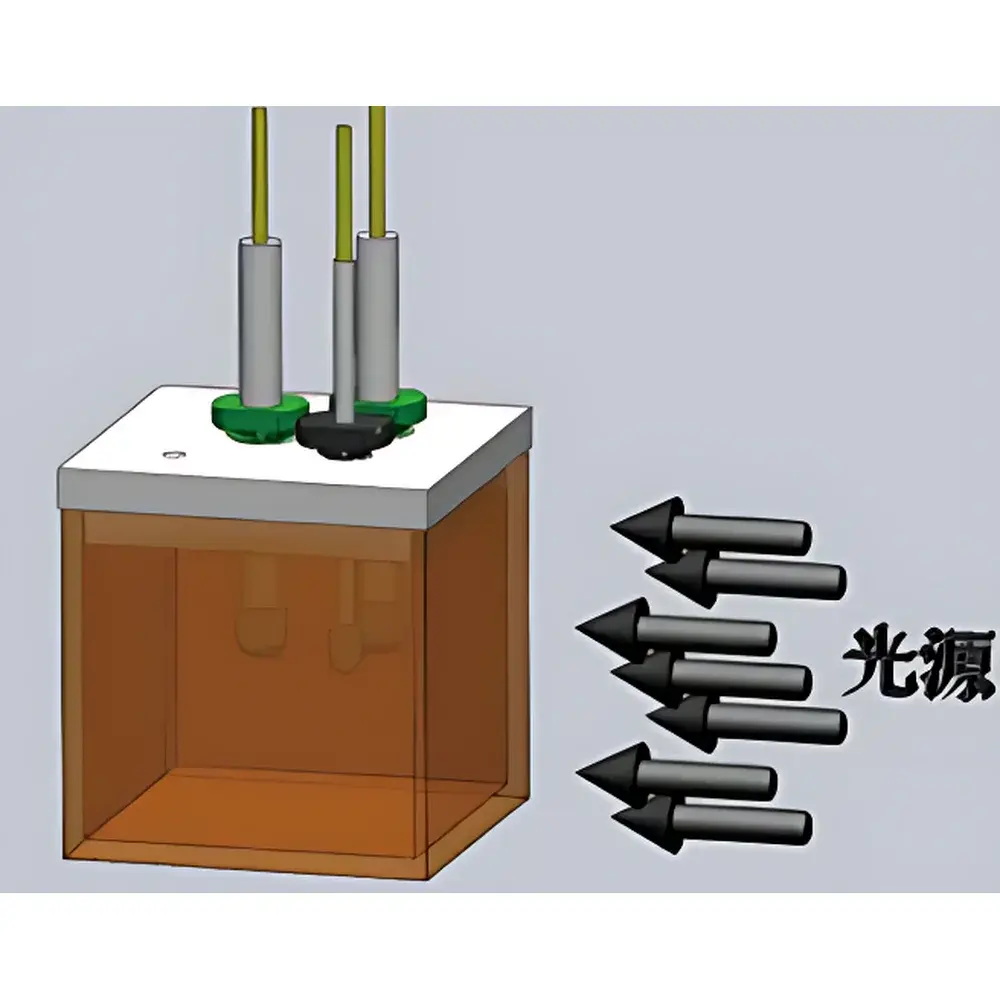
| Optical Configuration | Four-Sided Illumination |
| Transmission Range | 190–2500 nm |
| Electrode Compatibility | Three-Electrode System (WE/CE/RE) |
| Optional Features | PTFE Sealing Cap, Gas Inlet/Outlet Ports, Inert Atmosphere Purging |
Overview
The CEL-CPE50 Quartz Photoelectrochemical Reaction Cell is an engineered optical-electrochemical measurement platform designed for quantitative incident photon-to-current efficiency (IPCE) and action spectrum analysis in photoelectrocatalytic research. Built on the principles of controlled three-electrode electrochemistry coupled with spectrally resolved irradiance delivery, the cell enables simultaneous illumination from four orthogonal faces—facilitating uniform photon flux distribution across the electrode/solution interface and minimizing edge-shadowing effects. Its monolithic construction from high-purity fused quartz ensures exceptional UV transparency (down to 190 nm), thermal stability up to 800 °C, and chemical inertness against strong acids, bases, and organic solvents—critical for long-term stability during photocorrosion studies or oxidative water splitting experiments. The cell integrates seamlessly with CEL-SL series solar simulators and quantum yield measurement systems, supporting both front-side and back-side illumination configurations for comparative photophysical analysis.
Key Features
- Four-face optical access via precision-fused quartz walls—enables concurrent irradiation and independent measurement of incident and transmitted irradiance using calibrated photodiodes or integrating spheres.
- Standardized 50 mm cubic geometry (50 × 50 × 50 mm) optimized for reproducible light path length (10 mm effective optical path in standard orientation) and compatibility with commercial optical benches and goniometric mounts.
- Modular electrode interface accommodating standard 3 mm diameter working electrodes (e.g., FTO, ITO, or metal-oxide films on conductive substrates), platinum wire counter electrodes, and reversible reference electrodes (Ag/AgCl or SCE).
- Gas-tight sealing system with chemically resistant PTFE cap and dual stainless-steel gas ports—supports continuous N₂ or Ar purging to maintain O₂-free conditions during reduction-focused experiments (e.g., CO₂ photoreduction).
- No internal adhesives or epoxy joints—quartz body formed by direct high-temperature fusion, eliminating leaching artifacts and ensuring spectral integrity across UV-VIS-NIR.
Sample Compatibility & Compliance
The CEL-CPE50 accommodates liquid-phase electrolytes (aqueous and non-aqueous), colloidal suspensions, and thin-film photoanodes/cathodes deposited on transparent conductive substrates. It supports standard electrochemical techniques including linear sweep voltammetry (LSV), chronoamperometry (CA), and electrochemical impedance spectroscopy (EIS) under controlled illumination. The cell meets dimensional and material requirements specified in ASTM E2583–17 (Standard Practice for Measuring Incident Photon-to-Current Efficiency) and aligns with ISO 15714:2020 guidelines for optical characterization of photoactive materials. Its all-quartz construction complies with GLP laboratory practices for trace-metal-free operation and avoids interference in ICP-MS post-reaction analysis.
Software & Data Management
When paired with CEL-SL series instrumentation, the CEL-CPE50 interfaces with CEL-Quantum software (v4.2+), which implements automated wavelength-resolved IPCE calculation per IEC 60904-8 Ed.3:2022. The software logs timestamped irradiance values (W/m²/nm), applied potential (V vs. RHE), current density (mA/cm²), and calculated quantum efficiency (%) with audit-trail metadata compliant with FDA 21 CFR Part 11 requirements—including user authentication, electronic signatures, and immutable data export (CSV, HDF5). Raw spectral irradiance data can be exported for third-party radiometric calibration using NIST-traceable reference detectors.
Applications
- Quantitative IPCE mapping of metal oxide photoanodes (e.g., BiVO₄, Fe₂O₃, WO₃) under AM1.5G and monochromatic illumination.
- In situ monitoring of photocorrosion kinetics via time-resolved photocurrent decay under constant bias and variable wavelength excitation.
- Comparative evaluation of co-catalyst loading effects on charge separation efficiency using dual-beam differential photocurrent measurements.
- Photoelectrochemical impedance spectroscopy (PEIS) under open-circuit and biased conditions to extract surface state density and charge transfer resistance.
- Gas-phase product quantification (H₂, O₂, CO, CH₄) in sealed-cell configurations with online GC coupling via integrated gas sampling valves.
FAQ
Can the CEL-CPE50 be used with non-aqueous electrolytes such as acetonitrile or DMF?
Yes—the fused quartz body and PTFE cap are chemically compatible with common aprotic solvents; however, prolonged exposure to hot DMF (>60 °C) may affect PTFE seal integrity and is not recommended for extended thermal cycling.
Is the cell suitable for high-intensity pulsed laser irradiation?
It supports nanosecond-to-millisecond pulsed sources within the 190–2500 nm range; however, peak fluence must remain below 100 mJ/cm² per pulse to avoid quartz ablation or thermal shock cracking.
Does the cell include electrical feedthroughs for three-electrode wiring?
No—electrical connections are made externally via spring-loaded contacts or soldered leads passing through gas-tight bushings; users must supply compatible feedthroughs rated for vacuum or inert gas environments.
What is the maximum operating temperature?
The quartz body withstands continuous operation up to 200 °C; however, PTFE components limit safe sealing temperature to 130 °C—alternative Kalrez® or Viton® caps are available upon request for elevated-temperature applications.
How is optical alignment verified prior to IPCE measurement?
A collimated He–Ne laser (632.8 nm) and alignment pinhole kit (included with CEL-SL systems) are used to confirm coaxiality of all four optical paths; angular deviation tolerance is ±0.5° relative to the central electrode plane.
Related Products



