
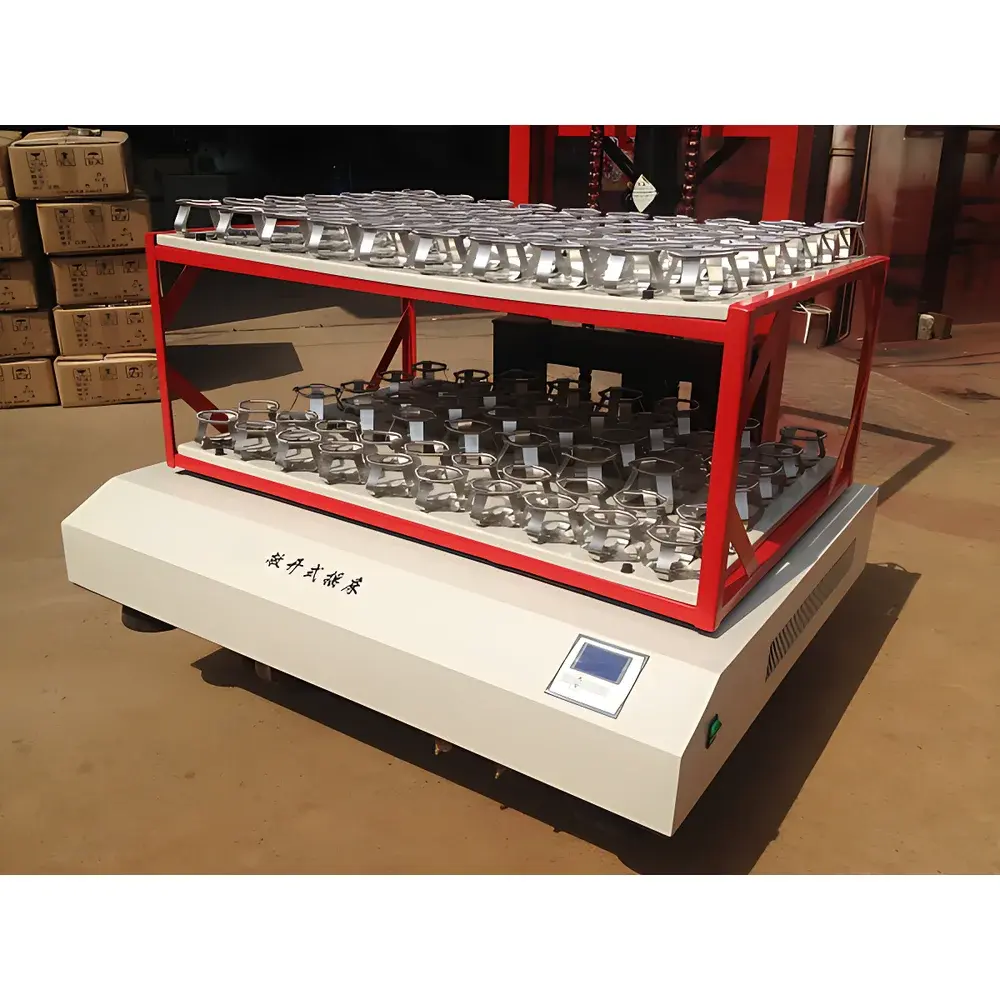
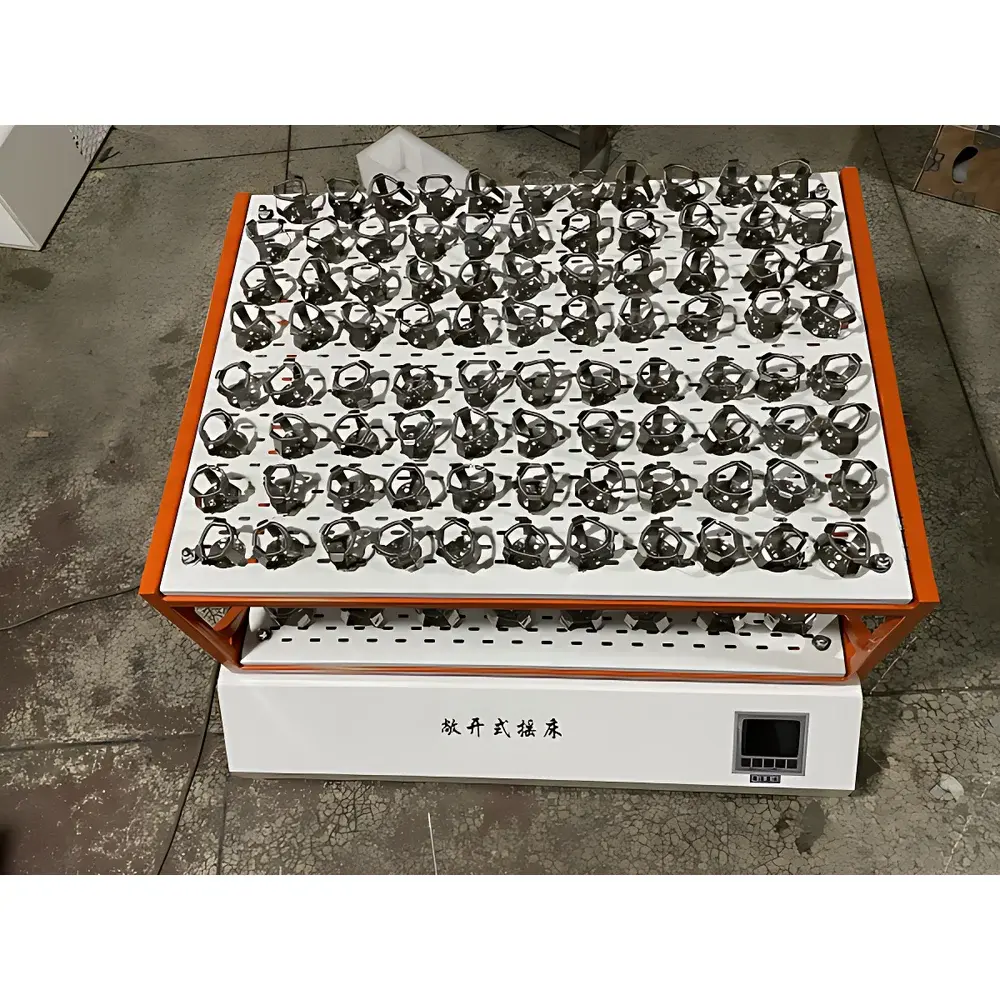
Zhongke Aobo TS-3112 Dual-Layer Open-Air Orbital Shaker
| Brand | Zhongke Aobo |
|---|---|
| Origin | Beijing, China |
| Model | TS-3112 (Dual-Layer) |
| Instrument Type | Air-Bath Constant-Temperature Orbital Shaker / Platform Shaker |
| Timer Range | 0–9999 min |
| Oscillation Speed | 20–300 rpm |
| Orbit Diameter | 26 mm |
| Temperature Control | Ambient-only (No heating/cooling) |
| Tray Quantity | 2 |
| Display | LCD |
| Speed Accuracy | ±1 rpm |
| Tray Dimensions | 800 × 600 mm (per layer) |
| Power | 250 W |
| Input | AC 220 V ±10%, 50 Hz ±2% |
| Construction | 304 Stainless Steel Deck |
| Drive Mechanism | Triple-Eccentric Balanced Shaft |
| Motor | Brushless DC Motor |
| Programming | Multi-Stage Programmable (Optional) |
| Safety | Auto-stop on speed deviation, power-fail parameter retention, soft-start |
Overview
The Zhongke Aobo TS-3112 Dual-Layer Open-Air Orbital Shaker is an engineered platform shaker designed for scalable, reproducible suspension culture of microbial, mammalian, and insect cells in Erlenmeyer flasks, baffled bottles, and other vented vessels. Unlike enclosed incubator shakers, this open-air configuration prioritizes accessibility, rapid heat dissipation, and compatibility with ambient-temperature aerobic cultivation workflows—particularly where precise temperature control is not required, but consistent orbital motion, mechanical stability, and long-term operational reliability are critical. Its core mechanism employs a triple-eccentric balanced shaft drive system, ensuring uniform angular velocity distribution across the entire tray surface—eliminating edge-to-center speed gradients commonly observed in single-cam or eccentric-rod designs. This architecture supports high-load operation (up to 20 kg per tray) at maximum speed (300 rpm) without resonance-induced vibration or mechanical drift, making it suitable for extended unattended runs in QC labs, bioprocess development suites, and academic fermentation studies.
Key Features
- Brushless DC motor with high starting torque and wide-speed regulation (20–300 rpm), enabling low-noise, low-heat, maintenance-free continuous operation—validated for >72-hour uninterrupted duty cycles.
- Triple-eccentric balanced drive mechanism ensures mechanical synchronization across all positions on both trays; eliminates differential shear stress between peripheral and central vessels.
- LCD interface with real-time dual-parameter display: setpoint vs. actual speed and timer countdown; supports both manual mode and multi-stage programmable sequences (optional firmware upgrade).
- Microprocessor-controlled soft-start function prevents sample splashing during acceleration and mitigates mechanical shock during startup/shutdown.
- 304 stainless steel deck surface—non-porous, corrosion-resistant, and autoclavable; detachable for thorough cleaning and decontamination between batches.
- Integrated safety logic monitors rotational speed continuously; triggers immediate shutdown if deviation exceeds ±3 rpm from setpoint, preventing motor overload or vessel ejection.
- Non-volatile memory retains user-defined parameters—including speed, time, and program steps—during unexpected power interruption, resuming from last known state upon restoration.
Sample Compatibility & Compliance
The TS-3112 accommodates standard laboratory glassware and plastic vessels up to 2 L capacity per position, including 250 mL, 500 mL, 1 L, and 2 L Erlenmeyer flasks (baffled or non-baffled), serum bottles, and shake tubes. Standard configurations support up to 60 × 500 mL flasks (dual-layer) or 70 × 1 L flasks (single-layer variant). The open-platform design complies with ISO 20957-3 (fitness equipment — stationary training equipment — Part 3: Additional specific safety requirements for strength training equipment) for mechanical stability and structural integrity under dynamic load. While not certified for GMP environments out-of-the-box, its construction materials (304 SS, UL-listed power supply, RoHS-compliant PCBs), traceable firmware versioning, and audit-ready parameter logging (via optional RS-232/USB data export) align with GLP documentation expectations for non-regulated R&D use. It meets IEC 61000-6-3 (EMC emission) and IEC 61000-6-2 (immunity) standards for laboratory electromagnetic environments.
Software & Data Management
The embedded microcontroller supports basic local data logging: timestamped speed, elapsed time, and fault events (e.g., over-speed, under-speed, power loss) stored in internal EEPROM (retention >10 years). Optional USB or RS-232 interface enables connection to external PCs running custom Python- or LabVIEW-based acquisition scripts for trend analysis, batch record generation, and CSV export. Firmware updates are performed via UART bootloader—no proprietary software required. For regulated environments requiring electronic records, third-party SCADA integration (e.g., Ignition, WinCC OA) is supported through Modbus RTU protocol (add-on module). Audit trail functionality—including operator ID tagging, change history, and digital signature fields—is available via optional 21 CFR Part 11-compliant middleware deployment.
Applications
- Microbial growth kinetics studies (E. coli, yeast, Bacillus spp.) under aerobic, ambient-temperature conditions.
- Seed train expansion for upstream bioprocessing—especially where scalability from shake flask to benchtop bioreactor is validated.
- Enzyme production and screening assays requiring homogeneous mixing without shear-sensitive cell lysis.
- Media optimization trials involving variable agitation rates and vessel fill volumes.
- Environmental microbiology: soil slurry homogenization, water sample mixing prior to filtration or plating.
- Cell line adaptation protocols where gradual ramp-up of agitation intensity supports metabolic transition.
FAQ
Does the TS-3112 include heating or cooling capability?
No. It is an ambient-only open-air shaker. Temperature control requires external environmental chambers or incubators.
Can both trays operate at independent speeds?
No. Both trays are mechanically coupled and run at identical speed and timing parameters.
Is the 26 mm orbit diameter adjustable?
No. The orbit is fixed at 26 mm (Φ26 mm), optimized for oxygen transfer efficiency in standard Erlenmeyer flasks.
What is the maximum load per tray?
Rated capacity is 20 kg per tray at 300 rpm, verified per ISO 10816-3 vibration severity thresholds.
Is calibration documentation provided?
Factory calibration certificate (speed accuracy ±1 rpm, timer accuracy ±0.1%) is included; traceable to NIM (National Institute of Metrology, China) standards.




