
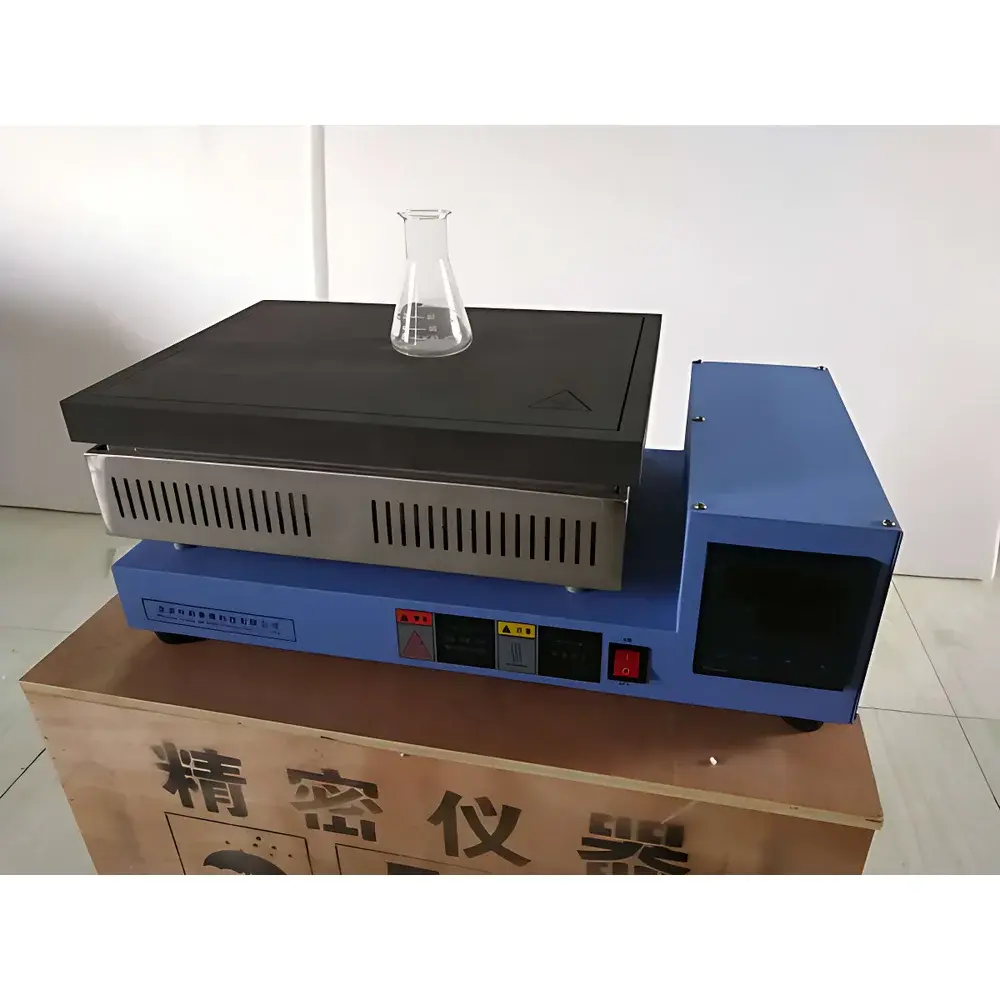
Zhongke Aobo SM-35-45 Graphite Electric Heating Plate
| Brand | Zhongke Aobo |
|---|---|
| Origin | Beijing, China |
| Manufacturer Type | Authorized Distributor |
| Country of Origin | China |
| Model | SM-35-45 |
| Price | USD 1,550 (approx.) |
| Heating Power | 3.5 kW |
| Max. Operating Temperature | 450 °C |
| Temperature Uniformity | ±1–3 °C across surface |
| Plate Dimensions | 400 × 300 mm |
| Heating Zone Dimensions | 400 × 300 mm |
| Display | Digital LED |
Overview
The Zhongke Aobo SM-35-45 Graphite Electric Heating Plate is a precision-engineered sample preparation instrument designed for high-temperature, chemically aggressive applications in analytical laboratories. It operates on resistive heating principles, utilizing a monolithic block of isostatically pressed, ultra-high-purity graphite as the active thermal mass. This architecture ensures rapid thermal response, exceptional lateral heat distribution, and long-term stability under sustained exposure to concentrated mineral acids (e.g., HNO₃, HCl, HF, H₂SO₄) and alkaline media. Unlike traditional ceramic or aluminum hotplates, the graphite core minimizes thermal lag and eliminates hot-spot formation—critical for reproducible digestion kinetics in EPA Method 3050B, ISO 11466, and USP compliant workflows. The unit is engineered for integration into regulated environments supporting ICP-OES, ICP-MS, AAS, and HG-AFS sample introduction pipelines, particularly during open-vessel acid digestion, acid evaporation (‘gassing off’), and pre-microwave digestion conditioning.
Key Features
- Isostatically pressed, high-purity graphite heating surface (99.99% C), 30 mm thick, offering superior thermal conductivity (>120 W/m·K), chemical inertness, and mechanical stability up to 450 °C.
- PID-based digital temperature control with ±1 °C accuracy over full range; programmable ramp-hold profiles support multi-stage heating protocols (e.g., slow ramp to 120 °C for organic matrix decomposition, hold at 180 °C for HNO₃/HF digestion, final ramp to 220 °C for complete HClO₄ fuming).
- Dual-layer thermal insulation: outer steel enclosure with air gap + inner refractory ceramic fiber (silica-alumina) barrier, reducing surface casing temperature to <60 °C at maximum setpoint and improving energy efficiency by ~35% vs. single-wall designs.
- Corrosion-resistant industrial-grade epoxy-polyester powder coating (ISO 2093 Class 2) applied to all non-graphite structural components; validated for continuous operation in ambient fume hood environments with >95% RH and repeated splashing of 6 M HCl or 48% HF.
- Large uniform heating zone (400 × 300 mm) accommodating up to twelve 50-mL PTFE or quartz digestion vessels simultaneously—optimized for throughput in QC/QA labs processing environmental soils, biological tissues, or pharmaceutical excipients.
Sample Compatibility & Compliance
The SM-35-45 accommodates standard digestion vessel formats including borosilicate glass beakers (up to 1 L), PTFE (Teflon™) and PFA vials (15–100 mL), quartz crucibles, and ceramic boats. Its inert graphite surface eliminates metal leaching risks—essential for trace-element analysis where background contamination must remain below sub-ng/g detection limits. The system complies with GLP documentation requirements via timestamped temperature logging (when paired with optional RS-485 interface), supports audit-ready operation per FDA 21 CFR Part 11 when integrated with validated LIMS platforms, and meets mechanical safety standards per IEC 61010-1:2010 (Equipment for Laboratory Use). It is routinely deployed in laboratories accredited to ISO/IEC 17025:2017 for testing competence.
Software & Data Management
While the base SM-35-45 operates via front-panel keypad and real-time LED display, an optional RS-485 serial interface enables bidirectional communication with PC-based control software (Windows/Linux compatible). This allows remote parameter setting, real-time temperature curve acquisition at 1 Hz resolution, automated report generation (CSV/PDF), and synchronization with laboratory information management systems (LIMS). All temperature events—including setpoint changes, alarm triggers, and power-on/off cycles—are time-stamped and stored locally (non-volatile memory, 10,000-event capacity), fulfilling ALCOA+ data integrity criteria for regulated industries.
Applications
- Open-vessel acid digestion of environmental samples (sediments, sludges, plant tissues) per EPA SW-846 Method 3050B and 3051A.
- Gassing-off (‘赶酸’) of digests prior to ICP-MS analysis to eliminate residual nitric or hydrofluoric acid without volatile element loss.
- Pre-concentration of aqueous extracts for heavy metal speciation (e.g., As(III)/As(V), Cr(III)/Cr(VI)) using controlled evaporation.
- Thermal conditioning of catalysts, battery electrode slurries, or polymer precursors in materials R&D labs.
- Controlled drying and charring of food matrices (e.g., infant formula, cereals) prior to ashing in muffle furnaces.
FAQ
What is the maximum recommended operating temperature for continuous use?
The graphite plate is rated for continuous operation at ≤420 °C; 450 °C is specified as short-term peak capability (≤30 min), beyond which long-term thermal degradation accelerates.
Can the heating plate be used inside a fume hood with active airflow?
Yes—its low external surface temperature and absence of exposed heating coils make it suitable for Class I and II biosafety cabinets and ducted fume hoods; airflow rates up to 1.2 m/s do not impair temperature stability.
Is calibration traceable to national standards?
The unit ships with a factory calibration certificate (NIST-traceable Pt100 reference probe); users may perform in-house verification using a calibrated thermocouple reader per ASTM E220.
Does the controller support multiple independent zones?
No—the SM-35-45 features a single-zone control architecture optimized for uniformity across the full 400 × 300 mm surface; multi-zone variants (e.g., SM-55-45) are available upon request.
What maintenance is required to ensure longevity?
Routine cleaning with deionized water and lint-free cloth after each use; annual inspection of PID sensor contact integrity and enclosure grounding resistance (must remain <1 Ω per IEC 61010).



