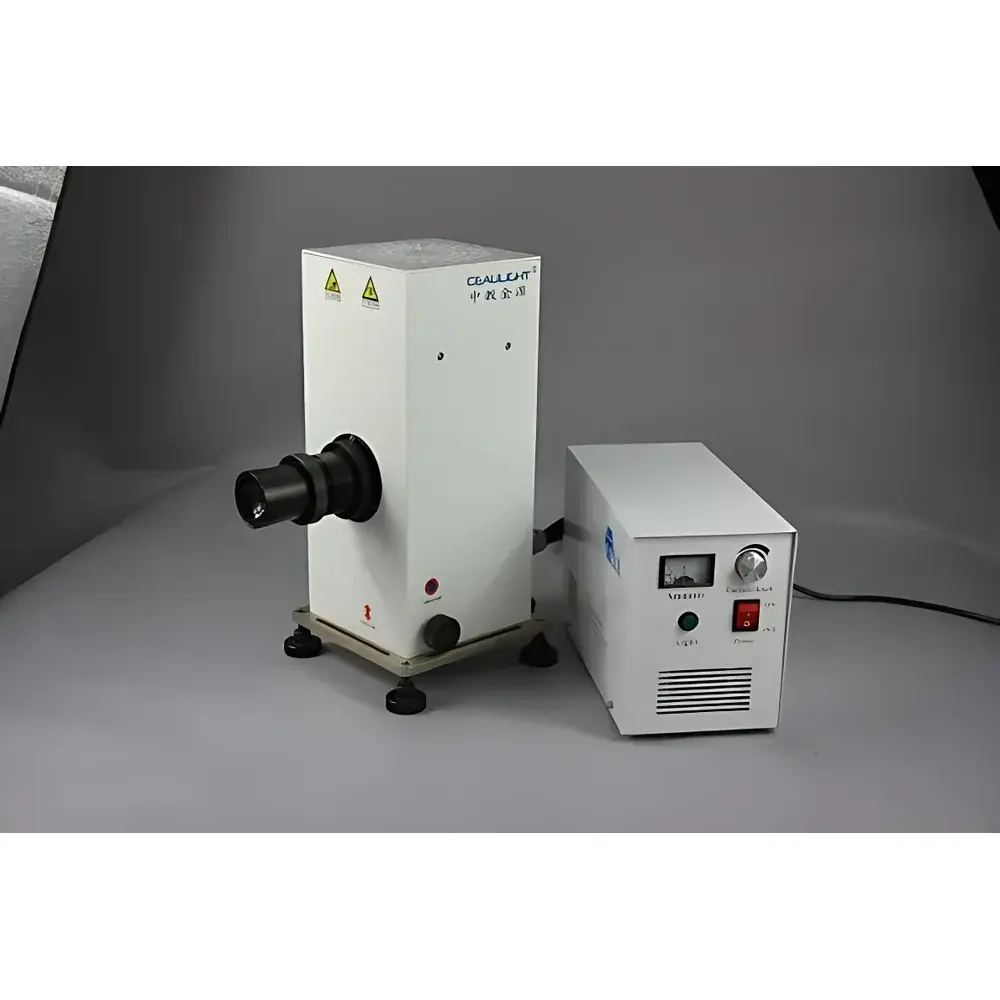
CEL-M500 / CEL-M350 High-Uniformity, High-Stability Mercury Arc Lamp Light Source
| Brand | CEAULIGHT (CEL) |
|---|---|
| Model | CEL-M500 / CEL-M350 |
| Light Source Type | Medium-Pressure Short-Arc Mercury Lamp |
| Illumination Mode | External Irradiation Configuration |
| Spectral Output Range | 185–1100 nm |
| Radiant Output Power | 15 W (CEL-M500) / 10 W (CEL-M350) |
| Output Power Density | 0.5–5 Sun (CEL-M500), 0.5–3 Sun (CEL-M350) |
| Beam Diameter | ≥60 mm (circular uniform irradiation field) |
| Stability | ≤1% RMS over 8 h |
| Lamp Lifetime | >800 h |
| Cooling Method | Forced-air convection |
| Compatible Filter Mounts | SM25.4, SM50.8, M52, M62 |
| Standard UV Bandpass Filters | 254, 313, 334, 350, 365, 380, 400, 405 nm |
| Filter Substrate Options | Fused silica (UV-grade quartz), BK7, K9, reflective aluminum-coated substrates |
Overview
The CEL-M500 and CEL-M350 are research-grade medium-pressure short-arc mercury vapor lamp light sources engineered for high spectral irradiance and exceptional temporal stability in the ultraviolet (UV) and near-visible spectral regions. These systems operate on the principle of high-frequency, high-voltage arc discharge within a sealed quartz envelope containing mercury vapor — generating intense line-dominated emission across 185–1100 nm, with pronounced peaks at 254 nm (resonance line), 313 nm, 365 nm (i-line), and 405 nm. Unlike broadband thermal or LED sources, mercury arc lamps deliver discrete, high-photon-flux spectral lines ideal for wavelength-selective photochemical activation, enabling precise control over reaction pathways in photocatalysis, photolysis, surface photoetching, and UV-curable synthesis. The optical architecture is optimized for external irradiation geometry, ensuring collimated, uniform illumination over a ≥60 mm circular field — critical for reproducible quantum yield measurements and spatially resolved reactor testing.
Key Features
- Stable arc ignition and maintenance via high-frequency electronic ballast (20–50 kHz), minimizing electrode sputtering and extending lamp lifetime beyond 800 hours
- Active thermal management using dual-stage forced-air cooling to maintain lamp wall temperature within ±2°C, ensuring <1% RMS irradiance drift over 8-hour continuous operation
- Modular mechanical design compatible with standard optical mounts (SM25.4, SM50.8, M52, M62), allowing seamless integration of UV-grade fused silica bandpass filters, plano-convex focusing lenses, and liquid light guides
- Calibrated radiant output power density (0.5–5 Sun for CEL-M500; 0.5–3 Sun for CEL-M350), traceable to NIST-traceable reference detectors (e.g., CEL-NP2000 radiometer)
- Interchangeable accessory compatibility with CEL-HX (xenon) and CEL-S series platforms — enabling hybrid light source configurations for multi-wavelength irradiation studies
Sample Compatibility & Compliance
The CEL-M series is designed for use with solid-state photocatalysts (e.g., TiO₂, g-C₃N₄, ZnO thin films), suspended nanoparticle colloids, gas-phase VOC mixtures in flow reactors, and micro-patterned photoresist layers. All optical components comply with ISO 10110-7 (surface quality of optical elements) and ASTM E275 (standard practices for UV spectrophotometry). Quartz envelopes meet USP requirements for UV-transmitting pharmaceutical-grade materials. The system supports GLP-compliant experimental workflows when paired with audit-trail-enabled radiometric calibration logs and timestamped irradiance monitoring records.
Software & Data Management
While the CEL-M series operates as a stand-alone analog light source, it integrates with third-party digital radiometry platforms (e.g., Ocean Insight spectrometers, Thorlabs PM100D power meters) via analog voltage output (0–5 V DC proportional to irradiance). When used with CEL’s optional NP2000 radiometer, users obtain real-time irradiance logging in CSV format with millisecond resolution, supporting post-acquisition spectral weighting (e.g., AM1.5G, UVA/UVB/UVC action spectra) per ISO 17025-accredited data reduction protocols. No proprietary software is required; all measurement files are natively compatible with MATLAB, Python (NumPy/Pandas), and OriginLab for kinetic modeling and actinometry.
Applications
- Quantitative photocatalytic degradation kinetics (e.g., methylene blue, phenol, NOₓ under 254/365 nm excitation)
- UV lithography process development and photoresist sensitivity mapping
- Photostability assessment of pharmaceuticals and polymers per ICH Q1B guidelines
- Photoelectrochemical cell characterization under monochromatic illumination (with appropriate bandpass filtering)
- Actinometric calibration of chemical actinometers (e.g., potassium ferrioxalate, Aberchrome 540)
- Time-resolved fluorescence quenching studies requiring stable UV pulsed or CW excitation
FAQ
What safety certifications does the CEL-M500/M350 hold?
The system complies with IEC 61000-6-3 (EMC emissions) and IEC 61000-6-2 (immunity); UV enclosure interlocks and ozone venting ports meet EN 60204-1 machinery safety standards.
Can the lamp output be intensity-modulated?
Yes — analog 0–5 V input allows external TTL or PWM-based dimming control down to 10% nominal power without arc instability.
Is ozone generation a concern during operation?
Below 200 nm emission produces ozone; built-in exhaust port (Ø12 mm) enables connection to active carbon scrubbers or fume hoods per OSHA PEL limits (0.1 ppm 8-hr TWA).
How is spectral output validated?
Each unit ships with a factory-measured spectral irradiance curve (1 nm resolution, 185–1100 nm), acquired using an AULTT-P series fiber-coupled spectrometer calibrated against NIST SRM 2031.
Are replacement lamps and filters supplied with NIST-traceable calibration certificates?
Yes — optional certified lamp sets include spectral irradiance reports traceable to NIST SRM 1935 (deuterium lamp) and SRM 2031 (tungsten halogen), issued by an ILAC-MRA accredited laboratory.