
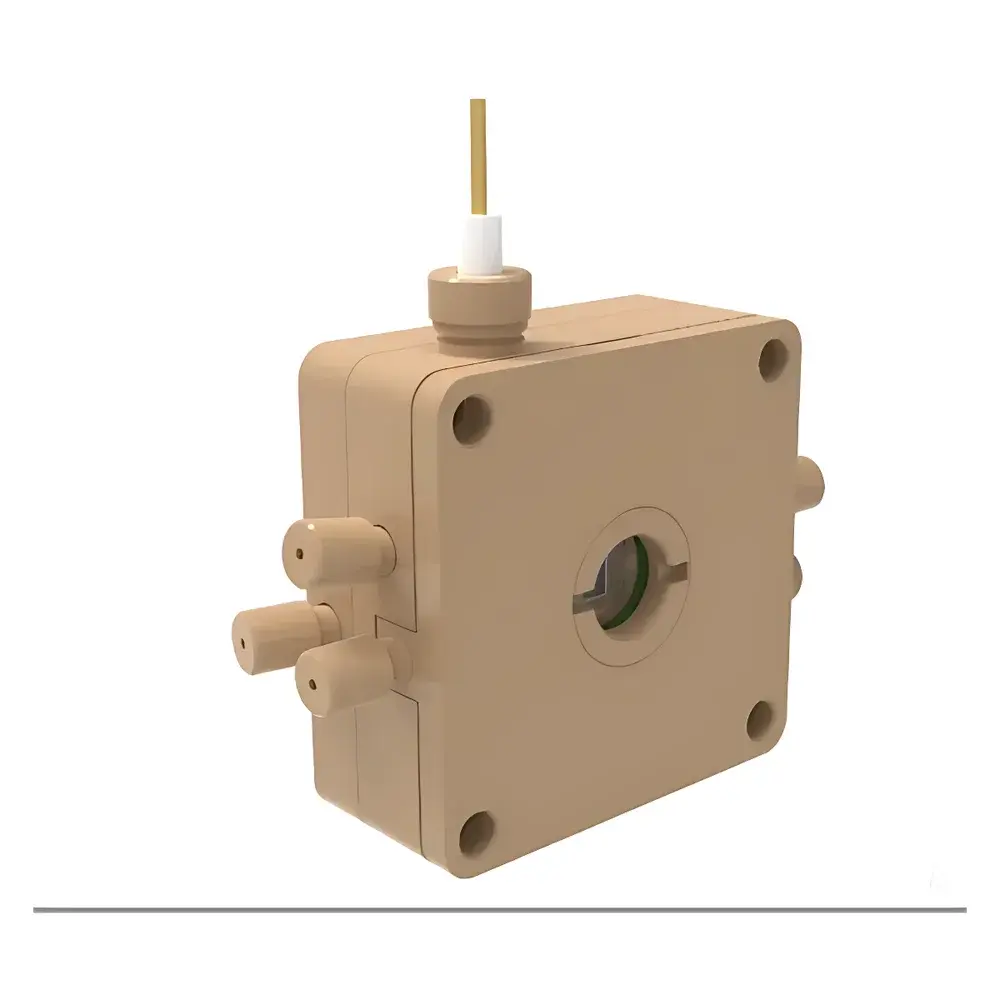
CEL-PERT02 Flow-Type Photoelectrocatalytic Reactor
| Brand | CEA (Zhongjiao Jinyuan) |
|---|---|
| Origin | Beijing, China |
| Manufacturer Type | OEM Producer |
| Country of Origin | China |
| Model | CEL-PERT02 |
| Pricing | Upon Request |
Overview
The CEL-PERT02 Flow-Type Photoelectrocatalytic Reactor is a precision-engineered electrochemical cell designed for continuous-flow photoelectrocatalytic studies involving CO₂ reduction, N₂ fixation, and O₂ evolution under controlled illumination and electrochemical bias. It operates on the principle of coupled photoexcitation and electrochemical charge transfer—where incident photons generate electron–hole pairs in a photoactive working electrode (typically a gas diffusion electrode, or GDE), while an applied potential drives interfacial redox reactions with high Faradaic efficiency. Its compact, low-volume architecture enables rapid mass transport, minimizes ohmic drop, and supports kinetic studies under true steady-state flow conditions—critical for quantifying turnover frequency (TOF), product selectivity, and long-term catalyst stability.
Key Features
- Ultra-Short Inter-Electrode Gap: Optimized electrode spacing (<1 mm) significantly reduces solution resistance (Rs) and cell voltage requirements—enabling stable operation with standard potentiostats (±10 V compliance range) without necessitating high-voltage instrumentation.
- Gas Diffusion Electrode (GDE) Integration: Designed for direct mounting of hydrophobic/hydrophilic GDEs on the working electrode side, facilitating efficient three-phase (gas–liquid–solid) boundary formation and maximizing reactant (CO₂/N₂/O₂) availability at the catalyst surface.
- Chemically Inert PEEK Construction: Entire cell body, end caps, and fluidic interfaces are machined from medical-grade polyether ether ketone (PEEK), ensuring exceptional resistance to strong acids, bases, organic solvents, and oxidative environments across pH 0–14 and temperatures up to 120 °C.
- Modular & Tool-Free Assembly: Snap-fit sealing mechanism and standardized 1/16″ Swagelok-compatible ports allow rapid disassembly, electrode replacement, and cleaning—minimizing downtime between experiments and supporting reproducible cell conditioning protocols.
- Low Dead Volume Architecture: Total internal volume of 0.96 mL ensures minimal residence time dispersion, enabling precise residence time control (τ = V/Q) and accurate correlation between flow rate, current density, and product formation rates.
Sample Compatibility & Compliance
The CEL-PERT02 accommodates standard 5–10 mm diameter disk-type GDEs or custom-patterned electrodes with integrated current collectors. Compatible electrolytes include aqueous KHCO₃, KOH, and non-aqueous acetonitrile/LiClO₄ systems. The reactor meets mechanical and material safety requirements outlined in ASTM D1711 (Standard Terminology Relating to Electrical Insulating Liquids) and ISO 10993-5 (Biological evaluation of medical devices – Tests for cytotoxicity). While not certified for industrial process use, its PEEK construction and leak-tight design support GLP-compliant lab-scale catalysis screening per ICH M7 and USP guidelines for analytical instrument qualification.
Software & Data Management
The CEL-PERT02 is hardware-agnostic and fully compatible with commercial electrochemical workstations (e.g., BioLogic SP-300, Pine Research WaveDriver 200, Metrohm Autolab PGSTAT302N) and flow control systems (e.g., Cole-Parmer Masterflex L/S, Fluigent MFCS-EZ). When paired with time-synchronized data acquisition, it supports automated logging of current, potential, flow rate, temperature, and inline gas chromatography (GC) or mass spectrometry (MS) outputs. Audit trails, user access controls, and electronic signatures can be implemented via third-party LIMS or ELN platforms compliant with FDA 21 CFR Part 11 when integrated into validated workflows.
Applications
- Steady-state CO₂ electroreduction to CO, formate, or ethylene under simulated solar illumination
- Photo-assisted nitrogen reduction reaction (NRR) to NH₃ in neutral or alkaline media
- Photoelectrochemical water oxidation kinetics using IrO₂- or NiFeOx-based GDEs
- In situ/operando spectroelectrochemical coupling with ATR-FTIR or Raman probes
- Accelerated catalyst durability testing under constant current or potential hold modes
FAQ
What electrode configurations are supported?
The CEL-PERT02 accepts planar gas diffusion electrodes (GDEs) with active diameters of 5–10 mm, mounted via compression against a platinum or carbon mesh counter electrode. Reference electrode integration requires external Luggin capillary placement.
Is optical access available for in situ illumination?
Yes—the top optical window (standard quartz or optional UV-fused silica) provides collimated illumination normal to the working electrode surface, supporting AM1.5G solar simulators and monochromatic LED sources down to 250 nm.
Can the reactor be used for high-pressure gas reactions?
It is rated for continuous operation up to 5 bar absolute pressure; higher pressures require custom O-ring materials and torque calibration per ASME B31.3 piping standards.
How is electrolyte replenishment managed during long-term runs?
The dual inlet/outlet configuration supports closed-loop recirculation with external reservoirs or open-flow operation with syringe or peristaltic pumping—enabling precise control over electrolyte composition and pH drift compensation.
Does the design accommodate reference electrode placement?
No integrated reference port is included; however, a standard Luggin capillary can be inserted externally through a dedicated side port (optional accessory) to minimize uncompensated resistance (Ru) without compromising flow dynamics.



