
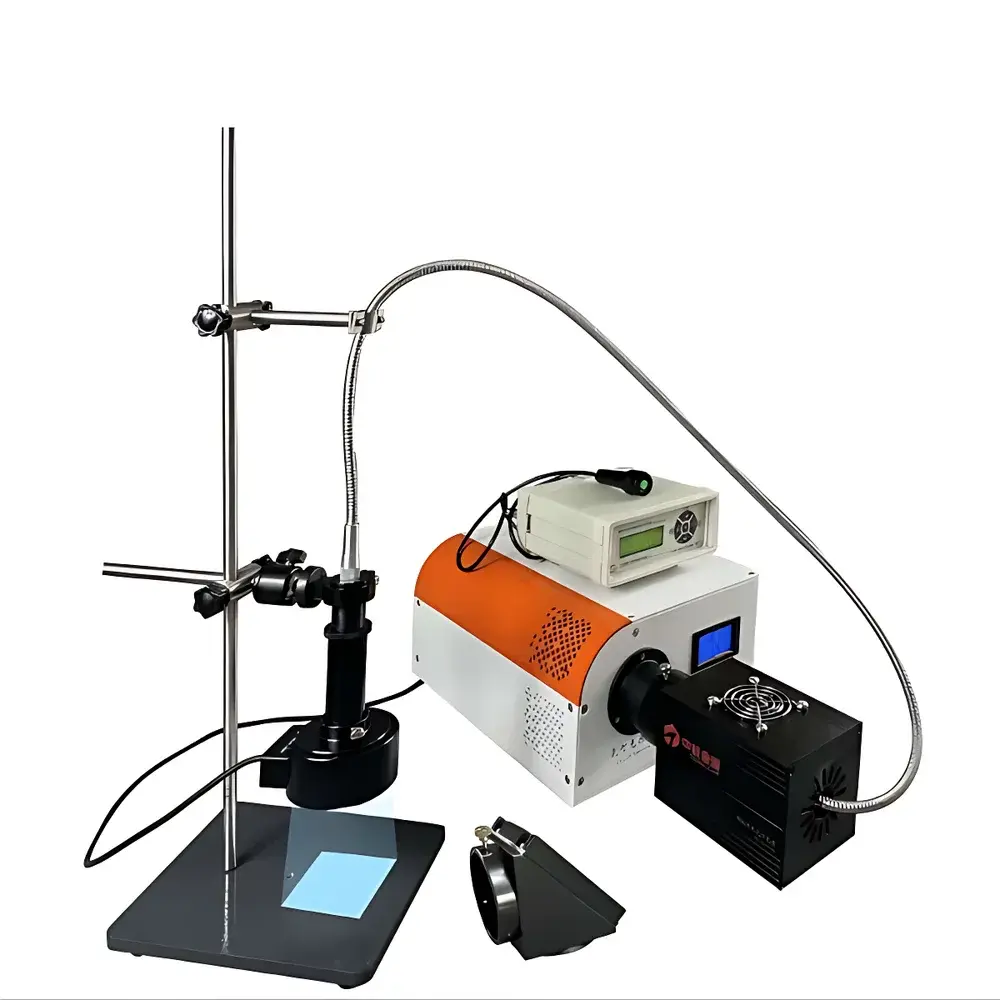
CEL-FES300 Multi-Functional Fiber-Coupled Xenon Light Source
| Brand | CEAULIGHT (Zhongjiao Jinyuan) |
|---|---|
| Origin | Beijing, China |
| Manufacturer Type | OEM/ODM Manufacturer |
| Product Category | Domestic |
| Model | CEL-FES300 |
| Light Source Type | 300 W Short-Arc Xenon Lamp |
| Illumination Mode | External Irradiation |
| Spectral Output Range | 300–2500 nm (ozone-free) |
| Fiber-Coupled Square Beam Dimensions | 10×10 mm to 60×60 mm (continuously adjustable) |
| Beam Uniformity (≤40 mm) | <5% |
| AM1.5G Spectrum Compliance | Integrated |
| UV Output (<390 nm) | 2.6 W |
| Visible Output (390–770 nm) | 18.6 W, 5000 lm, CCT 5600 K |
| IR Output (>770 nm) | 28.8 W |
| Total Radiant Power | 50 W |
| Input Power | 300 W (Ignition Voltage: 15 kV |
| Operating Voltage | 14 V DC) |
| Operating Current | 21 A (10–22 A range) |
| Lamp Lifetime | >1000 h (up to 6000 h under optimal conditions) |
| Electronic Shutter Accuracy | ±0.01 s |
| Light Stability (Fiber Output) | ±0.5% RMS over 8 h |
| Temperature-Controlled Cooling | Multi-point thermal monitoring with adaptive fan speed control |
| Optional Accessories | CEL-LMP400 Motorized Lift Stage, CEL-NP2000-2 High-Power Radiometer, Full-Line Quartz-Coated Bandpass & Cut-on/Cut-off Filters (e.g., UVIRCut400, AM1.5G, QD365, QD420, etc.) |
Overview
The CEL-FES300 Multi-Functional Fiber-Coupled Xenon Light Source is an engineered optical platform designed for precision photonic experimentation in photochemistry, photovoltaics, and catalytic research. It integrates a stabilized 300 W short-arc xenon lamp—selected for its continuous, solar-spectrum-mimicking emission from 300 nm to 2500 nm—with a high-efficiency fiber-coupling optical train and modular beam delivery architecture. Unlike conventional fixed-beam sources, the CEL-FES300 implements a dual-path illumination strategy: direct collimated irradiation via a rotatable head (for filter-integrated photocatalytic reactors) and spatially decoupled, flexible fiber output (for confined, remote, or multi-port experimental setups). Its spectral fidelity is validated against ASTM E927-21 reference standards for solar simulation, with built-in AM1.5G spectral filtering enabling Class AAA-equivalent performance (per IEC 60904-9:2020 Ed.3) when configured with the standard 40×40 mm square beam. The system operates under closed-loop thermal management, utilizing distributed temperature sensors and dynamically regulated forced-air cooling to maintain radiometric stability at ±0.5% over extended operation—critical for kinetic studies requiring reproducible photon flux.
Key Features
- Fiber-coupled output enabling spatially unrestricted illumination—ideal for glovebox-integrated PEC cells, microfluidic photoreactors, or multi-zone irradiation setups.
- Continuously adjustable square beam size (10×10 mm to 60×60 mm) via motorized focusing optics, with measured uniformity <5% across ≤40 mm apertures (verified per ISO 9050).
- Integrated electronic shutter with programmable timing resolution of 0.01 s, supporting pulse sequences, duty-cycle modulation, and automated cycling for transient photocurrent or quantum yield measurements.
- Pre-aligned AM1.5G spectral filter module (300–1100 nm), calibrated to NIST-traceable irradiance standards, eliminating need for external spectral correction in solar cell EQE or IPCE testing.
- Dual-output capability: simultaneous free-space irradiation (via rotating optical head with M62 filter mount) and fiber-guided delivery—enabling parallel experiments or reference-sample comparison.
- Real-time thermal feedback system with five-point thermal monitoring and adaptive fan-speed control ensures stable output power and extends lamp lifetime beyond 1000 h under GLP-compliant ambient conditions (23±2°C, RH <60%).
Sample Compatibility & Compliance
The CEL-FES300 supports standardized sample geometries used in ASTM G173-03, IEC 61215-2, and ISO 10527 photostability protocols. Its 40×40 mm uniform beam area accommodates standard 1 cm² photoelectrodes, 2×2 cm² perovskite solar cells, and 30 mm-diameter quartz reaction vials. All optical interfaces comply with ISO 10110 surface quality specifications (scratch-dig 60-40), and fused silica fiber bundles meet MIL-C-17F mechanical durability requirements. The system’s radiometric calibration traceability follows ISO/IEC 17025:2017 guidelines, with optional factory certification against NIST SRM 2241 (xenon lamp spectral irradiance standard). For regulated environments, audit trails for shutter actuation, power logging, and temperature history can be exported in CSV format—supporting 21 CFR Part 11 compliance when paired with validated LIMS integration.
Software & Data Management
The CEL-FES300 operates via embedded ARM-based controller with RS-485 and USB-C digital interfaces. Firmware supports SCPI command set for seamless integration into LabVIEW, Python (PyVISA), or MATLAB automation frameworks. Real-time parameters—including shutter state, elapsed exposure time, cumulative lamp hours, and thermal sensor readings—are logged locally (16 GB onboard flash) and exportable via USB or Ethernet. Optional PC software provides GUI-based scheduling of multi-step irradiation protocols (e.g., “10 s ON / 5 s OFF × 50 cycles” for accelerated aging), synchronized timestamping with external DAQ systems, and automatic generation of ISO 17025-compliant test reports including uncertainty budgets per GUM (JCGM 100:2008). No cloud dependency or proprietary runtime is required.
Applications
- Photoelectrochemical (PEC) characterization: transient photocurrent mapping, incident-photon-to-current efficiency (IPCE), and bias-dependent action spectra under controlled spectral irradiance.
- Perovskite and organic photovoltaic stability testing per IEC 61215-2 MQT 18 (UV pre-conditioning) and ISOS-L-3 protocols.
- Heterogeneous photocatalysis: H₂/O₂ evolution kinetics, CO₂ reduction product quantification (GC-TCD/FID), and VOC mineralization studies under simulated sunlight.
- Photobiological assays: action spectrum determination for microbial inactivation or plant photomorphogenesis using narrowband QD-series filters.
- Optical material degradation: accelerated weathering of polymers, coatings, and OLED encapsulants per ASTM G154 Cycle 1 (UV-A + condensation).
- Photoresponsive hydrogel swelling kinetics and light-triggered drug release profiling in controlled-environment chambers.
FAQ
What spectral range is delivered through the fiber output?
The fiber-coupled output delivers 350–1100 nm radiation, with AM1.5G spectral shaping applied internally. UV (1100 nm) components are attenuated to preserve fiber integrity and ensure spectral match to terrestrial solar irradiance.
Can the system be used for quantum yield measurements?
Yes—when paired with a calibrated reference detector (e.g., CEL-NP2000-2) and appropriate actinometry (e.g., potassium ferrioxalate), the CEL-FES300 supports absolute quantum yield determination per IUPAC recommendations.
Is the lamp replaceable by the end user?
Lamp replacement requires alignment recalibration and is recommended only by certified service personnel. Replacement lamps are supplied with individual spectral calibration certificates.
Does the system meet laser safety classifications?
It is classified as IEC 60825-1:2014 Class 3R for collimated output and Class 1 for fiber-coupled operation—no interlocks or safety goggles required beyond standard UV-handling PPE.
How is radiometric calibration maintained over time?
The system includes a built-in reference photodiode for daily drift checks. Annual recalibration against NIST-traceable standards is recommended for GLP/GMP applications.




