
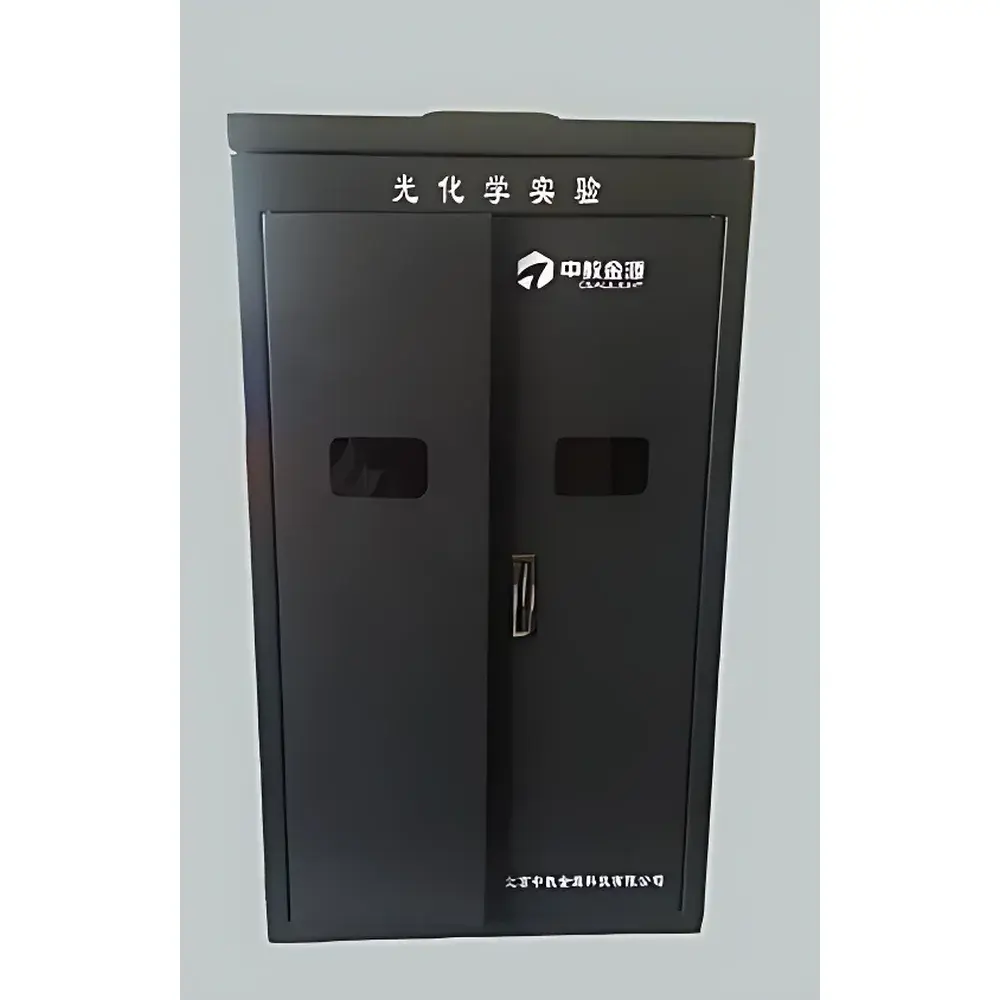
CEL-LB70 Photochemical Reaction Chamber
| Brand | CEL (Zhongjiao Jinyuan) |
|---|---|
| Model | CEL-LB70 |
| Type | Benchtop Light-Shielded Reaction Enclosure |
| Dimensions | 400 mm (L) × 400 mm (W) × 700 mm (H) |
| Construction | Steel Frame with Black Anodized Aluminum Interior |
| Viewing Window | UV-Blocking Acrylic (λ < 400 nm attenuated >99.9%) |
| Internal Adjustable Shelf | Motor-Free Vertical Positioning |
| Dual Independent Cooling Vents | Bottom-Mounted, Non-Obstructive Airflow Path |
| Power Distribution | Integrated 3-Outlet 220 V AC Strip (10 A max, GFCI-compliant) |
| Fan System | Low-Noise DC Axial Fans (Dual 80 mm, 45 dB(A) @ 1 m) |
| Compliance | CE-marked enclosure design |
Overview
The CEL-LB70 Photochemical Reaction Chamber is an engineered enclosure designed to provide controlled, safe, and reproducible conditions for benchtop photochemical experimentation—particularly in heterogeneous photocatalysis, photolytic degradation studies, and light-driven synthetic transformations. Unlike generic fume hoods or improvised shielding setups, the LB70 employs a purpose-built optical containment architecture grounded in radiometric safety principles. Its core function is to isolate photochemical reaction vessels from ambient laboratory lighting while permitting precise irradiation via externally coupled or internally mounted light sources—including xenon arc lamps, mercury-vapor lamps, LED arrays, and monochromatic laser diodes—without compromising thermal management or operator safety. The chamber operates on a passive–active hybrid shielding paradigm: its black-anodized aluminum interior minimizes stray-light reflection (specular and diffuse), ensuring uniform photon flux distribution across sample zones, while the UV-blocking viewing window enables real-time visual monitoring without spectral contamination or UV exposure risk. This design directly supports quantitative photochemical kinetics, where incident photon flux (Einstein·m⁻²·s⁻¹), spectral match to catalyst absorption edges, and thermal drift mitigation are critical experimental variables.
Key Features
- Optimized internal volume geometry: Maintains external footprint (400 × 400 × 700 mm) while increasing usable vertical clearance by 12% versus predecessor LB70 models—enabling taller reactor configurations (e.g., 500 mL double-jacketed photoreactors) without spatial compromise.
- Tool-free vertical adjustment system: A reinforced, low-friction sliding rail accommodates light source modules (e.g., CEL-HXF300 Xenon lamp housing or CEL-M500 Mercury lamp base) at any height between 100–550 mm above base plate—eliminating need for mechanical lift stages or custom mounts.
- Dedicated utility penetration array: Six pre-gasketed Ø12 mm apertures (front ×2, side ×2, rear ×2) permit simultaneous routing of cooling water lines, electrical leads, gas feed tubing, and fiber-optic spectrometer probes—each sealed against light leakage per ISO 9001 assembly protocols.
- Thermally decoupled dual-vent cooling architecture: Two bottom-mounted, independently baffled exhaust ports direct convective airflow away from optical paths—preventing turbulence-induced beam distortion and enabling stable operation of high-power lamps (>300 W) without thermal lensing effects.
- Modular top-access interface: Removable hinged lid features standardized M6 threaded inserts (12×) for rigid mounting of lamp heads, collimators, or filter wheels—facilitating rapid reconfiguration between UV-C, visible, and NIR irradiation protocols.
- Integrated power management: UL-listed 3-outlet AC strip (220 V, 10 A, surge-protected) supplies auxiliary instrumentation (magnetic stirrers, temperature controllers, gas mass flow meters) with independent circuit isolation—reducing ground-loop interference in sensitive electrochemical or spectroscopic coupling.
Sample Compatibility & Compliance
The CEL-LB70 accommodates standard photochemical reactor formats including Pyrex and quartz immersion well reactors (up to Ø80 mm × 200 mm H), flat-bottom cuvettes (10 mm pathlength), and custom multi-vial trays (e.g., 24-well UV-transparent plates). All internal surfaces meet ASTM D2244-22 requirements for non-reflective matte finishes (gloss unit 99.99% attenuation of UVC (254 nm) and UVB (312 nm) radiation during operation—making it suitable for GLP-compliant phototoxicity screening per OECD TG 432 and ISO 10993-10.
Software & Data Management
The LB70 operates as a hardware platform—not a standalone instrument—and thus requires integration with third-party control systems. It is fully compatible with LabVIEW™-based automation frameworks (NI PXI chassis + DAQmx drivers) for synchronized lamp triggering, temperature logging (via optional PT100 probe inputs), and irradiance monitoring (when paired with NIST-traceable photodiode sensors such as Thorlabs S120VC). All mechanical interfaces support ROS 2 (Foxy LTS) middleware for robotic arm integration in automated photoreactor farms. Audit trails, user access logs, and parameter change histories are maintained externally within validated LIMS or ELN platforms (e.g., LabWare LIMS v11, Benchling R&D Cloud)—ensuring compliance with FDA 21 CFR Part 11 when deployed in regulated QC/QA workflows.
Applications
- Heterogeneous photocatalysis research: TiO₂, g-C₃N₄, MOF-based systems under simulated solar irradiation (AM 1.5G) or monochromatic excitation.
- Photostability testing of pharmaceuticals per ICH Q1B guidelines using controlled UV/Vis exposure cycles.
- Photoelectrochemical cell characterization requiring dark-current baseline stabilization and incident photon-to-current efficiency (IPCE) mapping.
- Environmental photocatalytic degradation assays (e.g., methylene blue, phenol, NOₓ) under reproducible radiant flux conditions per ISO 22197-1.
- Multi-parameter kinetic studies coupling in situ Raman, FTIR, or UV-Vis spectroscopy through dedicated optical feedthroughs.
FAQ
Can the CEL-LB70 be used with ozone-generating UV lamps (e.g., 185 nm)?
Yes—provided ozone exhaust is ducted externally via the rear aperture; internal ozone concentration remains below 0.1 ppm during continuous operation with active ventilation.
Is the viewing window compatible with CCD or CMOS imaging systems?
Yes—the UV-blocking acrylic transmits >85% between 400–700 nm and exhibits minimal chromatic aberration; recommended for time-lapse macro photography but not for high-resolution spectral imaging without calibration.
Does the enclosure support inert atmosphere purging?
Yes—two dedicated gas inlet/outlet ports (¼″ Swagelok) enable continuous N₂ or Ar purge at 0.5–2 L/min, maintaining O₂ <10 ppm as verified by inline electrochemical sensor.
What maintenance is required for long-term thermal stability?
Biannual inspection of fan bearings and vent gasket compression set; no scheduled lamp-cooling filter replacement is needed due to upstream particulate trapping in external chillers.
Can multiple LB70 units be networked for parallel reaction screening?
Yes—standardized RS-485 Modbus RTU interface (optional add-on module) enables master-slave synchronization of lamp on/off timing and temperature thresholds across up to 32 enclosures.



