
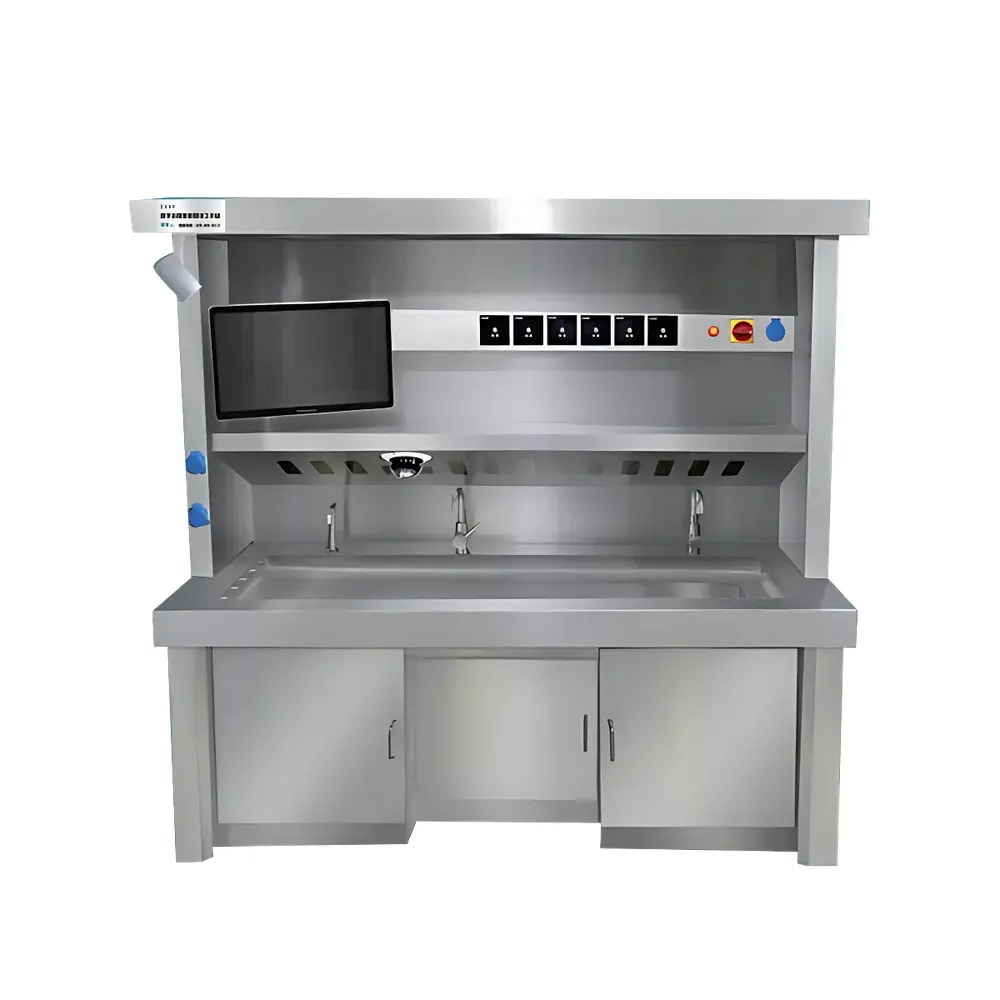
Histo-CN Smart Remote Digital Specimen Processing Workstation
| Brand | HISTO |
|---|---|
| Origin | Zhejiang, China |
| Manufacturer Type | Authorized Distributor |
| Country of Origin | China |
| Model | Histo-CN / Histo-QCT (Cangniu P1) |
| Pricing | Available Upon Request |
| Dimensions (L×W×H) | ≥1800 × 800 × 1900 mm |
| Control Interface | 7-inch PLC-programmable LCD touchscreen |
| Enclosure Material | ≥2.0 mm 304 stainless steel (electro-polished, welded-free visible seams) |
| Work Surface | ≥2.5 mm 304 stainless steel, seamless one-piece construction with full-radius internal corners |
| Rinse Sink | ≥400 × 350 × 300 mm, user-positionable |
| Exhaust System | Centrifugal fan with PP corrosion-resistant motorized damper, airflow ≥1500–1800 m³/h (CMA-certified test report provided) |
| UV Safety | Interlocked UV disinfection with programmable timer |
| Base Cabinet | Integrated cold/hot water supply (brand-name instant electric heater), bone tissue macerator (0.5 HP, 50 Hz, 304 stainless steel tank) |
| Faucets & Spray Gun | Full 304 stainless steel, anti-corrosion, spray gun extension ≥1 m |
| Imaging System | Built-in macro camera (≥8 MP, optical zoom ≥10×), 21″ all-in-one PC (mounting arm included), synchronized audio-video recording/playback |
| Auto-Flush Nozzles | 304 stainless steel, anti-clog internal design, continuous operation capable |
| Connectivity | Dual-camera system (main macro + 4K overhead), 5G-enabled real-time streaming |
| Remote Support | HISTO “InstantCall” telepathology service for frozen-section guidance and synchronous multi-user slide review |
Overview
The Histo-CN Smart Remote Digital Specimen Processing Workstation is an integrated, CE-compliant pathology workstation engineered for high-throughput gross specimen handling in clinical histopathology laboratories, academic medical centers, and reference labs. Designed to meet stringent biosafety and workflow efficiency requirements, it combines precision mechanical engineering with digital connectivity to support GLP-aligned tissue processing protocols. Its core operational principle centers on controlled environmental containment—leveraging negative-pressure ventilation, chemical-resistant material architecture, and real-time remote collaboration—to minimize occupational exposure while enabling standardized specimen documentation and expert consultation. The workstation adheres to ISO 13485 design controls for medical device-related laboratory equipment and incorporates structural features aligned with CLSI GP26-A4 recommendations for grossing area ergonomics and contamination control.
Key Features
- Structural integrity: All external and internal surfaces fabricated from ≥2.0 mm electropolished 304 stainless steel; work surface formed as a single seamless unit with fully radiused internal corners to eliminate microbial harborage points and simplify CIP (Clean-in-Place) validation.
- Negative-pressure exhaust: Centrifugal fan assembly delivering ≥1500–1800 m³/h volumetric flow, independently verified by CMA-accredited third-party testing; PP-lined motorized damper enables dynamic airflow modulation per SOP-defined workflow stages.
- Dual-mode disinfection: UV-C irradiation system with safety interlocks and programmable scheduling; complemented by automated 304 stainless steel rinse nozzles featuring self-clearing internal geometry for uninterrupted formalin removal.
- Integrated fluid management: Dedicated hot/cold water circuit powered by a certified instant electric heater (no storage tank); proprietary bone tissue macerator (0.5 HP, 304 SS chamber) ensures unimpeded drainage without sediment accumulation.
- Digital imaging suite: Co-located 8 MP macro lens (10× optical zoom) and 4K overhead camera, both synchronized via embedded 5G module for low-latency streaming to local network or cloud-based PACS archives.
- Human-centered interface: 7-inch industrial-grade PLC touchscreen with intuitive IEC 61131-3 logic programming; supports custom protocol sequencing, audit trail logging, and role-based access control (RBAC) for multi-user environments.
Sample Compatibility & Compliance
The Histo-CN workstation accommodates human and animal tissue specimens across all major organ systems—including but not limited to surgical resections, biopsies, autopsies, and cytology specimens—without modification. Its stainless-steel wetted surfaces resist degradation from formalin, xylene, ethanol, and sodium hypochlorite solutions at standard working concentrations. The system complies with ISO 15190:2020 (medical laboratories — requirements for safety), EN 14157:2003 (laboratory furniture — safety requirements), and relevant sections of USP Analytical Instrument Qualification. Exhaust performance data satisfies WHO Laboratory Biosafety Manual (4th ed.) Tier II containment expectations for Level 2 laboratories handling fixed tissues.
Software & Data Management
Embedded firmware supports DICOM-SR (Structured Reporting) export for macro-image annotation and metadata tagging (specimen ID, date/time, operator, grossing notes). All video recordings are timestamped and stored locally on the 21″ AIO PC with optional encrypted network backup to NAS or LIMS-integrated repositories. The 5G streaming architecture enables HIPAA-compliant remote viewing via TLS 1.3–secured endpoints. Audit trails record every PLC command execution, UV cycle initiation, flush activation, and remote session log-in—fully traceable for FDA 21 CFR Part 11 compliance when paired with validated electronic signature modules.
Applications
- Clinical grossing stations in CAP-accredited pathology departments requiring documented chain-of-custody for surgical specimens.
- Academic research labs conducting morphometric analysis where standardized macro-imaging and synchronized audio commentary are essential for reproducibility.
- Regional telepathology hubs deploying distributed grossing workflows supported by real-time expert oversight via HISTO InstantCall’s synchronized slide-viewing and annotation tools.
- Biosafety Level 2 (BSL-2) facilities managing infectious or hazardous tissue samples, where negative-pressure containment and automated decontamination reduce manual intervention risks.
- Contract research organizations (CROs) performing GLP-compliant toxicologic pathology studies requiring ALCOA+ data integrity principles across imaging, timing, and environmental logs.
FAQ
Does the workstation support integration with existing LIS or PACS platforms?
Yes—DICOM-SR export, HL7 v2.5.1 ADT/ORM message support, and configurable RESTful API endpoints enable bidirectional communication with major LIS (e.g., Sunquest, Cerner CoPath) and PACS vendors.
Is the 5G module field-upgradable to 5G-Advanced or future cellular standards?
The embedded module uses M.2 Key-B form factor with carrier-agnostic firmware; hardware-level upgrades require certified service technician deployment per IEC 62304 Class B software lifecycle requirements.
Can the UV disinfection cycle be scheduled during non-operational hours without manual intervention?
Yes—PLC scheduler permits time-based activation with dual verification (door position sensor + motion detection) to ensure personnel absence prior to irradiation.
What validation documentation is provided for installation qualification (IQ) and operational qualification (OQ)?
Factory-issued IQ/OQ protocols, CMA-certified airflow reports, material traceability certificates (MTRs) for all 304 SS components, and software verification summary per IEC 62304 Annex C are included in the delivery package.
Is the bone tissue macerator compliant with EU Machinery Directive 2006/42/EC?
Yes—the unit carries CE marking under Annex IV; full technical file available upon request for Notified Body review.



