
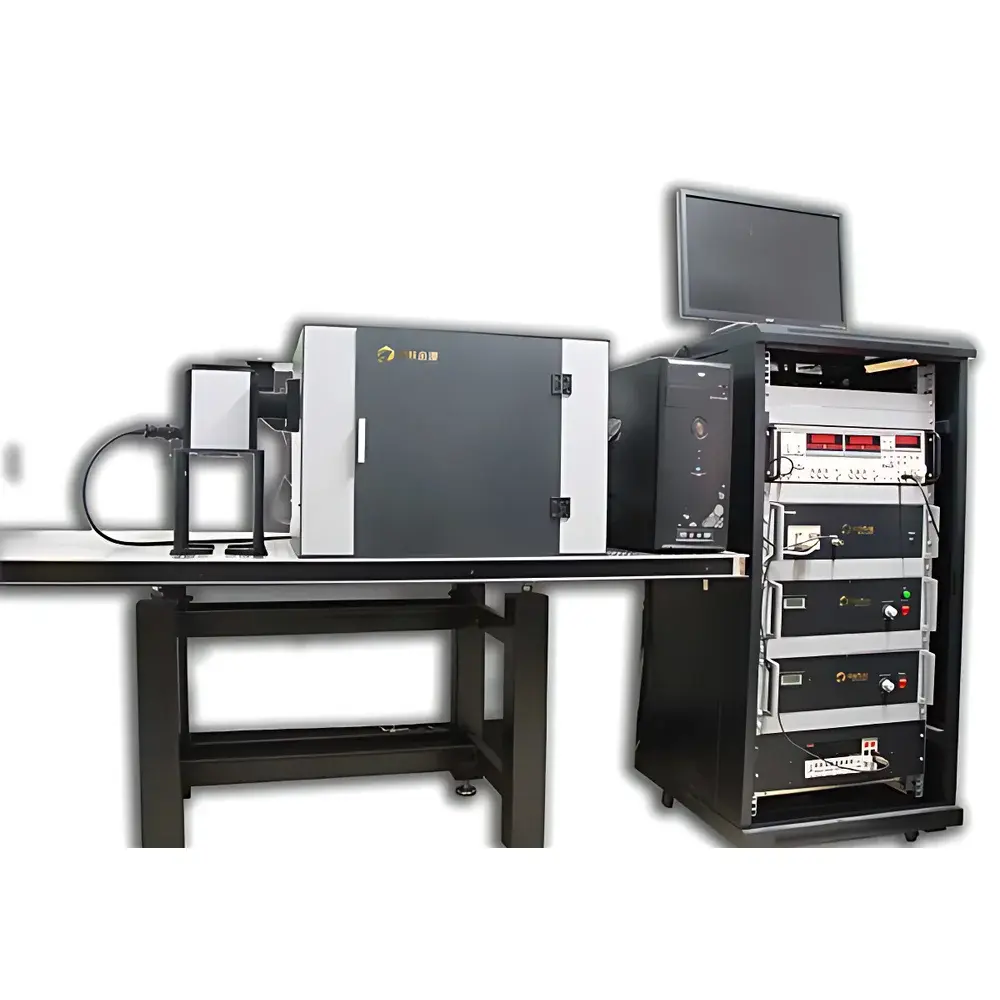
CEL-SPIP QE/IPCE Upgrade Module for Surface Photovoltage Spectroscopy
| Brand | CEL (CNI) |
|---|---|
| Model | CEL-SPIP |
| Origin | Beijing, China |
| Manufacturer | Beijing CNI Co., Ltd. |
| Type | OEM Upgrade Module for SPS Systems |
| Light Source | 500 W Osram Xe Lamp |
| Spectrometer | 300 mm Focal Length, High-Resolution Imaging Spectrometer |
| Spectral Range | 200–1100 nm |
| Calibration Standard | NIST-traceable UV-enhanced reference detector |
| Measurement Modes | DC & AC (chopped, 5–1000 Hz) |
| Positioning | Motorized Horizontal Precision Translation Stage |
| Data Synchronization | Integrated hardware-triggered acquisition (light source, spectrometer, lock-in amplifier) |
| Repeatability | <0.3% (J<sub>sc</sub>) |
| Compliance | ASTM E1021, ISO 18746, IEC 60904-8 Ed.3 |
| Software | CEL-QEPro v3.x with GLP-compliant audit trail, 21 CFR Part 11 optional modules |
Overview
The CEL-SPIP QE/IPCE Upgrade Module is an engineered enhancement for the CEL-SPS1000 Surface Photovoltage Spectroscopy (SPS) platform, designed to extend its analytical capability into quantitative quantum-efficiency metrology. Built upon a vertically aligned optical architecture, the module integrates a stabilized 500 W Osram xenon lamp and a high-fidelity 300 mm focal-length imaging spectrometer to deliver spectral irradiance stability ≤±0.2% over 1 hour. Its core function is to enable absolute external quantum efficiency (EQE), incident photon-to-current efficiency (IPCE), and spectral responsivity (Rλ) measurements under controlled monochromatic illumination. The system operates on the principle of modulated photocurrent detection—where incident light is mechanically chopped and the resulting AC photovoltage or photocurrent signal is extracted via dual-phase lock-in amplification—ensuring high signal-to-noise ratio even at sub-mA photocurrent levels. This architecture supports both DC steady-state and AC dynamic response characterization, making it suitable for probing charge separation kinetics, surface recombination velocity, and interfacial carrier extraction efficiency in photoactive materials.
Key Features
- Optical path fully enclosed and vibration-isolated to eliminate ambient light interference and air-current-induced drift
- Motorized horizontal precision translation stage (±0.5 µm repeatability) for automated switching between calibrated reference and test samples
- NIST-traceable UV-enhanced silicon photodiode standard (calibrated from 200–1100 nm at 1 nm intervals) for absolute spectral responsivity calibration
- Automated spectral scanning with continuous wavelength stepping (0.1–5 nm step resolution) and real-time intensity normalization
- AC measurement mode with user-selectable chopper frequency range (5–1000 Hz), optimized for distinguishing bulk vs. interface-limited transport
- Hardware-synchronized acquisition across light source shutter, spectrometer CCD trigger, and lock-in amplifier reference output
- Compliance-ready firmware architecture supporting audit trails, electronic signatures, and configurable user access levels per FDA 21 CFR Part 11 requirements
Sample Compatibility & Compliance
The CEL-SPIP module is validated for planar, non-scattering photoelectrodes and devices including single-crystal Si, multicrystalline Si, perovskite thin films, dye-sensitized solar cells (DSSCs), and emerging metal oxide semiconductors (e.g., BiVO4, Fe2O3). Sample mounting follows ASTM E1021-22 guidelines for spectral responsivity testing of photovoltaic devices, with active area definition via precision apertures (1.0 cm² nominal). All optical components—including quartz windows, reflective optics, and fiber-coupled spectrometer input—are selected for minimal UV degradation and thermal drift. System-level calibration adheres to ISO 18746:2021 (Photocurrent quantum efficiency measurement of photoelectrochemical cells) and IEC 60904-8 Ed.3 (spectral mismatch correction for PV device characterization).
Software & Data Management
CEL-QEPro v3.x is a Windows-based application developed specifically for quantum efficiency metrology. It provides full instrument control, real-time spectral preview, automatic dark-current subtraction, and integrated AM1.5G spectral weighting per ASTM G173-03. Raw data are stored in HDF5 format with embedded metadata (wavelength, integration time, chopper frequency, sample ID, operator, timestamp). The software supports batch processing of multi-sample datasets, automatic Jsc calculation from IPCE curves, and export to CSV, MATLAB (.mat), or PDF report templates compliant with GLP documentation standards. Optional 21 CFR Part 11 modules include role-based login, electronic signature capture, and immutable audit logs for regulated QA/QC environments.
Applications
- Quantitative evaluation of charge-carrier generation and collection efficiency in lab-scale solar cells and photoelectrodes
- Diagnostics of spectral losses due to parasitic absorption, reflection, or incomplete carrier extraction
- Correlation of IPCE onset edge with material bandgap and interfacial energy alignment
- Mapping spatial uniformity of photoresponse using programmable XY-stage integration (optional)
- Time-resolved EQE analysis under variable chopping frequencies to extract carrier lifetime and diffusion length
- Validation of optical modeling (e.g., transfer matrix simulations) against empirical spectral response data
FAQ
Does the CEL-SPIP module require modification of the existing CEL-SPS1000 base system?
No—it is a plug-and-play upgrade kit that retains all original SPS functionality while adding QE/IPCE measurement capability through optical and electronic interface expansion.
Can the system measure internal quantum efficiency (IQE)?
Yes—when coupled with a calibrated integrating sphere (optional accessory), the module supports reflectance/transmittance correction to derive IQE from measured IPCE.
Is AM1.5G spectral irradiance simulation built-in?
Yes—the software includes the ASTM G173-03 reference spectrum and performs automatic convolution of measured IPCE with the standard spectrum to compute Jsc.
What is the minimum detectable photocurrent in AC mode?
With 1 s integration time and 100 Hz chopping, the system achieves a current noise floor of ≤50 pA RMS for typical 1 cm² samples.
Are calibration certificates provided with the UV-enhanced reference detector?
Yes—each unit ships with a NIST-traceable calibration certificate valid for 12 months, covering responsivity, linearity, and spectral uniformity across 200–1100 nm.
Related Products



