
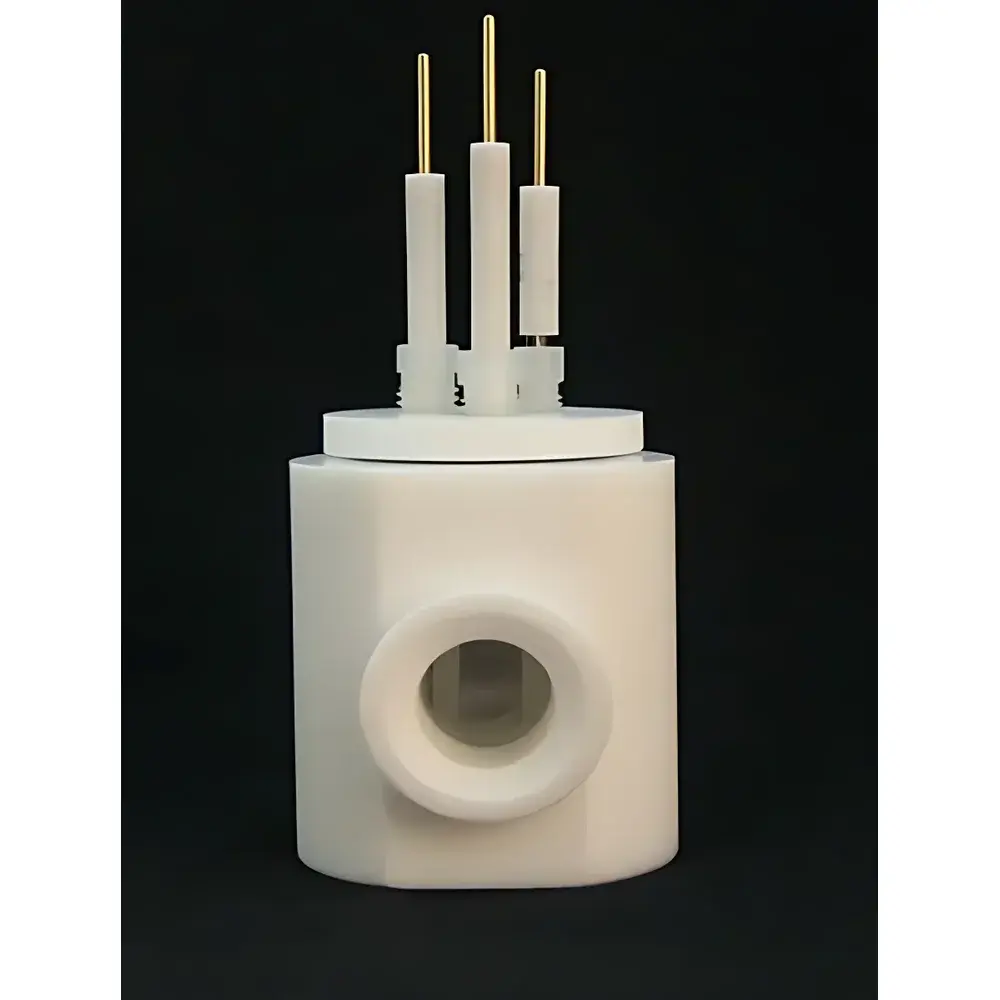
Zhongjiaojinyuan PECK40SP Sealed Photoelectrochemical Cell (PTFE Body)
| Brand | Zhongjiaojinyuan |
|---|---|
| Origin | Beijing, China |
| Manufacturer Type | Direct Manufacturer |
| Country of Origin | China |
| Model | PECK40SP |
| Component Category | Optical Component |
| Body Material | PTFE (Polytetrafluoroethylene) |
| Optical Window | Fused Silica, 24 mm Diameter, Quick-Release Mount |
| Cell Volume | 50 mL |
| Operating Temperature Range | ≤ 80 °C |
| Electrode Configuration | Pt Wire Counter Electrode, Ag/AgCl Reference Electrode, Pt Clip Working Electrode Holder |
| Compliance | Designed for ISO/IEC 17025-aligned electrochemical laboratories |
| Customization Available | 100 mL volume option on request |
Overview
The Zhongjiaojinyuan PECK40SP Sealed Photoelectrochemical Cell is an engineered optical-electrochemical interface device designed for controlled illumination and precise electrochemical measurement under inert or ambient atmospheres. Built upon the Couette–Taylor flow principle adapted for static cell geometry, it enables simultaneous light irradiation through a high-transmittance fused silica window and three-electrode potentiostatic control. Its fully PTFE construction ensures chemical inertness against strong acids (e.g., H₂SO₄, HCl), alkalis (e.g., KOH), organic solvents (e.g., acetonitrile, DMF), and halogenated electrolytes commonly used in photoanode/cathode studies. The cell operates exclusively in non-pressurized, ambient-pressure configurations and is optimized for steady-state photocurrent quantification, transient photocurrent decay analysis, and action spectrum acquisition in aqueous and non-aqueous media.
Key Features
- Fully PTFE body with integrated O-ring sealing system ensuring long-term gas-tight integrity during extended chronoamperometric or impedance measurements
- Quick-release 24 mm fused silica optical window (UV–VIS transmission >90% from 190–2500 nm) enabling reproducible incident photon flux calibration per ASTM E948 and ISO 10523
- Modular electrode assembly: standardized M6 threaded ports accommodate interchangeable working electrode clips (Pt, GC, FTO, ITO substrates), Pt wire counter electrodes (diameter 0.5 mm, length 30 mm), and double-junction Ag/AgCl reference electrodes with ceramic frit junctions
- 50 mL internal volume with calibrated fill line; optional 100 mL variant available for dilute-solution kinetic studies requiring lower ohmic drop
- Thermal stability validated up to 80 °C—exceeding typical operational limits of conventional epoxy-sealed cells while maintaining dimensional stability and seal integrity
- Compliant with GLP documentation requirements: each unit bears engraved serial number traceable to manufacturing batch and material lot certification (ASTM D4894 for PTFE resin)
Sample Compatibility & Compliance
The PECK40SP supports heterogeneous photoelectrocatalytic systems including metal oxide semiconductors (TiO₂, BiVO₄, Fe₂O₃), quantum dot films (PbS, CdSe), perovskite thin films, and molecular photosensitizers (Ru(bpy)₃²⁺, Ir(ppy)₃). It is compatible with standard potentiostats (e.g., BioLogic SP-300, Metrohm Autolab PGSTAT302N) via 4-mm banana plug connections. All wetted materials meet USP Class VI biocompatibility standards and are certified free of extractables per ISO 10993-12. The design conforms to IEC 61000-6-3 for electromagnetic compatibility in shared lab environments and supports audit-ready operation under FDA 21 CFR Part 11 when paired with compliant data acquisition software.
Software & Data Management
While the PECK40SP is a passive cell requiring external instrumentation, its mechanical and optical specifications are fully documented in manufacturer-provided .STEP and .IGES CAD files for integration into COMSOL Multiphysics® v6.0+ models (electrochemical + heat transfer + ray optics modules). Calibration certificates include spectral transmittance curves (200–1100 nm), thermal expansion coefficients (CTE = 1.1 × 10⁻⁴ K⁻¹), and dielectric constant (εᵣ = 2.1 at 1 MHz). Raw experimental datasets generated using this cell may be archived in FAIR-compliant formats (.csv with metadata headers per ISA-Tab v1.1) and linked to institutional digital repositories via DOIs.
Applications
- Quantitative incident-photon-to-current-efficiency (IPCE) mapping of photoanodes under monochromatic LED or xenon-filtered illumination
- Stability assessment of photocorrosion-prone materials (e.g., Cu₂O, Si) via 24-h chronoamperometry at fixed bias under N₂-saturated electrolyte
- In situ UV-Vis absorption spectroelectrochemistry using fiber-optic coupling to spectrophotometers (e.g., Avantes AvaSpec-ULS2048CL-EVO)
- Photoelectrochemical impedance spectroscopy (PEIS) for charge-transfer resistance and Helmholtz layer capacitance extraction
- Two-electrode photoelectrolysis testing for solar hydrogen generation metrics (STH, ABPE)
FAQ
Can the PECK40SP be used with corrosive molten salt electrolytes?
No. PTFE softens above 260 °C and exhibits creep under sustained load; molten salts require nickel-alloy or quartz-bodied cells rated for >400 °C.
Is the fused silica window replaceable in the field?
Yes. The window mounts via a compression ring and Viton O-ring (included); replacement kits (Part #W-24FQ-SILICA) are available with NIST-traceable transmittance certification.
Does the cell support rotating disk electrode (RDE) configuration?
No. The PECK40SP is a static cell. For RDE photoelectrochemistry, consider the companion PECK-RDE40 series with motorized shaft feedthrough.
What is the maximum permissible light intensity without thermal distortion?
At 80 °C ambient, continuous irradiation up to 1.5 suns (150 mW/cm²) is validated; higher intensities require active cooling jackets (optional accessory: CJK-PECK-COOL).
Are electrode alignment tolerances specified?
Yes. Working–counter electrode separation is fixed at 12.0 ± 0.3 mm; reference electrode tip protrudes 1.5 ± 0.2 mm into bulk solution to minimize iR drop (verified by finite-element simulation).





