
CEL-SPEC Surface Photovoltage Upgrade Module for Photoelectrochemical QE/IPCE Measurements
| Brand | CEA-Light |
|---|---|
| Origin | Beijing, China |
| Manufacturer Type | OEM Manufacturer |
| Product Category | Domestic |
| Model | CEL-SPEC Surface Photovoltage Upgrade Module for QE/IPCE |
| Light Source Type | High-Stability Xenon Arc Lamp (500 W, OSRAM, Germany) |
| Illumination Mode | External Horizontal Beam Configuration |
| Spectral Range | 200–1100 nm |
| Spectral Resolution | ≤1.0 nm (300 mm Focal Length Spectrometer) |
| QE/IPCE Accuracy | Traceable to NIST-Traceable UV-Enhanced Calibrated Standard Source |
| Short-Circuit Current Repeatability | <0.3% (RSD) |
| AC Modulation Mode | Chopped Light, Frequency Range: 5–1000 Hz |
| Synchronization | Hardware-Triggered Acquisition Across Light Source, Spectrometer, and Potentiostat |
| Software Compatibility | Windows 7/8/10 |
| Optional Electrochemical Workstation | BioLogic SP-300 / ZIVE SP1 or ADMIRAL Squidstat Plus (with EIS up to 1 MHz, CV up to ±10 V, Current Range: 100 nA–1 A, 8 Decades) |
Overview
The CEL-SPEC Surface Photovoltage Upgrade Module is a precision optical-electrochemical integration platform engineered for quantitative quantum efficiency characterization of photoactive materials in liquid-phase electrochemical environments. Built as a functional extension to the CEL-SPS1000 Surface Photovoltage Spectroscopy system, it reconfigures the optical architecture into a dual-path layout—retaining the original vertical beam path for surface photovoltage (SPV) measurements while adding a fully isolated horizontal beam path dedicated to photoelectrochemical quantum efficiency (QE) and incident photon-to-current efficiency (IPCE) analysis. The module leverages a stabilized 500 W OSRAM xenon arc lamp with spectral output calibrated against a NIST-traceable UV-enhanced standard source, enabling absolute responsivity calibration across the full 200–1100 nm range. Its optomechanical design features enclosed, vibration-damped light paths, eliminating ambient interference and ensuring long-term photometric stability required for high-fidelity spectral responsivity mapping.
Key Features
- Dual-beam optical architecture: Simultaneous, non-interfering vertical (SPV) and horizontal (QE/IPCE) illumination paths
- High-stability 500 W xenon lamp (OSRAM XBO series) with integrated power supply and thermal management
- 300 mm focal length imaging spectrometer with dual-output port—optimized for both monochromatic excitation and broadband monitoring
- Motorized horizontal translation stage with sub-micron positioning repeatability for automated standard/test sample exchange
- Hardware-synchronized acquisition: TTL-triggered coordination among lamp chopper, spectrometer grating drive, and potentiostat data capture
- AC-coupled measurement mode with user-selectable chopping frequency (5–1000 Hz) and phase-sensitive detection capability
- Compliance-ready architecture: Supports audit trails, parameter logging, and timestamped metadata export for GLP/GMP-aligned workflows
Sample Compatibility & Compliance
The CEL-SPEC module is compatible with standard three-electrode photoelectrochemical cells (e.g., quartz-cuvette-based or custom flow cells), supporting both opaque and transparent working electrodes (e.g., FTO-, ITO-, or metal-supported photocatalysts). It accommodates aqueous and non-aqueous electrolytes and enables in situ electrochemical characterization under controlled illumination. All optical components are housed in sealed, light-tight enclosures meeting IEC 61000-4-3 immunity standards for electromagnetic compatibility. When paired with FDA 21 CFR Part 11–compliant electrochemical workstations (e.g., BioLogic SP-300 or ADMIRAL Squidstat Plus), the full system supports regulated environments requiring electronic signatures, user access control, and immutable data archiving. Measurement protocols align with ASTM E2564 (Standard Test Method for Quantum Efficiency of Photocatalytic Materials) and ISO 10678 (Photocatalytic Activity Assessment).
Software & Data Management
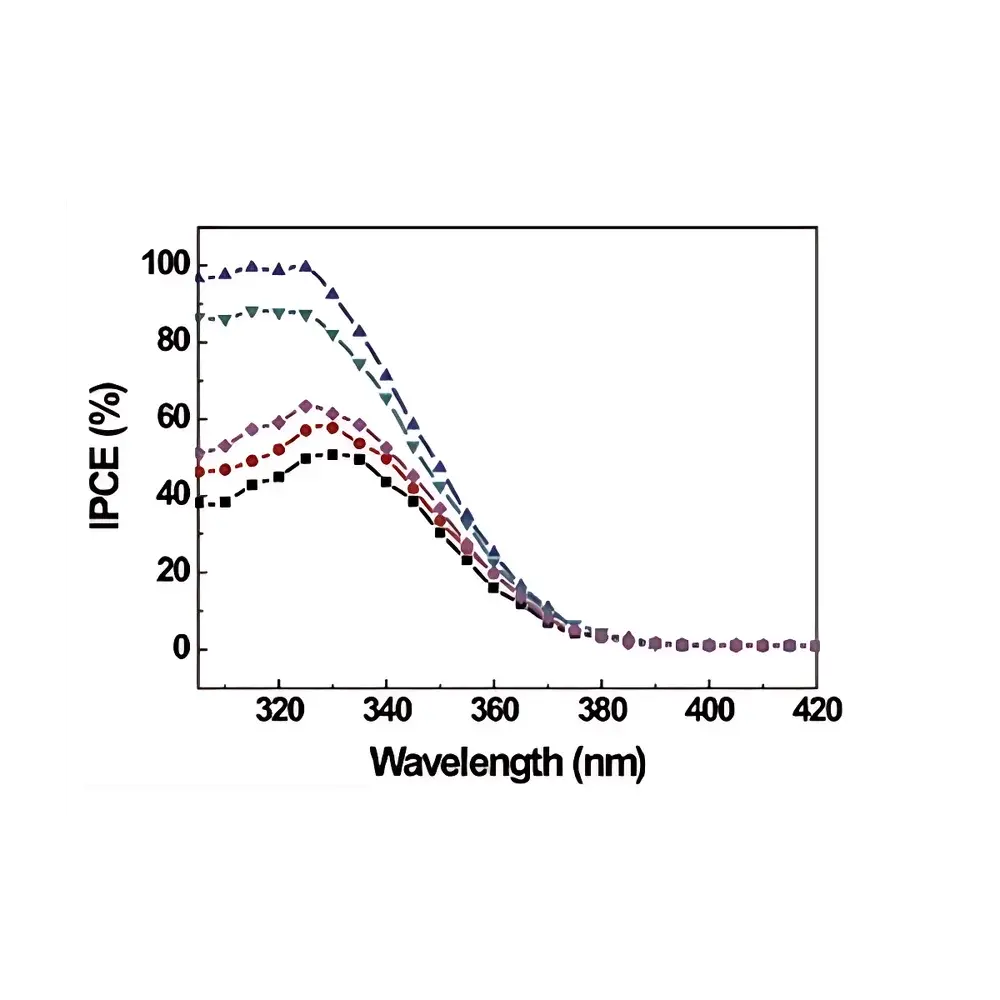
The dedicated acquisition software provides unified control of lamp intensity, monochromator wavelength sweep, chopper frequency, and electrochemical biasing parameters. It implements real-time calculation of QE (A/W) and IPCE (%) using the formula: IPCE(%) = (1240 × Jsc) / (λ × Pin) × 100, where Jsc is short-circuit current density (mA/cm²), λ is wavelength (nm), and Pin is incident irradiance (mW/cm²) measured in situ via calibrated photodiode. Data export formats include CSV, HDF5, and MATLAB-compatible .mat files. Raw spectral scans, chronoamperometric transients, CV loops, and EIS Nyquist/Bode plots are time-stamped and linked to experimental metadata (lamp hours, grating position, cell temperature, reference electrode potential). Audit logs record all parameter changes and user actions per session.
Applications
- Quantitative IPCE mapping of photoanodes (e.g., BiVO₄, Fe₂O₃, WO₃) and photocathodes (e.g., Cu₂O, Si, p-InP) in aqueous electrolytes
- Correlation of surface photovoltage response (from vertical path) with bulk charge separation efficiency (from horizontal QE path)
- Stability assessment via repeated IPCE scans under potentiostatic hold or during chronoamperometry
- Electrochemical impedance spectroscopy (EIS) under monochromatic illumination to resolve wavelength-dependent interfacial charge transfer resistance
- Development and validation of tandem photoelectrochemical devices requiring spectral mismatch analysis
- Academic and industrial R&D labs performing DOE-compliant photocatalyst screening per US Department of Energy’s Hydrogen and Fuel Cell Technologies Office guidelines
FAQ
What electrochemical workstations are officially supported?
BioLogic SP-300, ZIVE SP1, and ADMIRAL Squidstat Plus are validated for hardware-level synchronization; other potentiostats may be integrated via analog/digital I/O with custom scripting.
Is the 200–1100 nm spectral coverage continuous and gap-free?
Yes—the 300 mm spectrometer uses a single grating and optimized detector array (Si CCD + InGaAs extended) to deliver seamless coverage without grating swaps or detector transitions.
How is absolute irradiance calibrated at each wavelength?
Using a factory-calibrated, NIST-traceable UV-enhanced silicon photodiode with certified spectral responsivity from 200–1100 nm; calibration is performed before each measurement sequence.
Can the module operate in potentiostatic, galvanostatic, or open-circuit modes during IPCE acquisition?
Yes—all standard electrochemical control modes are available, with bias applied synchronously with monochromatic illumination steps.
Does the system support automated multi-sample sequential testing?
Yes—the motorized XY stage enables programmable positioning of up to 12 standard/test samples; software includes batch acquisition templates with auto-save naming conventions.




