
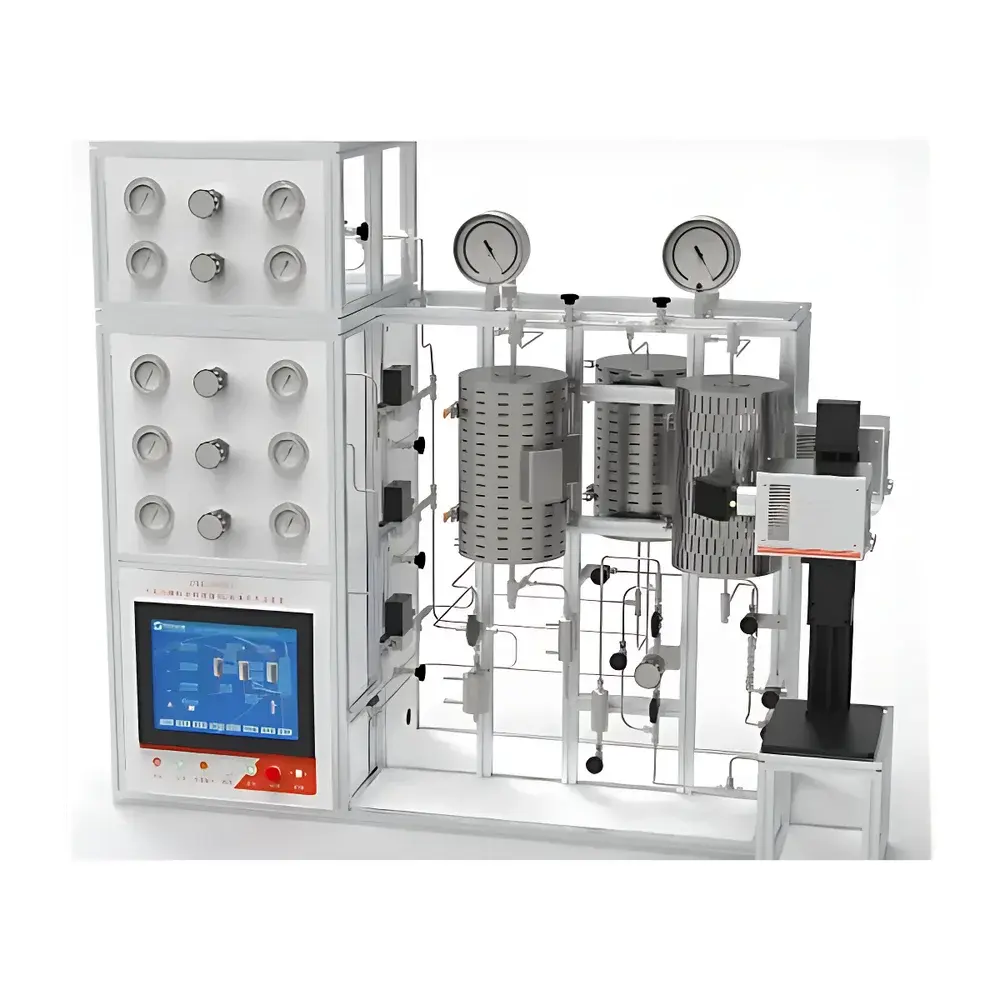
English Product Name
| Brand | Zhongjiaojinyuan |
|---|---|
| Origin | Beijing, China |
| Manufacturer Type | Direct Manufacturer |
| Country of Origin | China |
| Model | CO₂ Integrated Utilization Thermal & Photo-Thermal Catalytic Reaction System (Customizable HP/LP Configuration) |
| Pricing | Available Upon Request |
| Frame Dimensions | 1130 mm × 550 mm × 1340 mm |
| Construction Material | ASTM A240 316L Stainless Steel |
| Thermal Reactor Temp. Range | 0–800 °C |
| Photo-Thermal Reactor Temp. Range | 0–800 °C |
| Max. High-Pressure Operation | < 10 MPa |
| Max. Low-Pressure Operation | < 0.6 MPa |
| Vaporization Zone Temp. | 0–300 °C |
| Tubing Trace Heating | 0–200 °C |
| Liquid Flow Rate | 0.1–5 mL/min |
| Catalyst Bed Volume | < 5 mL |
| Gas Flow Control | Mass Flow Controllers with Gas-Specific Calibration Factors |
| Safety | Dual-stage overpressure relief, real-time overtemperature/overpressure interlock, alarm logging |
Overview
The Zhongjiaojinyuan CO₂ Integrated Utilization Thermal & Photo-Thermal Catalytic Reaction System is a fully integrated, benchtop-scale fixed-bed catalytic evaluation platform engineered for rigorous kinetic studies, catalyst screening, and process parameter optimization under controlled thermal, photo-thermal, and pressure-variable conditions. It operates on the principle of heterogeneous catalysis in continuous-flow mode, supporting gas-phase, liquid-phase, and concurrent gas–liquid–solid reaction configurations. The system enables precise decoupling of thermal activation energy from photon-driven surface excitation—critical for mechanistic investigation of CO₂ hydrogenation (e.g., to CH₄, CO, CH₃OH, or C₂+ hydrocarbons), dry reforming (CO₂ + CH₄ → 2CO + 2H₂), and photocatalytic reduction pathways. Its dual-reactor architecture accommodates both conventional resistive-heated zones and optically coupled photo-thermal modules with quartz-jacketed reactors compatible with UV–Vis–NIR irradiation sources (e.g., Xe lamps, LED arrays, or solar simulators). All operational parameters—including temperature ramp profiles (linear or multi-step), pressure setpoints, mass flow rates, and vapor-phase concentration—are programmable via embedded industrial control software compliant with IEC 61131-3 logic standards.
Key Features
- Modular high-pressure (< 10 MPa) and low-pressure (< 0.6 MPa) subsystems with independent pressure regulation, including proportional unloading valves, calibrated pressure transducers (±0.25% FS), and redundant mechanical burst discs.
- Multi-zone thermal management: independent PID-controlled heating for reactor bed (0–800 °C), vaporization module (0–300 °C), and trace-heated stainless-steel tubing (0–200 °C), all with Class II thermocouple inputs and ±1 °C stability.
- Automated vapor calibration: integrated constant-temperature saturator module using volatile organics (e.g., toluene, H₂O, alcohols) to generate stable ppm-level vapor streams without reliance on certified standard gases—reducing consumables cost by >70% in long-duration screening campaigns.
- Gas selection intelligence: MFCs equipped with user-selectable gas-specific K-factors stored in non-volatile memory, enabling accurate flow delivery across >12 common gases (CO₂, H₂, CO, CH₄, N₂, Ar, O₂, NH₃, etc.) without recalibration.
- Real-time safety interlock architecture: hardware-level monitoring of all critical sensors; automatic shutdown upon deviation from preset thresholds, with event-stamped audit trail exportable in CSV or PDF format per GLP requirements.
- Benchtop footprint (1130 × 550 × 1340 mm) with structural frame fabricated from anodized 6063-T5 aluminum extrusions and 316L stainless-steel wetted parts meeting ASME BPE surface finish specifications (Ra ≤ 0.4 µm).
Sample Compatibility & Compliance
The system supports solid catalysts in powder, pellet, or monolithic form (bed volume ≤5 mL), accommodating both powdered catalysts requiring quartz wool retention and structured catalysts mounted on ceramic or metallic substrates. Liquid-phase co-feeds include water, methanol, ethanol, and aqueous amine solutions. All fluid-contact components comply with ASTM A240 316L material certification and are passivated per ASTM A967. Pressure vessels conform to PED 2014/68/EU Category IV design criteria. Electrical controls meet CE/UL 61010-1 safety standards. Data acquisition and reporting functions support 21 CFR Part 11-compliant electronic signatures when paired with validated software configuration (available as optional upgrade).
Software & Data Management
Control and data acquisition are managed through a ruggedized industrial touchscreen PC running Windows IoT Enterprise with proprietary LabReact™ v4.2 software. The interface provides synchronized visualization of up to 16 analog channels (temperature, pressure, flow, light intensity), with configurable alarm thresholds, trend logging at 100 ms intervals, and automated report generation (PDF/Excel) containing metadata, raw sensor traces, and user-defined calculation fields (e.g., CO₂ conversion %, selectivity, STY). Exported datasets include timestamped headers, instrument ID, operator login, and version-tracked method files. Audit trails are immutable and retain full history of parameter changes, manual overrides, and system events—fully traceable for internal QA audits or regulatory submissions.
Applications
- Kinetic modeling of CO₂ methanation (Sabatier reaction) under industrially relevant pressure gradients (0.1–5 MPa).
- Photo-thermal synergy assessment in plasmonic catalysts (e.g., Au/TiO₂, Cu/CeO₂) under simultaneous thermal ramping and broadband illumination.
- Stability testing of MOF- or zeolite-based adsorbent-catalyst bifunctional materials under cyclic pressurization/depressurization.
- Transient response analysis (TPD/TPR integration-ready) via programmed temperature desorption or reduction protocols.
- Validation of catalyst performance against ASTM D7214 (catalyst activity testing), ISO 11464 (gas-phase catalytic reactions), and USP chromatographic method transfer workflows.
FAQ
Can this system be integrated with external GC or MS analyzers?
Yes—standard 1/8″ Swagelok® ports with heated transfer lines (up to 200 °C) enable seamless coupling to third-party gas chromatographs, mass spectrometers, or FTIR systems via time-synchronized TTL triggers.
Is remote monitoring supported?
The system includes Ethernet/IP and Modbus TCP interfaces; secure remote access is enabled via VPN-configured VNC or TeamViewer sessions with role-based authentication.
What catalyst forms are compatible with the fixed-bed geometry?
Powders (with frit retention), extrudates (1–3 mm diameter), pellets (3–5 mm), and monoliths (up to 10 mm square cross-section) can be loaded using the removable quartz liner assembly.
Does the photo-thermal module support wavelength-selective irradiation?
Optional bandpass filter wheels and fiber-coupled LED sources (255 nm–1550 nm) are available to isolate specific absorption bands for mechanistic photoexcitation studies.
Are validation documents provided for GMP environments?
IQ/OQ documentation packages—including sensor calibration certificates (NIST-traceable), loop check reports, and software verification protocols—are available upon request for regulated laboratory deployment.



