
Keithley 2600 Series SourceMeter Software Suite (Electrochemical + Dual-Channel + Integrated Analysis)
| Brand | China Education Goldsource |
|---|---|
| Origin | Beijing, China |
| Manufacturer Type | Original Equipment Manufacturer (OEM) |
| Regional Classification | Domestic (China) |
| Models Supported | Keithley 2600, 2611, 2614 |
| Pricing | Available Upon Request |
Overview
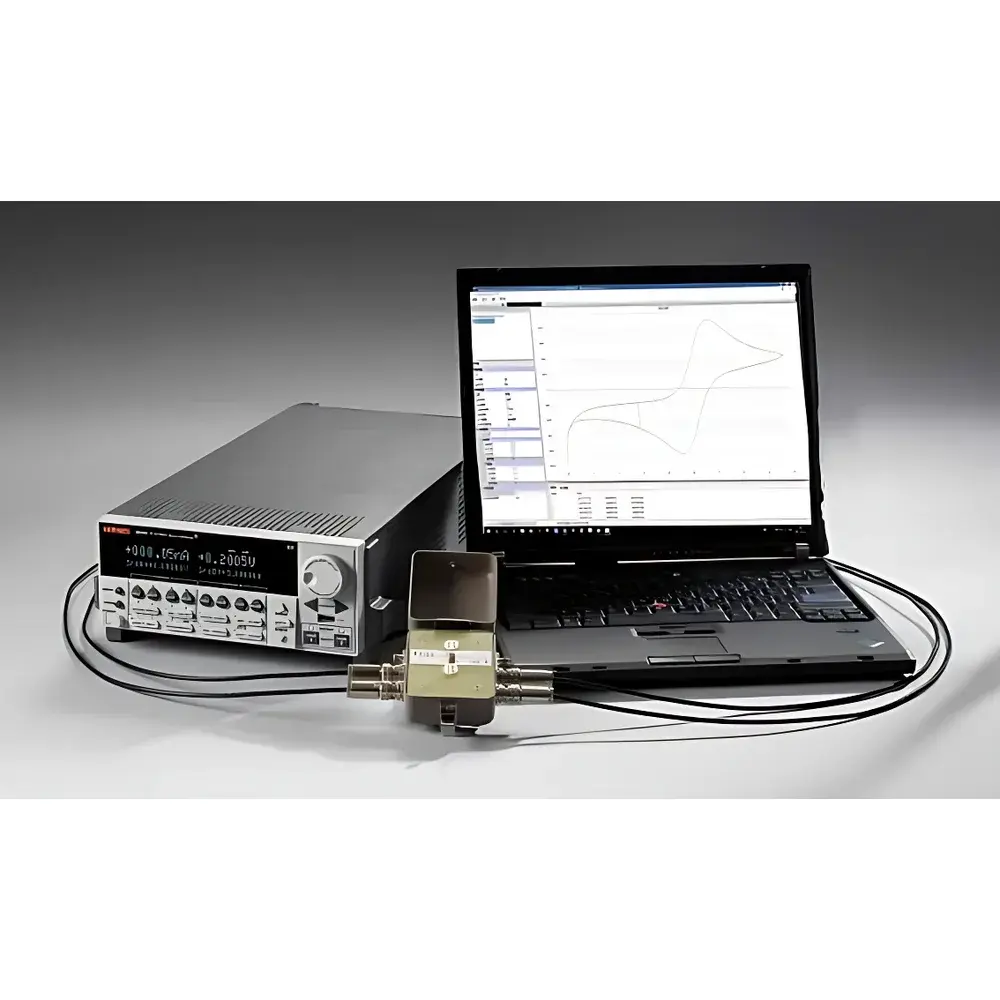
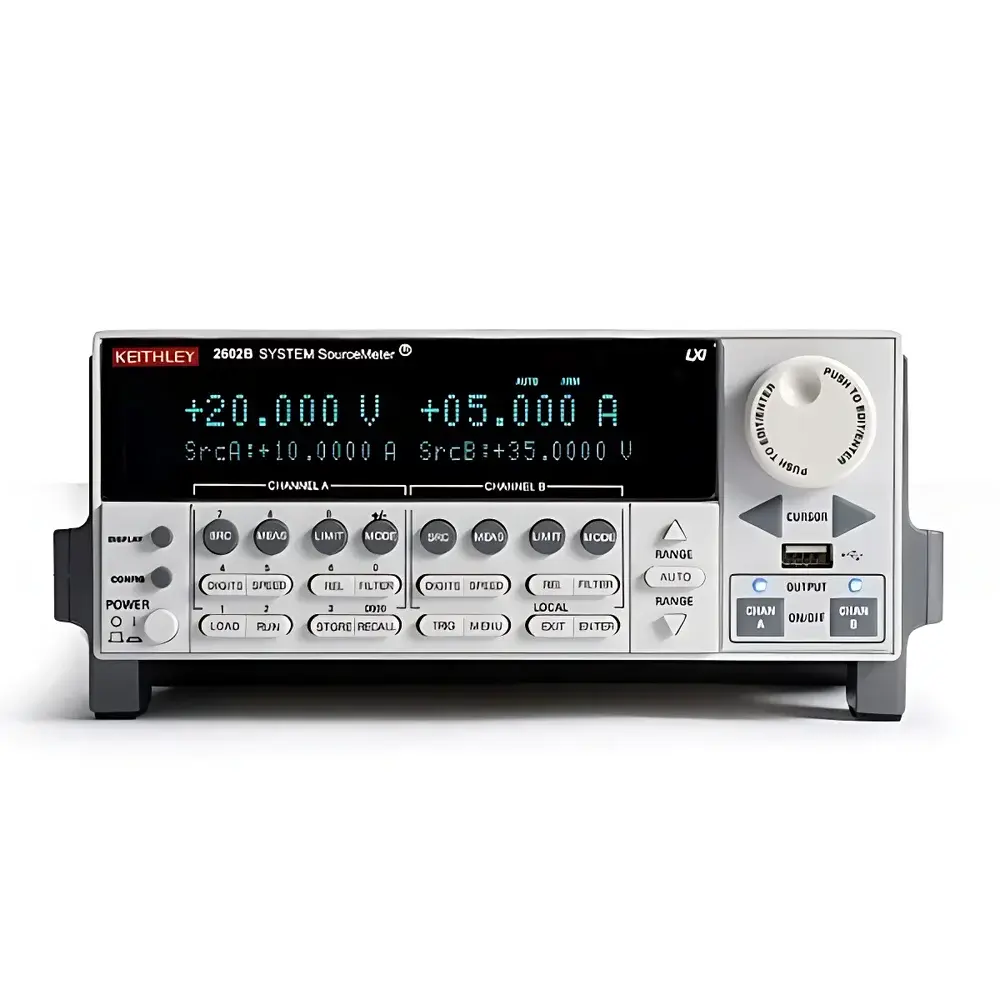
The Keithley 2600 Series SourceMeter Software Suite is a rigorously engineered application platform designed for precision source-and-measure instrumentation control, specifically optimized for the Keithley 2600, 2611, and 2614 SourceMeter Units (SMUs). Built upon industry-standard SCPI command architecture and fully compatible with TSP (Test Script Processor) scripting, this software enables true four-quadrant sourcing and synchronized measurement—capable of delivering and measuring voltage (±200 V), current (±1 A), resistance (down to 100 fΩ), and charge (pC-level resolution) with sub-femtoampere current sensitivity. Its core functionality bridges semiconductor device characterization, electrochemical analysis, photovoltaic evaluation, and reliability stress testing under controlled DC, pulsed, or swept excitation conditions. The software operates as a host-based interface—fully compliant with Windows OS environments—and integrates seamlessly with LabVIEW, MATLAB, Python (via PyVISA), and .NET frameworks for automated test system deployment in R&D labs, wafer-level probe stations, and quality assurance environments.
Key Features
- Dual-channel synchronized sourcing and measurement—enabling correlated IV sweeps, gate-drain interdependence analysis, and parallel device comparison without timing skew.
- Comprehensive electrochemical module supporting cyclic voltammetry (CV), multi-step potentiostatic/galvanostatic protocols, and real-time current integration for charge quantification—aligned with ASTM E1935 and ISO 12944 corrosion testing conventions.
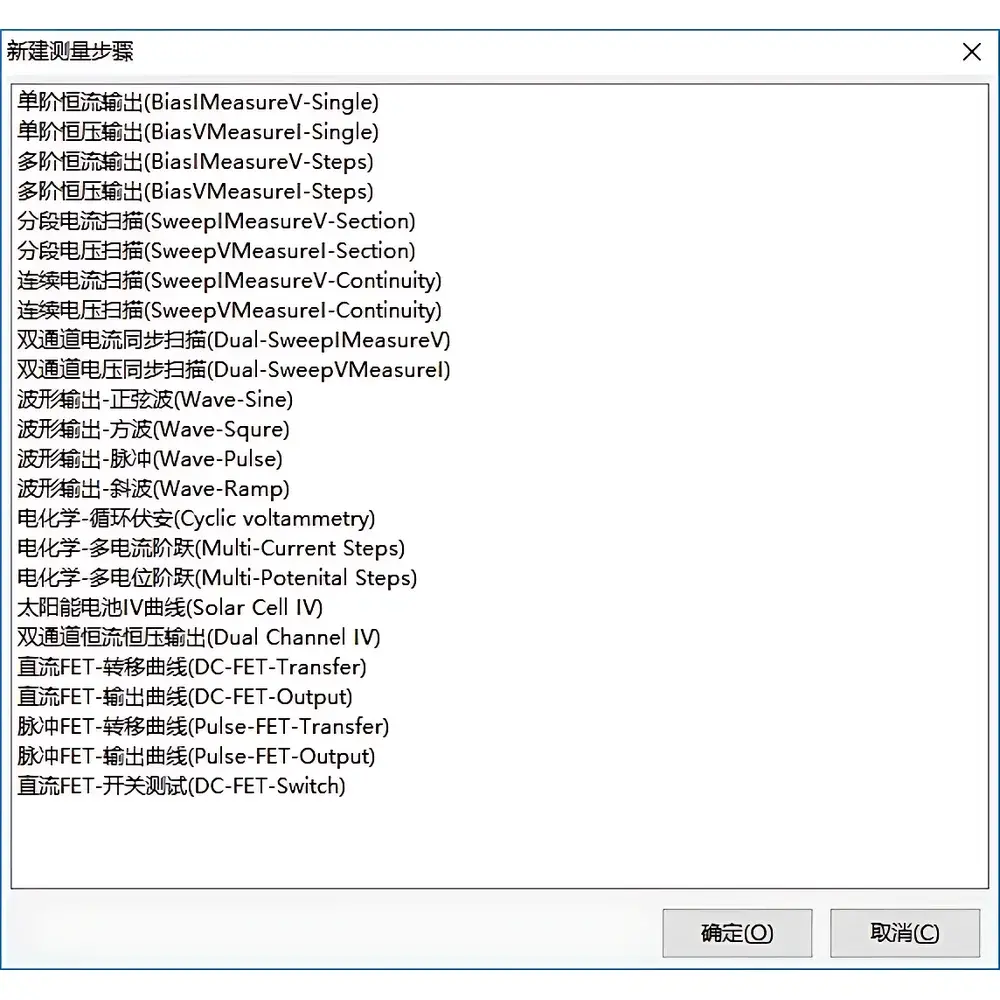
- 24 preconfigured test methods—including DC-FET transfer/output curves, pulse-FET characterization (minimizing self-heating artifacts), solar cell IV extraction (with series/shunt resistance calculation), and dual-channel continuity scanning for interconnect integrity assessment.
- Flexible sweep architectures: single-point bias-and-measure, stepped sweeps (linear/logarithmic), segmented sweeps (user-defined voltage/current ranges with independent step resolution), and continuous real-time waveform acquisition (up to 1 MS/s sampling rate on supported models).
- Hardware-accelerated TSP scripting execution—allowing on-instrument execution of complex sequences (e.g., NBTI stress followed by parametric recovery measurement), reducing PC-to-instrument latency and improving repeatability in high-throughput screening.
- Configurable measurement parameters: NPLC (number of power line cycles) selection from 0.01 to 10, 2-wire or 4-wire remote sensing mode, auto-zero enable/disable per measurement cycle, and digital filtering (moving average, median, or FIR) for noise suppression in low-level signal environments.
Sample Compatibility & Compliance
The software supports characterization of discrete passive components (resistors, capacitors, thermistors, MOVs), active semiconductor devices (BJTs, MOSFETs, JFETs, HEMTs, RFICs, ASICs, SoCs), optoelectronic emitters (LEDs, HBLEDs, VCSELs, laser diodes), photovoltaic cells (perovskite, silicon, CIGS), battery electrodes, and electrochemical working electrodes (Pt, Au, GC, carbon cloth). All measurement routines adhere to fundamental metrological traceability principles. Data export formats (CSV, XLSX, TDMS) support GLP/GMP audit requirements; timestamped logs with operator ID and instrument calibration status meet FDA 21 CFR Part 11 electronic record integrity guidelines when deployed with validated system configurations.
Software & Data Management
Data acquisition is structured around hierarchical project files (.ksp), preserving instrument configuration, script logic, raw measurement vectors, and metadata (temperature, humidity, probe station position). Real-time plotting supports overlay of up to eight traces with logarithmic scaling, derivative computation (dI/dV, dV/dI), and automatic parameter extraction (Vth, Ion/Ioff, Rs, Rsh, FF, Voc, Jsc). Exported datasets include full uncertainty propagation annotations where applicable (e.g., based on SMU accuracy specifications per Keithley’s published calibration certificates). Version-controlled script libraries facilitate method transfer across laboratories, while role-based user permissions (admin/operator/viewer) ensure procedural consistency in regulated environments.
Applications
- Semiconductor process development: threshold voltage shift tracking, mobility extraction, subthreshold swing analysis, and hot-carrier injection (HCI) degradation monitoring.
- Wafer-level reliability testing: time-dependent dielectric breakdown (TDDB), negative bias temperature instability (NBTI), and electromigration lifetime projection.
- Electrochemical energy storage: solid-electrolyte interphase (SEI) formation kinetics, lithium plating detection, and impedance spectroscopy correlation via hybrid potentiostatic-pulsed protocols.
- Photovoltaic R&D: spectral response mapping, light-soaking stability assessment, and series resistance optimization via multi-bias point IV fitting.
- MEMS/NEMS device validation: pull-in voltage determination, hysteresis loop quantification, and contact resistance mapping across microscale interconnect arrays.
FAQ
Is this software officially licensed by Tektronix/Keithley?
No—it is a third-party application developed by China Education Goldsource for interoperability with Keithley 2600-series hardware. It does not replace Keithley’s native KickStart or TestScript Studio but extends functionality for specialized electrochemical and dual-channel workflows.
Does it support remote operation over LAN or GPIB?
Yes—full TCP/IP socket communication (VISA-based) and IEEE-488.2 (GPIB) are implemented, enabling integration into factory automation systems and centralized test management platforms.
Can measurement scripts be exported for reuse on other Keithley instruments?
TSP scripts generated within the suite are portable across all 2600-series SMUs; however, model-specific features (e.g., extended current ranges on 2636B) require manual validation prior to cross-platform deployment.
What operating systems are supported?
Windows 10/11 (64-bit) with .NET Framework 4.8 and VISA Runtime 20.0 or later. Virtual machine environments (VMware, Hyper-V) are supported if USB/GPIB/LAN interfaces are properly passthrough-configured.
Is GLP-compliant data archiving available?
Yes—audit trails record operator login, script execution timestamps, instrument firmware versions, calibration due dates, and raw binary data checksums, satisfying ALCOA+ (Attributable, Legible, Contemporaneous, Original, Accurate, Complete, Consistent, Enduring, Available) data integrity criteria.



