
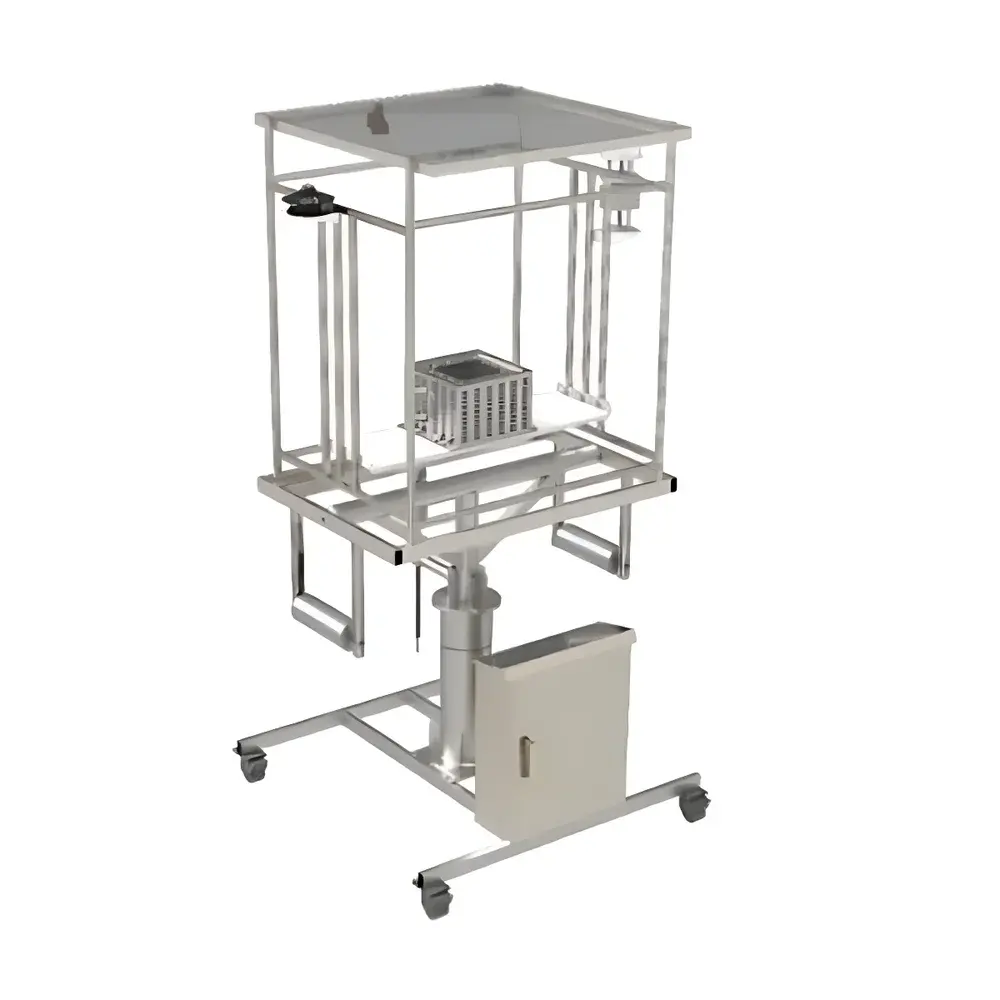
CEL-TCR1000 Solar Thermal Concentration Reactor with Automated Sun-Tracking System
| Brand | CEA-Light |
|---|---|
| Model | CEL-TCR1000 |
| Origin | Beijing, China |
| Manufacturer Type | Direct Manufacturer |
| Product Category | Domestic |
| Component Type | Optical Instrument Assembly |
| Dimensions (L×W×H) | 2.4 m × 1.2 m × 1.2 m |
| Fresnel Lens Size | 1 m × 1 m, Focal Length: 1 m |
| Sample Holder Cross-Sections | 10×10 cm, 8×8 cm, 6×6 cm, 4×4 cm, 2×2 cm (custom sizes available) |
| Maximum Load Capacity | <70 kg (including wind load) |
| Azimuth Tracking Range | −100° to +100° |
| Elevation Tracking Range | 25° to 90° |
| Anemometer Range | 0–40 m/s, Start-up Wind Speed: 0.5 m/s, Accuracy: ±2% FS, Resolution: 0.01 m/s |
| Wind Vane Range | 0–360°, Accuracy: ±3°, Resolution: 1° |
| Ambient Temperature Measurement Accuracy | ±1 ℃ |
| Pyranometer Sensitivity | 7–14 µV·W⁻¹·m⁻² |
| Pyranometer Spectral Range | 300 nm–3000 nm |
| Pyranometer Field of View | 0–180° (hemispherical) |
| Pyranometer Irradiance Range | 0–2000 W·m⁻² |
| Pyranometer Annual Stability | ≤±2% |
| Operating Temperature Range | Ambient to 800 ℃ |
| Vertical Temperature Sensor Positions | 3 locations along reactor axis |
| Adjustable Reactor Height | Yes, via height-adjustment plate |
Overview
The CEL-TCR1000 Solar Thermal Concentration Reactor with Automated Sun-Tracking System is a field-deployable, outdoor-capable experimental platform engineered for quantitative evaluation of solar-to-thermal energy conversion and storage performance in phase-change and non-phase-change materials. It operates on the principle of concentrated solar irradiation using a large-area, plano-convex Fresnel lens (1 m × 1 m, f = 1 m), which focuses direct normal irradiance onto a vertically oriented, insulated metal pressure reactor. The system employs dual-axis solar tracking—azimuth (−100° to +100°) and elevation (25° to 90°)—to maintain near-normal incidence of sunlight on the lens surface throughout daylight hours, maximizing optical coupling efficiency and thermal flux density at the focal plane. Designed for rigorous outdoor thermophysical characterization, the CEL-TCR1000 integrates real-time environmental monitoring (ambient temperature, relative humidity, wind speed/direction) alongside high-temperature reactor operation (up to 800 ℃), enabling controlled correlation between incident solar irradiance and material thermal response under realistic atmospheric conditions.
Key Features
- Dual-axis automated sun-tracking mechanism with precision stepper motor control and real-time astronomical algorithm-based positioning, ensuring continuous optical alignment within ±0.5° tracking error.
- Modular sample chamber architecture featuring five standardized internal liners (10×10 cm to 2×2 cm cross-sections), each compatible with thermally stable, inert crucible inserts; custom liner geometries available upon request.
- Vertically stacked triple-point thermocouple array mounted along the reactor’s central axis, enabling spatially resolved temperature profiling across the sample volume to quantify axial thermal gradients during heating/cooling cycles.
- Adjustable reactor-lens distance via calibrated height adjustment plate, permitting systematic variation of peak irradiance intensity (0–2000 W·m⁻²) at the sample plane without mechanical reconfiguration.
- Integrated Class A-certified pyranometer with hemispherical (0–180°) field-of-view, spectral response covering 300–3000 nm (matching AM1.5G solar spectrum), and annual stability ≤±2%, compliant with ISO 9060:2018 standards.
- Environmental sensor suite including NIST-traceable anemometer (0–40 m/s, ±2% FS), wind vane (±3° accuracy), and digital hygrothermograph, all time-synchronized with reactor telemetry for multivariate data correlation.
Sample Compatibility & Compliance
The CEL-TCR1000 accommodates solid, granular, or packed-bed thermal storage media—including paraffin-based PCMs, molten salt composites, metal hydrides, and ceramic phase-change ceramics—within its stainless-steel reactor vessel fitted with high-temperature insulation (rated to 900 ℃). Liner interchangeability supports comparative testing across scale-dependent thermal diffusion regimes. All structural components meet ISO 14001 environmental design criteria; the tracking frame complies with IEC 61215 mechanical load requirements for outdoor photovoltaic mounting systems (wind load ≤70 kg inclusive). Data acquisition firmware adheres to GLP principles, supporting audit-ready timestamped logs with hardware-level calibration metadata embedded per measurement cycle.
Software & Data Management
The system operates via a ruggedized industrial controller running embedded Linux, interfacing with all sensors through isolated 24-bit ADC channels. Raw data—including irradiance, three-point temperature, wind vector, ambient T/RH, and actuator position—is logged at user-configurable intervals (1 s to 10 min) to encrypted onboard SD storage. Optional Ethernet/WiFi connectivity enables remote monitoring via secure HTTPS dashboard, supporting CSV/NetCDF export for post-processing in MATLAB, Python (Pandas/SciPy), or ASTM E2914-compliant thermal analysis workflows. Calibration certificates for pyranometer and thermocouples are stored in device memory and automatically appended to exported datasets.
Applications
- Quantitative assessment of thermal storage capacity, enthalpy hysteresis, and cycling stability in next-generation PCM formulations under natural solar flux conditions.
- Validation of computational fluid dynamics (CFD) and finite-element thermal models against experimentally derived axial temperature profiles and transient heat-up/cool-down kinetics.
- Outdoor benchmarking of solar concentrator-reactor coupling efficiency, including optical losses due to atmospheric scattering, lens soiling, and off-axis tracking drift.
- Environmental impact studies evaluating wind-induced convective cooling effects on reactor thermal retention, enabled by optional aerodynamic shielding and paired wind-speed-correlated temperature regression.
- Pre-normative testing support for ISO/IEC technical committee activities related to solar thermal energy storage certification (e.g., ISO 24194, IEC 62788-7-2).
FAQ
What is the maximum operational temperature of the reactor, and how is thermal stability maintained?
The reactor is rated for continuous operation from ambient temperature up to 800 ℃. Thermal stability is achieved via multi-layer mineral wool insulation surrounding the stainless-steel vessel, combined with active feedback control of sample-stage heating elements (if externally integrated) and real-time compensation using the three-point vertical temperature profile.
Can the system operate autonomously over extended periods without manual intervention?
Yes. The embedded controller executes fully autonomous daily tracking, data logging, and environmental monitoring. Battery-backed RTC and watchdog timer ensure uninterrupted operation across power outages; runtime exceeds 72 hours on standard 12 V DC auxiliary supply.
Is the pyranometer calibration traceable to national metrology institutes?
Yes. Each unit ships with a factory calibration certificate traceable to NIM (National Institute of Metrology, China) and cross-verified against WRR (World Radiometric Reference) standards at PMOD/WRC, Davos.
How is wind loading accounted for in structural design?
The frame structure is engineered to withstand gust loads up to 40 m/s (equivalent to Beaufort Scale 12) with safety factor ≥2.0 per EN 1991-1-4:2019, and total system mass (≤70 kg) includes dynamic wind pressure contribution in static load calculations.
Are software updates and firmware patches provided post-purchase?
Yes. Registered users receive biannual firmware updates addressing sensor drift correction algorithms, expanded environmental data interpolation models, and compatibility with new liner configurations—all distributed via secure OTA (over-the-air) channel or encrypted USB delivery.





