
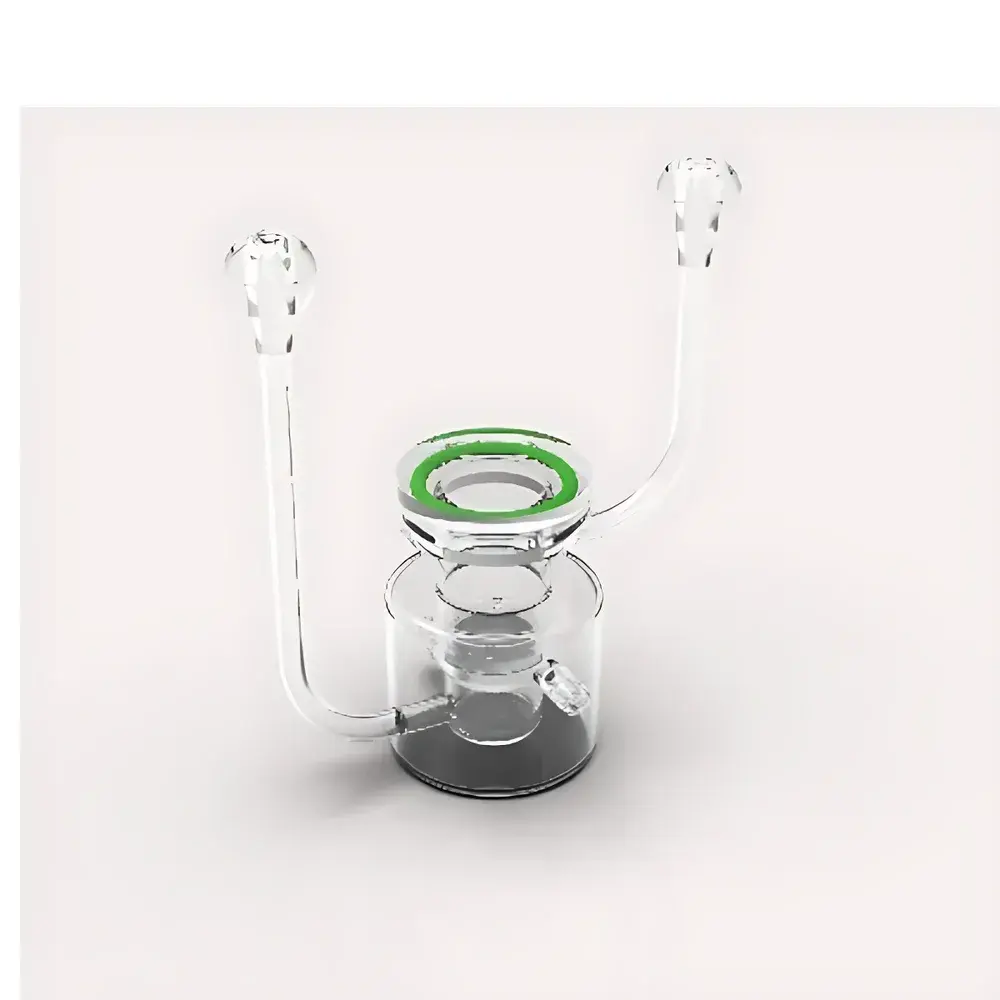
Online CO₂ Reduction Photoreactor System by CNI
| Brand | CNI |
|---|---|
| Model | Online CO₂ Reduction Photoreactor |
| Type | Gas–Solid Phase Photochemical Reactor with Integrated Temperature Control and Circulation |
| Light Source Interface | External Irradiation via 28# Standard Ground Joint |
| Sealing | Dual O-Ring Flanged Connection |
| Catalyst Mounting | Removable Fritted Glass Disc (Porosity G3, Ø25 mm) |
| Reaction Volume | 50 mL |
| Optional Additive | Trace H₂O Injection Port |
| Compliance | Designed for ASTM E2715-21 & ISO 22196 Photocatalytic Activity Assessment Protocols |
Overview
The CNI Online CO₂ Reduction Photoreactor is a purpose-engineered gas–solid phase photochemical reaction system designed for quantitative evaluation of photocatalytic CO₂ reduction performance under controlled thermal and irradiative conditions. It operates on the principle of heterogeneous photocatalysis, where semiconductor catalysts (e.g., TiO₂, g-C₃N₄, or Cu-based MOFs) immobilized on a removable fritted glass disc are illuminated by an externally coupled light source—typically a high-stability xenon or mercury lamp equipped with appropriate optical filters (UV, visible, or full-spectrum). The reactor enables continuous gas-phase circulation through a closed-loop configuration, facilitating real-time monitoring of CO₂ consumption and product evolution (e.g., CH₄, CO, CH₃OH, H₂) via online GC or MS coupling. Its integrated temperature regulation module maintains isothermal operation between 10 °C and 80 °C (±0.3 °C stability), critical for kinetic discrimination and Arrhenius analysis in photocatalytic studies.
Key Features
- Modular 50 mL cylindrical quartz body with 28# standard taper ground joint interface—ensures interchangeability with common vacuum manifolds, gas dosing lines, and analytical sampling ports.
- Removable G3-porosity sintered glass disc (Ø25 mm) for uniform catalyst deposition and mechanical retention; compatible with slurry-derived, drop-cast, or spray-coated catalyst layers.
- Dual O-ring flanged sealing system using fluorosilicone elastomer (FVMQ), rated for vacuum service up to 10⁻³ mbar and positive pressure up to 0.3 MPa—validated per ISO 15848-1 leakage class A.
- Integrated Peltier-based temperature control unit with PID feedback loop and external Pt100 sensor port—supports both heating and cooling modes without auxiliary chiller requirements.
- Dedicated micro-dosing port for controlled introduction of liquid co-reactants (e.g., 1–50 μL H₂O) into the gas stream, enabling systematic study of humidity effects on CO₂ photoreduction selectivity.
- Gas recirculation pathway includes inline stainless-steel filter (0.2 μm), calibrated mass flow controller (MFC range: 0–100 sccm), and non-return valve—ensuring stoichiometric gas residence time control and prevention of back-diffusion.
Sample Compatibility & Compliance
The reactor accommodates powdered, pelletized, or thin-film heterogeneous catalysts with particle sizes ranging from 10 nm to 200 μm. Its design conforms to ASTM E2715-21 “Standard Practice for Evaluating Photocatalytic Activity of Materials Using Carbon Dioxide Reduction” and supports method validation under ISO 22196:2011 for antimicrobial and redox-active surface characterization. All wetted components—including quartz body, PTFE-lined caps, and stainless-steel fittings—meet USP Class VI biocompatibility and FDA 21 CFR Part 11 data integrity prerequisites when operated with compliant data acquisition systems. The system is fully compatible with GLP/GMP audit trails when paired with validated chromatographic or spectroscopic analyzers.
Software & Data Management
While the base reactor operates as a hardware platform without embedded firmware, it integrates seamlessly with third-party process control software (e.g., LabVIEW, MATLAB, or Python-based PySerial/DAQmx frameworks) via analog voltage outputs (0–10 V) for temperature setpoint, MFC flow rate, and optional thermocouple readouts. All mechanical interfaces follow SEMI F47-0212 standards for vacuum compatibility, and digital I/O signals support synchronization with shutter controllers, lamp power supplies, and GC trigger pulses. Raw operational logs—including timestamps, setpoints, and sensor readings—can be exported in CSV or HDF5 format for traceable post-processing in accordance with ALCOA+ principles (Attributable, Legible, Contemporaneous, Original, Accurate, Complete, Consistent, Enduring, Available).
Applications
- Quantitative assessment of CO₂-to-fuel conversion efficiency (e.g., quantum yield, turnover frequency) across wavelength-resolved illumination conditions.
- Long-duration stability testing (>100 h) of photocatalysts under dynamic gas composition (CO₂/N₂/H₂O/O₂ mixtures).
- Kinetic modeling of surface adsorption–desorption equilibria using in situ DRIFTS-compatible viewport configurations.
- Multi-variable optimization studies combining temperature, light intensity, gas flow rate, and water partial pressure.
- Method development for ISO/IEC 17025-accredited photocatalytic testing laboratories seeking traceable calibration against NIST SRM 2073a (TiO₂ P25 reference material).
FAQ
Is the reactor compatible with vacuum ultraviolet (VUV) light sources?
Yes—the fused quartz body transmits down to 160 nm; however, VUV operation requires optional MgF₂ viewport substitution and purge gas (Ar or N₂) to prevent ozone formation.
Can the fritted disc be replaced with alternative substrates?
Yes—standard 25 mm discs in alumina, stainless steel mesh, or conductive ITO-coated glass are mechanically interchangeable using the same clamping flange.
Does the system include gas analysis instrumentation?
No—gas chromatography (GC-TCD/FID), mass spectrometry (MS), or FTIR modules must be selected and interfaced separately per user analytical requirements.
What maintenance intervals are recommended for O-rings and frits?
Fluorosilicone O-rings should be inspected and replaced every 6 months under continuous operation; sintered glass frits require ultrasonic cleaning in acetone after each 10 experimental cycles.
Is remote monitoring supported?
Yes—via RS-485 Modbus RTU interface (optional add-on module), enabling integration into centralized lab automation platforms such as DeltaV or LabArchives.




