
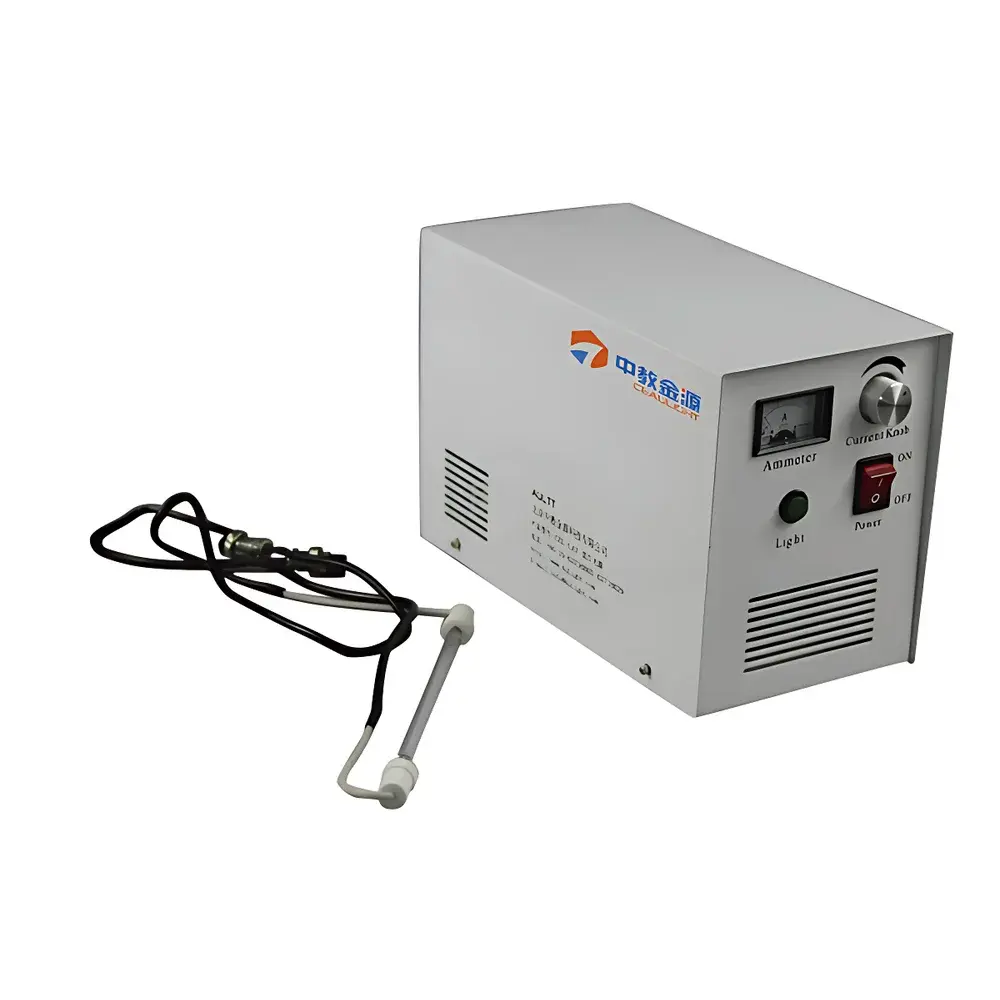
CEL-WLAX500 Visible-Light External Irradiation Photochemical Reaction System
| Brand | CEA (China Education Goldsource) |
|---|---|
| Origin | Beijing, China |
| Manufacturer Type | OEM Manufacturer |
| Product Origin | Domestic (PRC) |
| Model | CEL-WLAX500 |
| Light Source Type | 500 W Long-Arc Xenon Lamp |
| Irradiation Mode | Top-Down External Illumination |
| Input Voltage | 220 V AC |
| Lamp Length | 220 mm |
| Compatible Reactor Volume | 1–500 mL |
| Effective Illumination Area | 200 × 300 mm |
| Reflector Type | Full-Spectrum Parabolic Aluminum Reflector |
| Optional Accessories | Bandpass/Longpass/Shortpass Optical Filters (e.g., UV cutoff ≥395 nm, visible bandpass 400–780 nm, UVA 320–400 nm) |
| Cabinet Dimensions (Optional) | 400 × 400 × 500 mm or 400 × 400 × 700 mm |
| Cooling | Forced-air ventilation compatible |
| Compliance | Designed for laboratory-scale photochemical research under ambient atmospheric conditions |
Overview
The CEL-WLAX500 Visible-Light External Irradiation Photochemical Reaction System is an engineered platform for controlled top-down photonic stimulation in open or semi-open reaction configurations. It operates on the principle of broadband spectral irradiation using a stabilized 500 W long-arc xenon lamp, delivering continuous output across the full visible spectrum (approximately 350–800 nm) with significant near-UV and near-IR components. Unlike internal immersion-type light sources, the CEL-WLAX500 employs an external illumination architecture—positioned above the reaction vessel—enabling rapid setup, real-time visual monitoring, and compatibility with standard laboratory glassware (e.g., quartz or borosilicate beakers, Petri dishes, custom flow cells). Its parabolic full-spectrum reflector optimizes photon flux density across a uniform 200 × 300 mm irradiation field, achieving spatial irradiance homogeneity suitable for comparative photocatalytic screening, photoelectrochemical characterization (e.g., solar cell I-V testing), and synthetic photochemistry under ambient pressure and temperature conditions.
Key Features
- 500 W long-arc xenon lamp with stable DC or AC-powered electronic ballast, ensuring consistent radiometric output over extended operational cycles
- Top-down external irradiation geometry optimized for vertical reactor alignment and minimal thermal coupling to samples
- Modular optical interface: standardized M39 or SM1-threaded mount at lamp housing exit for direct integration of interference filters, cut-off filters, or diffusers
- Full-spectrum high-reflectivity aluminum parabolic reflector designed to maximize collimation efficiency and minimize divergence beyond ±15°
- Robust ventilated enclosure options (400 × 400 × 500 mm or 400 × 400 × 700 mm) supporting active air cooling, electrical safety shielding, and darkroom-compatible operation
- Scalable reactor compatibility: validated for volumes from 1 mL micro-reactions to 500 mL batch systems using standard lab-grade quartz or fused silica windows
Sample Compatibility & Compliance
The CEL-WLAX500 is intended for use in non-pressurized, atmospheric photochemical experiments requiring reproducible broadband illumination. It supports heterogeneous photocatalysis (e.g., TiO₂, g-C₃N₄, MOFs), homogeneous photoredox catalysis, polymer photo-crosslinking, and photoelectrochemical evaluation of thin-film devices. The system complies with general laboratory safety standards for Class 3B optical radiation sources (IEC 60825-1:2014); users must implement appropriate UV-blocking eyewear and skin protection when operating without spectral filtering. While not certified to ISO/IEC 17025 or GLP, its design facilitates traceable experimental documentation—lamp runtime logging, filter identity tagging, and irradiance mapping protocols align with ASTM E2583-21 (Standard Practice for Photocatalytic Activity Measurement) and ISO 10678:2010 (Photocatalysis — Determination of Photocatalytic Activity).
Software & Data Management
The CEL-WLAX500 operates as a hardware-only platform without embedded firmware or proprietary control software. Integration with third-party data acquisition systems is supported via analog voltage output (0–5 V) proportional to lamp current, enabling synchronization with spectroradiometers (e.g., Ocean Insight HDX), thermal sensors, or potentiostats. Users may record irradiance profiles using calibrated silicon photodiodes or spectroradiometers traceable to NIST standards. For regulatory environments (e.g., academic GMP-aligned labs), manual logbooks or ELN entries—including lamp serial number, filter ID, exposure duration, and ambient temperature/humidity—are recommended to satisfy audit requirements under 21 CFR Part 11 for electronic records where applicable.
Applications
- Visible-light-driven photocatalytic degradation of organic pollutants (e.g., methylene blue, phenol) in aqueous suspension
- Photoelectrochemical performance mapping of perovskite or dye-sensitized solar cells under simulated AM1.5G illumination
- Wavelength-selective photoisomerization and [2+2] cycloaddition reactions using interchangeable optical filters
- Accelerated photostability testing of pharmaceutical intermediates or polymer coatings
- Teaching laboratories: quantitative demonstration of quantum yield, action spectra, and Lambert–Beer law deviations under polychromatic excitation
FAQ
Can the CEL-WLAX500 be used with UV-transmitting reactors?
Yes—when paired with optional UV-pass filters (e.g., UVA 320–400 nm) and quartz reaction vessels, it supports near-UV photochemistry. Standard borosilicate glass blocks below ~300 nm.
Is radiometric calibration included with the system?
No—calibration requires external instrumentation. We recommend annual verification using a NIST-traceable spectroradiometer or calibrated photodiode sensor.
What is the typical lamp lifetime under continuous operation?
Rated average life is 1,000 hours at rated power; output intensity degrades gradually (~15% lumen depreciation at 500 h), necessitating periodic recalibration.
Can the system accommodate custom-sized reactors or multi-position trays?
Yes—the open-top cabinet design allows mechanical adaptation for tray-based parallel reactors up to 200 × 300 mm footprint; mounting brackets and leveling feet are user-configurable.
Does the system meet CE or UL safety certification?
It is manufactured to IEC 61000-6-3 (EMC emission) and IEC 61000-6-2 (immunity) requirements but lacks formal CE/UL marking; end-users are responsible for local regulatory validation prior to installation.




