
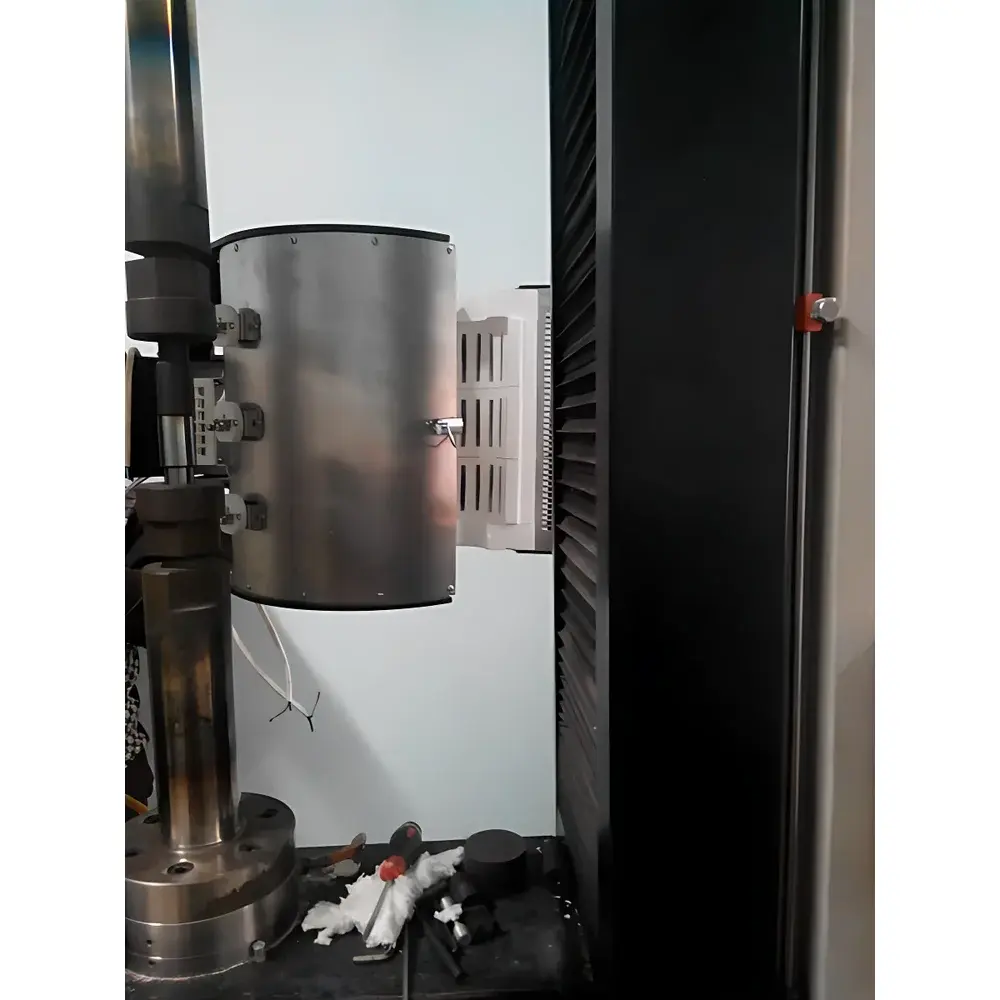
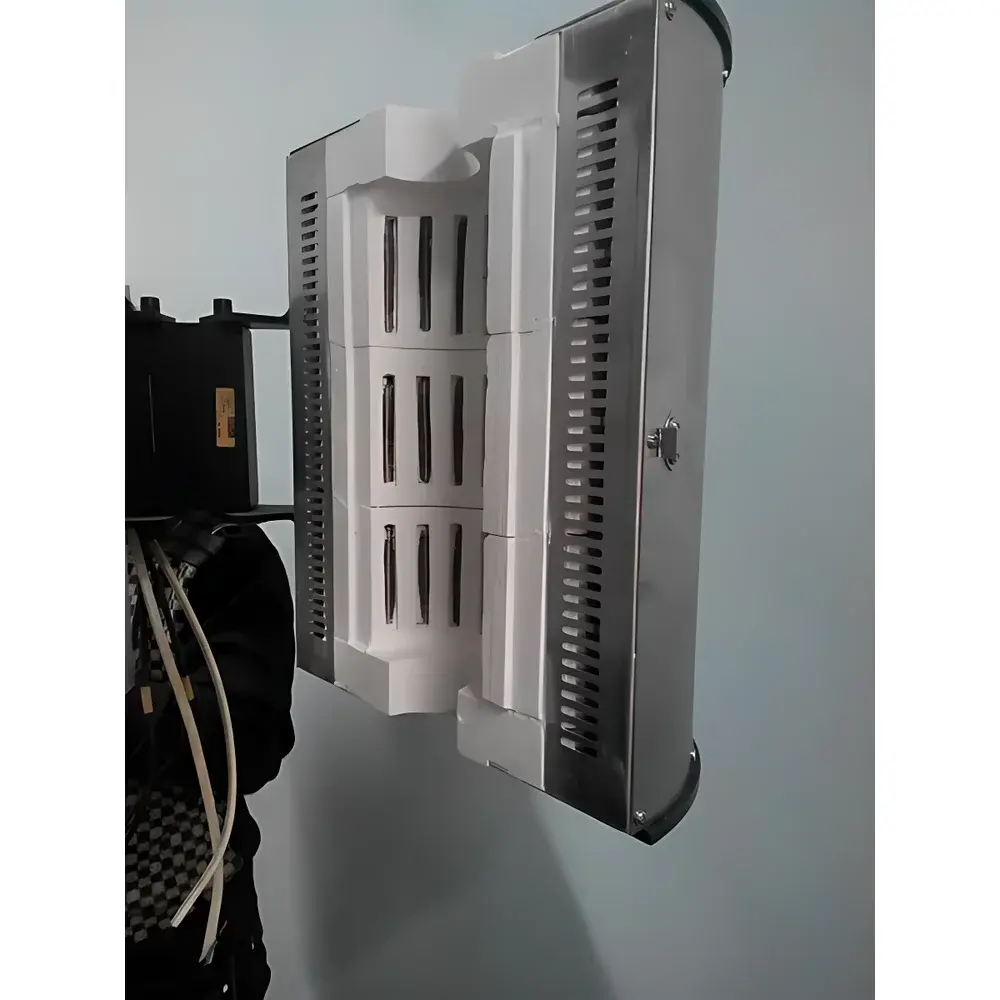
Zhongke Aobo GL Vertical Triple-Zone Heating Furnace
| Brand | Zhongke Aobo |
|---|---|
| Origin | Beijing, China |
| Model | GL |
| Chamber Volume Options | 6 L, 9 L, 20 L, 30 L, 60 L |
| Max Operating Temperature | 1000 °C (standard), optional up to 1700 °C |
| Heating Rate | ≤30 min (100 °C → 1000 °C) |
| Power Supply | 16 A / 220 V (6 L & 9 L) |
| External Surface Temperature at 1000 °C Hold | ≤55 °C |
| Insulation Material | High-purity ceramic fiber |
| Heating Element Configuration | Dual-side embedded heating panels with imported ultra-high-temperature resistance elements |
| Control System | Independent digital temperature controller with PID algorithm, programmable ramp/soak profiles, and real-time display |
| Safety Features | Over-temperature protection, thermal cut-off switch, door interlock, grounded chassis |
Overview
The Zhongke Aobo GL Vertical Triple-Zone Heating Furnace is a precision-engineered laboratory furnace designed for controlled thermal processing across diverse scientific and industrial applications. Unlike conventional single-zone muffle furnaces, this vertical configuration integrates three independently controllable axial heating zones—enabling precise thermal gradient establishment, uniform heat distribution along tall or layered samples, and enhanced process repeatability in applications requiring staged heating or differential thermal treatment. Its core architecture employs high-density ceramic fiber insulation, minimizing thermal mass and enabling rapid heating rates while maintaining low external surface temperatures (<55 °C at steady-state 1000 °C operation). The furnace operates on fundamental resistive heating principles, with imported high-temperature alloy heating elements mounted on dual-side衬板 (side-panel) supports—ensuring mechanical stability, uniform radiant flux, and extended service life under cyclic thermal stress.
Key Features
- Triple-Zone Thermal Control: Three independent PID-controlled heating zones allow user-defined temperature gradients (e.g., preheat–hold–cool profiles), critical for ashing protocols, thermal gravimetric analysis (TGA) sample preparation, and multi-step calcination.
- Rapid Thermal Response: Achieves 100 °C to 1000 °C in under 30 minutes; 100 °C to 1700 °C in under 90 minutes—enabled by low-thermal-mass ceramic fiber insulation and optimized element geometry.
- Modular & Service-Oriented Design: Separated furnace body and intelligent controller facilitate maintenance; side-opening door and accessible side-panel heating elements simplify heater replacement without disassembling the insulation structure.
- Energy-Efficient Operation: Ceramic fiber construction reduces power consumption by ~50% versus traditional brick-lined furnaces of equivalent volume; 6 L and 9 L models operate on standard 220 V / 16 A circuits, minimizing infrastructure requirements.
- Enhanced Safety Architecture: Integrated over-temperature cutoff, door interlock switch, grounded metal chassis, and thermal barrier design ensure compliance with IEC 61010-1 safety standards for laboratory electrical equipment.
- Configurable Ventilation & Atmosphere Options: Standard rear exhaust port supports passive fume removal; optional gas inlet/outlet fittings enable inert (N₂, Ar) or reducing (H₂/N₂) atmosphere processing per ASTM E1111 and ISO 8573-1 purity guidelines.
Sample Compatibility & Compliance
The GL furnace accommodates crucibles, boats, and trays conforming to ISO 3505 (ceramic labware dimensions) and ASTM E1447 (crucible classification). Its vertical chamber geometry supports tall cylindrical samples (e.g., coal cores, catalyst monoliths, medical tissue cassettes) and stacked multi-layer configurations used in pharmaceutical residual solvent analysis (USP ) and coal proximate analysis (ASTM D3172, D3174, D3175). The furnace meets general laboratory equipment requirements under GLP and GMP environments when operated with documented calibration (traceable to NIST-certified thermocouples) and routine performance verification (e.g., temperature uniformity mapping per ASTM E220).
Software & Data Management
The integrated digital controller features a 4-digit LED display, programmable 30-segment ramp/soak profiles, and real-time temperature logging via RS485 interface (Modbus RTU protocol). Optional data acquisition software enables time-stamped export of temperature vs. time datasets in CSV format—supporting audit trails required under FDA 21 CFR Part 11 when paired with user authentication and electronic signature modules. Calibration constants are stored in non-volatile memory, and system diagnostics report heater resistance drift and sensor fault codes to aid preventive maintenance planning.
Applications
- Coal & Energy Analysis: Moisture, ash, volatile matter, and fusibility testing per ASTM D3172–D3176 and ISO 1171.
- Pharmaceutical & Clinical Labs: Sample ashing prior to heavy metal testing (ICH Q2(R2)), residue-on-ignition (USP ), and histological tissue processing.
- Environmental & Water Testing: Total suspended solids (TSS) and total dissolved solids (TDS) gravimetric determination (EPA Method 160.1), sediment ash content analysis.
- Materials Science: Pre-sintering of ceramic green bodies, binder burnout in powder metallurgy, and thermal cycling of battery electrode materials.
- Petrochemical Research: Coke residue quantification (ASTM D524), asphaltene fraction decomposition studies, and catalyst regeneration simulations.
FAQ
What temperature uniformity can be expected across the triple-zone chamber?
Typical radial uniformity within ±5 °C and axial gradient control within ±10 °C per zone at 1000 °C, verified using 3-point NIST-traceable thermocouple mapping per ASTM E220 Annex A3.
Is the furnace suitable for use under inert gas purge?
Yes—optional gas inlet/outlet ports support continuous purge flow; maximum recommended flow rate is 1.5 L/min to maintain thermal stability and avoid convective cooling effects.
How often does the furnace require calibration verification?
Per ISO/IEC 17025 recommendations, verify temperature accuracy annually or after 200 operating hours—whichever occurs first—using calibrated reference thermocouples and documented SOPs.
Can custom furnace dimensions or higher temperature ratings be supplied?
Yes—Zhongke Aobo offers OEM engineering for non-standard chamber geometries (e.g., tubular, well-type, or multi-port configurations) and extended temperature variants up to 1800 °C upon request, subject to structural and safety validation.



