
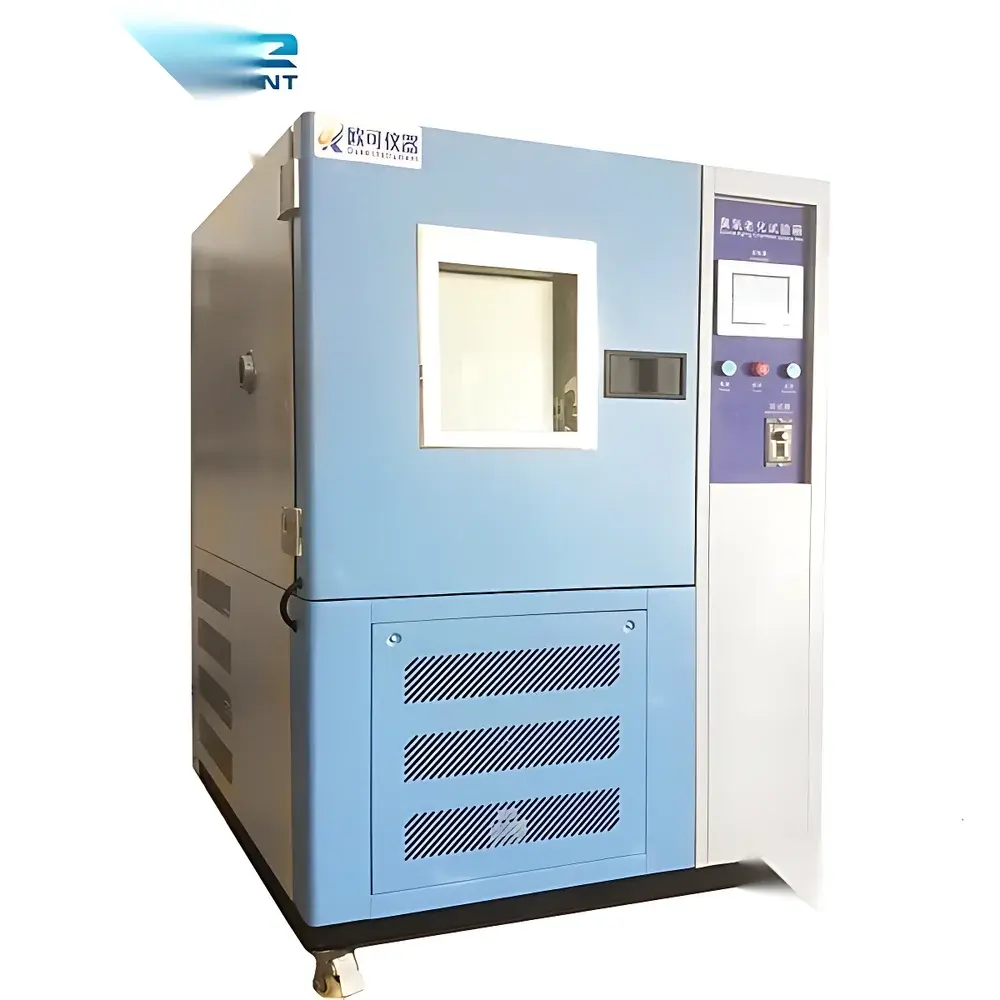
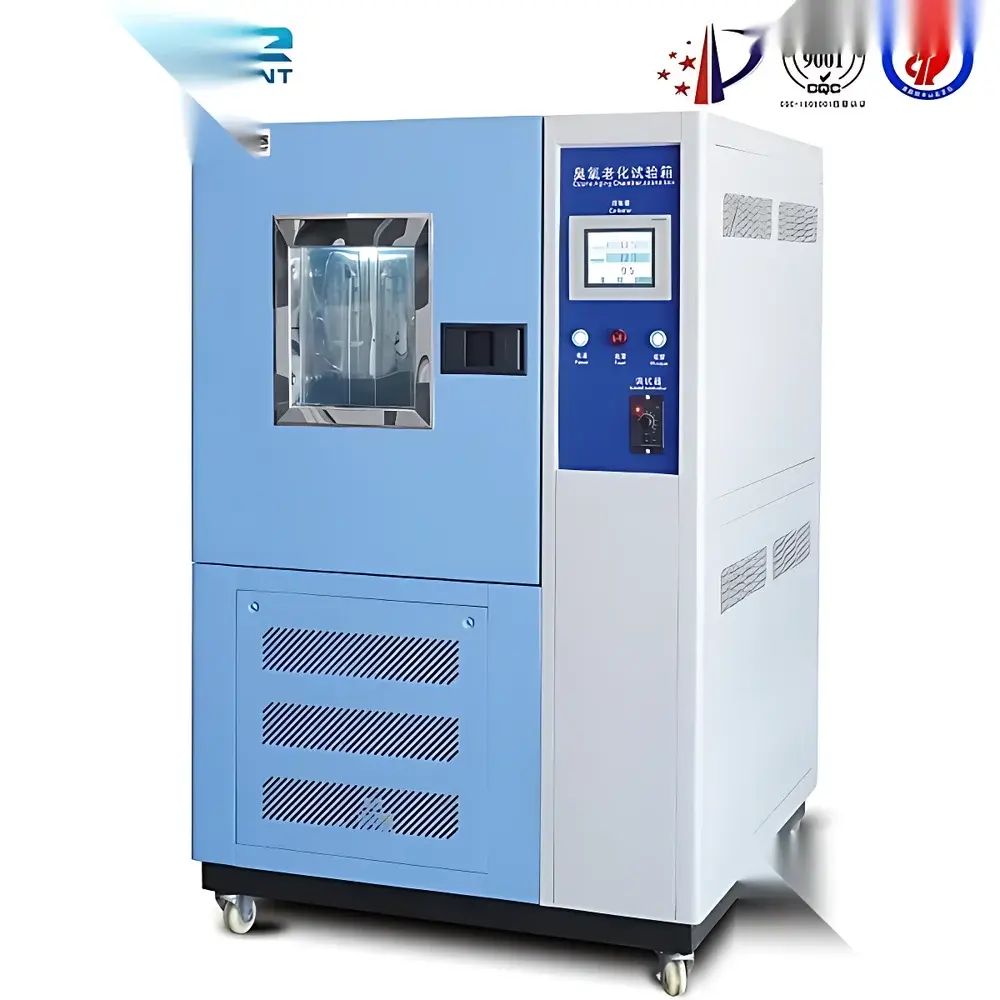
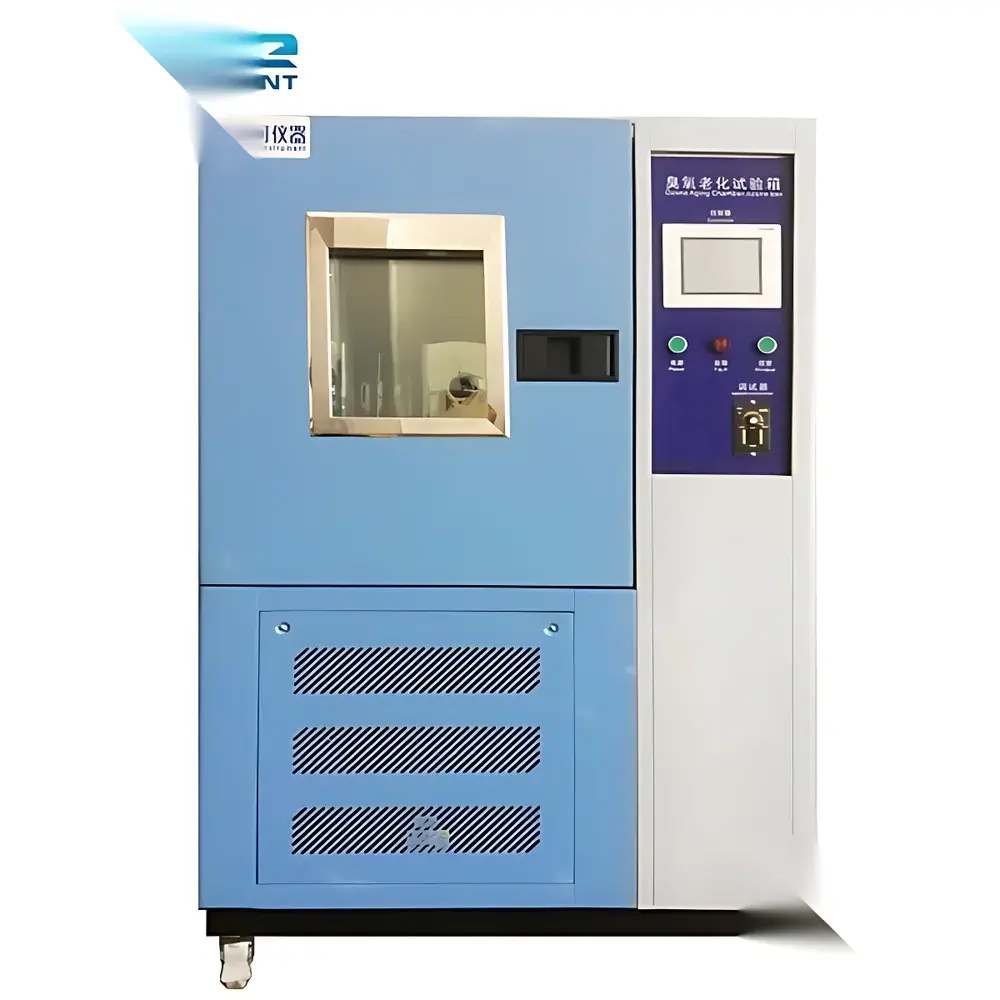
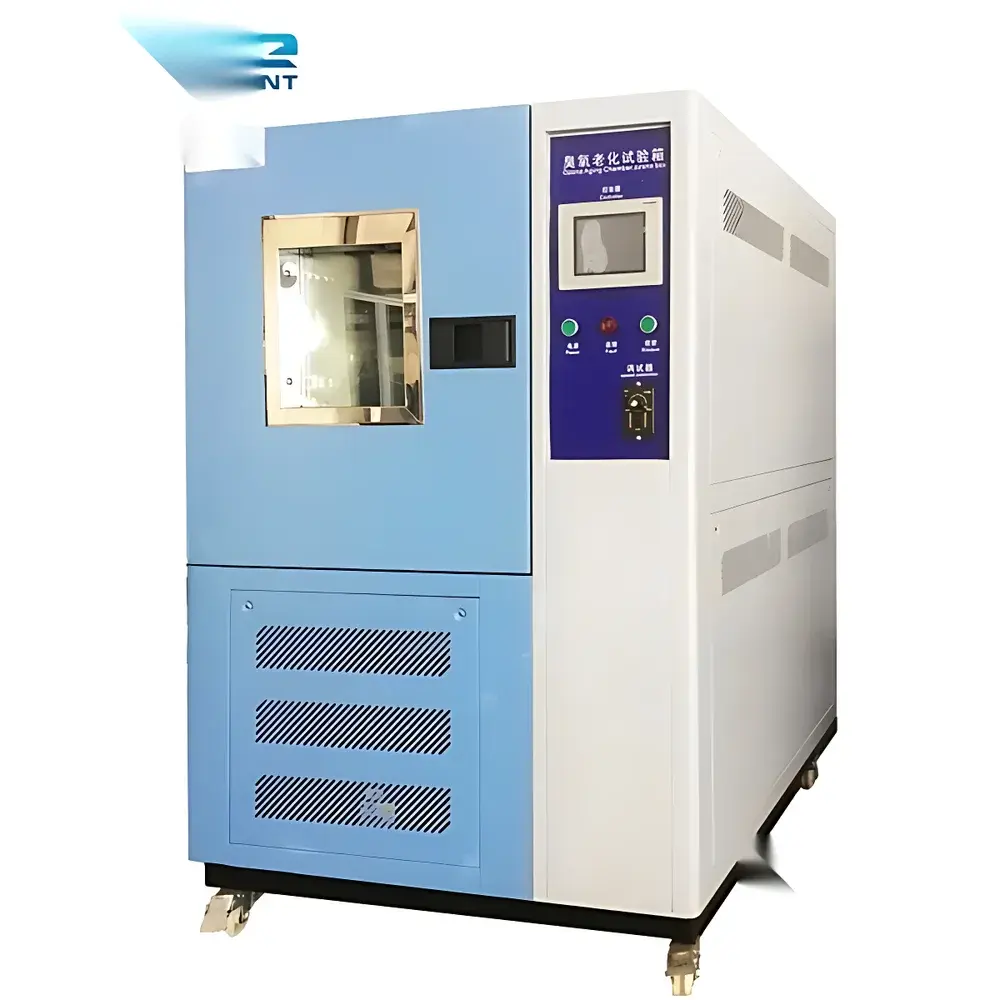
Ozone Aging Test Chamber – QY Series (Customizable Volume Models: QY-80 to QY-1000)
| Key Specifications | Brand: OEM / Industrial Grade |
|---|---|
| Origin | Imported |
| Temperature Range | 25–40 °C |
| Humidity Range | 30–65 %RH |
| Ozone Concentration Range | 50–1500 pphm |
| Temp. Uniformity | ±0.5 °C |
| Sample Rotation Speed | 1 rpm (360° continuous) |
| Gas Flow Velocity | 8–16 mm/s |
| Ozone Generation | Silent Discharge Tube |
| Ozone Detection | Nondispersive UV Absorption Analyzer (≥5 yr service life) |
| Control System | Weilun Color Touchscreen + Siemens PLC |
| Compliance | GB/T 7762–2003, GB/T 2951.21–2008, GB/T 11206–2009, ISO 1431-1:2004 |
| Safety | Fully Enclosed Ozone Loop, Leakage Protection, Over-Temp/Over-Current/Motor Thermal Cut-off |
| Interface | 4–20 mA analog output, RS232 communication port |
| Power Supply | AC 380 V ±5 %, 50 Hz ±0.5 Hz |
Overview
The QY Series Ozone Aging Test Chamber is an industrial-grade environmental test system engineered for accelerated evaluation of elastomeric and polymeric materials under controlled ozone exposure. It operates on the principle of dynamic or static ozone-induced cracking assessment—where specimens are subjected to precisely regulated concentrations of ozone (50–1500 pphm) within a thermally and hygrometrically stabilized stainless-steel reaction chamber. The system employs silent discharge ozone generation, ensuring stable output without nitrogen oxide byproducts, and integrates a nondispersive ultraviolet (UV) absorption analyzer for real-time, trace-level ozone quantification. Designed in strict alignment with international standards—including ISO 1431-1:2004, GB/T 7762–2003, and GB/T 2951.21–2008—the chamber supports both static tensile testing and dynamic rotational aging protocols, enabling reproducible simulation of atmospheric ozone degradation mechanisms critical to rubber compound development, automotive sealing systems, cable insulation qualification, and aerospace elastomer validation.
Key Features
- Fully sealed, leak-tight ozone gas recirculation loop constructed from electropolished 316 stainless steel—eliminates ambient contamination and ensures operator safety.
- Adjustable ozone concentration control (50–1500 pphm) via closed-loop feedback using a factory-calibrated UV absorption sensor with ≥5-year operational lifespan and built-in drift compensation.
- Motor-driven sample rotation mechanism delivering precise 1 rpm continuous 360° rotation—engineered to follow cycloidal trajectory per ASTM D1149 reference geometry, minimizing mechanical stress artifacts during dynamic testing.
- Integrated dual-parameter PID control architecture managing simultaneous setpoint regulation of temperature (25–40 °C), relative humidity (30–65 %RH), and ozone concentration—with auto-tuning capability and digital setpoint recall.
- Human-machine interface featuring a Weilun 7-inch color touchscreen HMI paired with Siemens S7-1200 PLC logic—supporting multi-step program sequencing, event logging, and alarm history with timestamped records.
- Dedicated metrology access port compliant with national calibration protocols; enables third-party verification of ozone concentration accuracy without system disassembly.
Sample Compatibility & Compliance
The QY chamber accommodates standardized dumbbell, ring, or strip specimens per ISO 1431-1 and GB/T 7762, with customizable internal volumes (QY-80 to QY-1000 models) supporting specimen dimensions up to 100 cm × 100 cm × 100 cm. All models comply with GLP-aligned data integrity requirements: audit-trail-enabled parameter logging, tamper-resistant storage of calibration certificates, and configurable retention policies for test reports. The system meets electrical safety standards IEC 61000-6-2/6-4 and is CE-marked for use in EU-regulated laboratories. Optional IQ/OQ documentation packages support GMP-compliant installation and operational qualification per FDA 21 CFR Part 11 guidelines when integrated into regulated quality systems.
Software & Data Management
Embedded firmware supports local data export via USB flash drive in CSV format, including time-stamped ozone concentration, chamber temperature/humidity, and motor status. RS232 serial interface enables bidirectional communication with LIMS or MES platforms for automated report ingestion. The controller stores ≥10,000 data points internally with cyclic overwrite protection. All parameter changes—whether manual override or scheduled ramp—are logged with user ID, timestamp, and pre/post values. Calibration events trigger mandatory electronic signature capture, satisfying traceability mandates under ISO/IEC 17025 and CNAS accreditation frameworks.
Applications
- Evaluation of crack resistance in natural rubber (NR), styrene-butadiene rubber (SBR), nitrile rubber (NBR), and EPDM compounds used in tires, hoses, and vibration dampers.
- Accelerated aging validation of insulated wires and cables per IEC 60811-506 and UL 1581.
- Material screening for outdoor photovoltaic gaskets, roofing membranes, and railway suspension components exposed to urban ozone environments.
- Research into antioxidant efficacy and protective wax migration kinetics under oxidative stress conditions.
- Quality conformance testing for medical device elastomers (e.g., tubing, seals) where ozone-induced embrittlement compromises functional integrity.
FAQ
What ozone concentration ranges does the QY chamber support, and how is stability maintained?
The system delivers 50–1500 pphm with ±5 pphm repeatability over 72-hour continuous operation, achieved via proportional-integral-differential (PID) control of discharge voltage and mass flow modulation.
Is dynamic rotation mandatory, or can static testing be performed?
Both modes are supported: static fixtures maintain constant strain while dynamic mode rotates specimens at 1 rpm—user-selectable via HMI menu without hardware modification.
How frequently must the UV ozone sensor be recalibrated?
Annual calibration is recommended; the analyzer includes zero-gas port and built-in span-check function using certified ozone standard gas (traceable to NIST).
Can the chamber integrate with existing laboratory automation networks?
Yes—RS232 and optional Ethernet/IP modules enable SCADA integration, and 4–20 mA analog outputs support legacy DCS interfaces.
What safety interlocks prevent hazardous ozone release during maintenance?
Three independent hardware interlocks cut power to the ozone generator upon door opening, pressure drop detection, or thermal runaway—verified during factory FAT and documented in the safety manual.



