
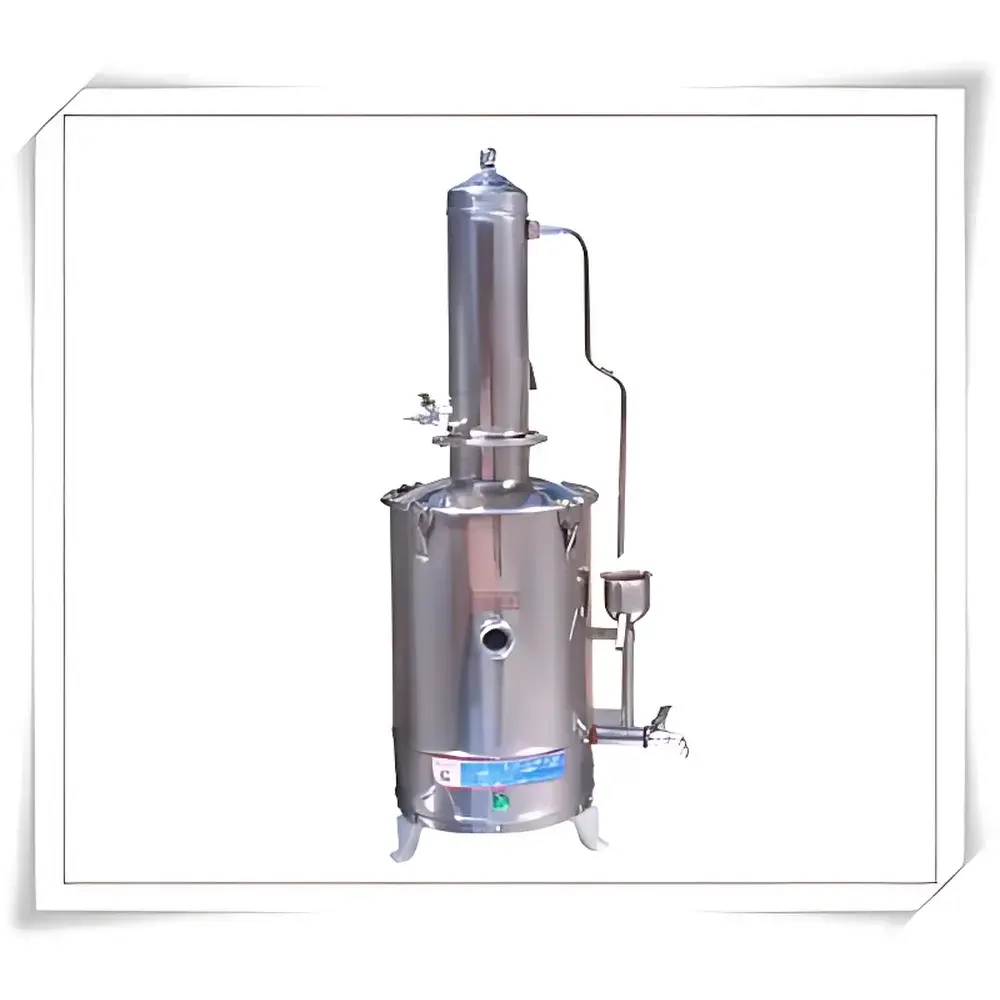
Zhongke Aobo HS·Z68·5 Stainless Steel Electric Distillation Apparatus
| Brand | Zhongke Aobo |
|---|---|
| Origin | Beijing, China |
| Model | HS·Z68·5 |
| Capacity | 5 L |
| Output Rate | 5 L/h |
| Power | 575 W |
| Voltage | 220 V AC |
| Dimensions (Ø × H) | 220 × 750 mm |
| Net Weight | 5 kg |
| Construction | Electropolished 316 stainless steel body with quartz-glass condenser assembly |
| Instrument Type | Benchtop electric distillation apparatus for primary-grade distilled water production |
Overview
The Zhongke Aobo HS·Z68·5 is a benchtop electric distillation apparatus engineered for consistent, on-demand production of primary-grade distilled water in laboratory, clinical, and industrial quality control environments. It operates on the principle of thermal phase separation: feed water is heated to boiling within a sealed stainless steel evaporation chamber; steam rises through a precisely dimensioned vapor pathway into a vertically oriented quartz-glass condenser cooled by ambient air or optional recirculating coolant; condensed vapor is collected as purified distillate free of non-volatile ions, organic contaminants, particulates, and microorganisms. Unlike reverse osmosis or deionization systems, distillation provides inherent removal of pyrogens, endotoxins, and volatile organics with boiling points significantly higher than water—making it indispensable for applications requiring thermally stable, low-conductivity water per ASTM D1193 Type IV and ISO 3696 Grade 3 specifications.
Key Features
- Electropolished 316 stainless steel evaporation chamber ensures long-term corrosion resistance against chloride-rich tap water and periodic cleaning agents.
- Integrated quartz-glass condenser tube offers superior thermal stability, UV transparency, and chemical inertness—critical for minimizing metal leaching and maintaining distillate purity over extended operation cycles.
- Thermostatically controlled heating element with overtemperature cutoff (≥110 °C) and dry-run protection circuitry enhances operational safety and equipment longevity.
- Built-in water-level sensor prevents heater activation below minimum fill line, eliminating risk of thermal damage during startup or low-water conditions.
- Modular design enables straightforward disassembly for routine descaling, gasket replacement, and condenser inspection without specialized tools.
- Compliant with IEC 61010-1:2010 for electrical safety in laboratory equipment; CE-marked for EMC and low-voltage directive conformity.
Sample Compatibility & Compliance
The HS·Z68·5 accepts municipal tap water, softened water, or pre-filtered feed sources with total dissolved solids (TDS) ≤ 500 ppm and free chlorine ≤ 2 mg/L. It is not designed for seawater, high-hardness well water (>180 ppm CaCO₃), or chemically aggressive process effluents. Distillate conductivity typically measures <5 µS/cm at 25 °C when operated with clean feed and maintained per manufacturer’s cleaning schedule. The unit supports GLP-compliant documentation workflows: output volume can be manually logged against time-stamped batch records, and its mechanical operation allows full traceability under FDA 21 CFR Part 11–aligned manual SOPs. Meets requirements for water used in USP Purified Water preparation steps and ASTM E2932-22 Annex A1 for analytical reagent water generation.
Software & Data Management
This is a standalone electromechanical instrument with no embedded firmware, touchscreen interface, or digital connectivity. All operational parameters—including run duration, batch volume, and maintenance intervals—are recorded manually using laboratory notebooks or LIMS-integrated paper-based log sheets. Its simplicity eliminates cybersecurity vulnerabilities, firmware obsolescence risks, and software validation burdens associated with connected instruments. For regulated environments, the absence of electronic data capture aligns with traditional GLP/GMP audit expectations where manual entries are contemporaneous, signed, and reviewed—provided institutional SOPs define clear procedures for calibration verification (e.g., annual conductivity meter check against NIST-traceable standards) and preventive maintenance logging.
Applications
- Preparation of solvent blanks and diluent water for HPLC, IC, and GC-MS analysis where organic residue interference must be minimized.
- Feed water for ultrapure water systems (e.g., Milli-Q®, ELGA PURELAB) to reduce upstream pretreatment load and extend RO membrane life.
- Media preparation in microbiology labs requiring endotoxin-free water for sterility testing and culture broth formulation.
- Calibration standard dilution in clinical chemistry analyzers where conductivity drift affects ion-selective electrode accuracy.
- Teaching laboratories demonstrating phase-change purification principles, energy balance calculations, and material compatibility in thermal processing.
FAQ
What feed water quality is recommended for optimal performance and service life?
Use municipally treated tap water with residual chlorine <2 mg/L and hardness <120 ppm CaCO₃. Pre-filtration through a 5-µm sediment filter and activated carbon cartridge is strongly advised to reduce scaling and extend cleaning intervals.
Can this unit produce water meeting CLSI EP28-A3c specifications for Clinical Laboratory Reagent Water (CLRW)?
No—CLRW requires conductivity ≤0.1 µS/cm and bacterial count <10 CFU/mL, which necessitates post-distillation polishing (e.g., UV oxidation + 0.22-µm filtration). The HS·Z68·5 delivers primary distilled water suitable as feedstock for such polishing stages.
Is quartz-glass condenser replacement available as a spare part?
Yes—quartz condenser assemblies (P/N: Z68-QC-05) and silicone gaskets (P/N: Z68-GSK-01) are stocked and shipped globally within 5 business days.
Does the unit comply with ISO/IEC 17025 calibration requirements?
While the apparatus itself is not calibratable as a measuring instrument, its output can be verified via independent conductivity and TOC testing per ISO 14489. Calibration of supporting test equipment (e.g., conductivity meters) must follow ISO/IEC 17025-accredited procedures.
What is the expected service interval between descaling treatments?
Under typical Beijing municipal water conditions (hardness ~150 ppm), descaling with 5% citric acid solution is required every 120–150 operating hours. Frequency increases proportionally with feed water hardness and daily usage duration.



