
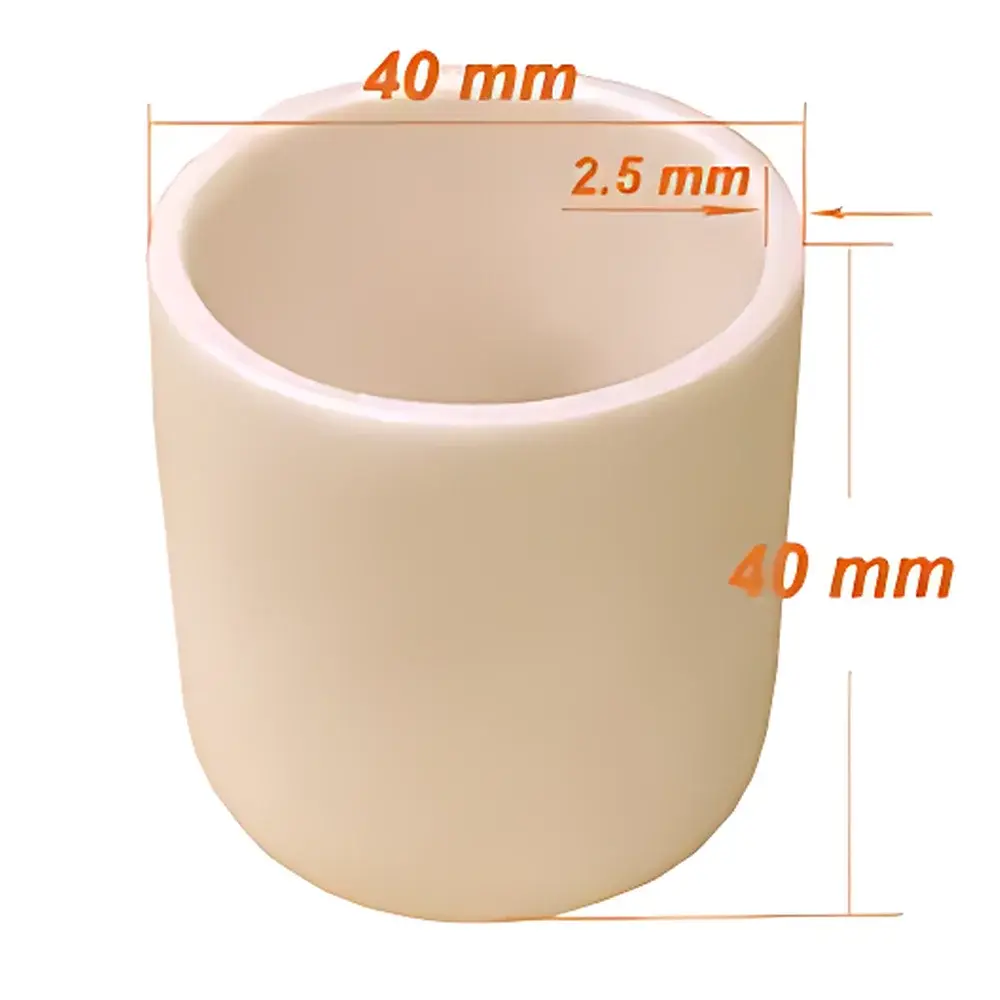
Zhongke Aobo ZKAB-Al2O3 High-Purity Alumina Crucible (40×40 mm Square Type)
| Brand | Zhongke Aobo |
|---|---|
| Origin | Beijing, China |
| Model | 40×40 mm (Square) |
| Material | ≥99% Al₂O₃ |
| Max Continuous Use Temperature | 1600 °C |
| Max Short-Term Temperature | 1800 °C |
| Bulk Density | ≥3.80 g/cm³ |
| Apparent Porosity | <1% |
| Flexural Strength | >350 MPa |
| Compressive Strength | >12,000 MPa |
| Dielectric Constant (1 MHz) | ~9.8 |
| Chemical Composition | Al₂O₃ ≥99%, R₂O ≤0.2%, Fe₂O₃ ≤0.1%, SiO₂ ≤0.2% |
Overview
The Zhongke Aobo ZKAB-Al2O3 High-Purity Alumina Crucible is a precision-engineered laboratory ceramic component designed for high-temperature thermal processing, quantitative gravimetric analysis, ash content determination, and molten sample handling in analytical and materials science laboratories. Constructed from sintered alpha-alumina (α-Al₂O₃) with ≥99% purity, this crucible operates reliably under oxidizing, inert, and mildly reducing atmospheres—making it suitable for applications ranging from ASTM E1729-compliant ashing procedures to ISO 5660 cone calorimetry sample containment. Its dense microstructure (bulk density ≥3.80 g/cm³, apparent porosity <1%) ensures minimal contamination risk and exceptional dimensional stability during repeated thermal cycling between ambient and 1800 °C.
Key Features
- Ultra-high-purity alumina composition (Al₂O₃ ≥99 wt%), minimizing trace metal leaching and ensuring compatibility with ICP-MS, XRF, and AAS sample preparation workflows.
- Thermal resilience: rated for continuous service at 1600 °C and short-term exposure up to 1800 °C—validated per ISO 2738 for refractory ceramic performance.
- Superior thermal shock resistance due to low coefficient of thermal expansion (≈8.5 × 10⁻⁶ /°C) and optimized grain-boundary engineering, significantly reducing fracture risk during rapid heating or quenching.
- High mechanical integrity: flexural strength >350 MPa and compressive strength >12,000 MPa enable safe handling of dense, viscous melts—including alkali metal carbonates, borax fluxes, and rare-earth oxide mixtures.
- Dimensionally stable geometry: square cross-section (40 × 40 mm) with tight tolerance control (±0.2 mm), facilitating reproducible placement in muffle furnaces, thermogravimetric analyzers (TGA), and automated ashing systems.
Sample Compatibility & Compliance
This crucible demonstrates broad chemical inertness toward acids (excluding hydrofluoric acid and hot phosphoric acid), alkalis (e.g., NaOH, KOH melts above 500 °C), and molten salts (e.g., Li₂B₄O₇, Na₂CO₃). It is routinely employed in USP heavy metals testing, EPA Method 3050B acid digestion support, and ASTM C704 abrasion resistance calibration. All units are manufactured under controlled cleanroom conditions and documented per ISO 9001 quality management requirements. Batch-specific certificates of conformance—including raw material traceability, sintering profile logs, and post-sintering density verification—are available upon request for GLP/GMP-regulated environments.
Software & Data Management
While the crucible itself is a passive consumable, its specifications are fully integrated into laboratory information management systems (LIMS) and electronic lab notebooks (ELN) via standardized metadata templates compliant with ASTM E2500-21. Each lot is assigned a unique identifier enabling full audit trail linkage to furnace calibration records, TGA method files (e.g., TA Instruments TRIOS v6.2), and regulatory submissions requiring material-of-construction documentation per FDA 21 CFR Part 11 Annex 11 requirements.
Applications
- Gravimetric analysis of ash content in coal, biomass, polymers, and pharmaceutical excipients (ASTM D3174, ISO 1171).
- Pre-concentration of environmental water samples prior to ICP-OES/MS analysis (EPA 200.7, ISO 17294-2).
- High-temperature synthesis of ceramic precursors, including YAG phosphors and solid-state battery cathode materials (e.g., NMC, LFP).
- Calibration reference for differential scanning calorimetry (DSC) baseline correction and heat capacity measurements.
- Support vessel for fusion sample preparation using lithium metaborate/tetraborate fluxes in XRF spectroscopy.
FAQ
Can this crucible be used in a hydrogen atmosphere?
Yes—provided the hydrogen is dry and free of moisture or hydrocarbons; prolonged exposure to wet reducing atmospheres may promote surface reduction of minor transition metal impurities.
Is it compatible with HF-based etching solutions?
No—hydrofluoric acid rapidly attacks alumina; fused silica or platinum crucibles are recommended for HF-containing chemistries.
What is the recommended cooling protocol after high-temperature use?
Allow gradual cooling inside the furnace to ≤200 °C before removal; avoid forced air quenching or contact with cold surfaces to preserve structural integrity.
Do you offer custom geometries with metrology certification?
Yes—non-standard shapes (e.g., stepped, tapered, or multi-compartment designs) can be fabricated with optional NIST-traceable dimensional inspection reports and thermal cycle validation data.
How should these crucibles be cleaned between uses?
Rinse with high-purity deionized water, followed by ultrasonic cleaning in 10% HNO₃ (if metallic residue is present), then bake at 1000 °C for 1 hour to restore surface stoichiometry.



