
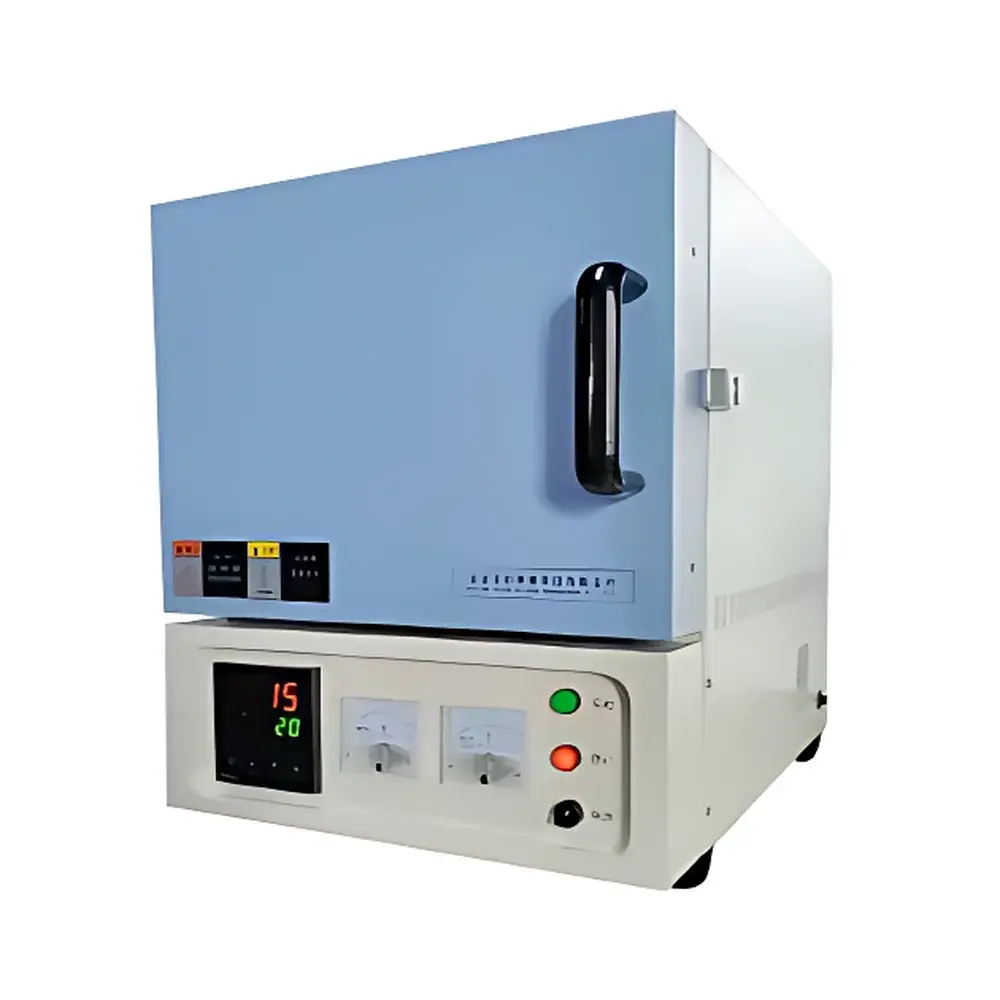
Zhongke Aobo TE0414 Integrated Ceramic Fiber Muffle Furnace
| Brand | Zhongke Aobo |
|---|---|
| Origin | Beijing, China |
| Model | TE0414 |
| Instrument Type | Box-Type Muffle Furnace |
| Max Temperature | 1400 °C |
| Operating Temperature Range | 300–1300 °C |
| Temperature Control Accuracy | ±1 °C |
| Heating Element | Silicon Carbide Rod (SiC) |
| Thermocouple Type | S-Type |
| Power Rating | 4000 W |
| Ramp Rate to Max Temperature | 40 °C/min |
| Internal Chamber Dimensions | 150 × 150 × 200 mm (W × D × H) |
| Insulation Material | 1600 °C-rated Polycrystalline Mullite Ceramic Fiber |
| Control System | 30-Stage Programmable PID Controller |
| Safety Protections | Over-Temperature, Thermocouple Break, and Overload Protection |
| Surface Temperature at 1000 °C | ≤50 °C (measured after 1 h stabilization) |
| Compliance | Designed per GB/T 10066.1–2004 (General Requirements for Industrial Resistance Furnaces), compatible with ISO/IEC 17025 laboratory environmental conditioning workflows |
Overview
The Zhongke Aobo TE0414 Integrated Ceramic Fiber Muffle Furnace is a high-performance box-type resistance furnace engineered for precision thermal processing in research laboratories, quality control environments, and industrial R&D settings. It operates on the principle of resistive heating via silicon carbide (SiC) rods, delivering stable, uniform temperature distribution across its insulated chamber. Unlike conventional refractory brick or metal-sheathed furnaces, the TE0414 employs a monolithic polycrystalline mullite ceramic fiber lining rated to 1600 °C — enabling rapid thermal cycling, exceptional energy efficiency, and minimized thermal mass. Its maximum operating temperature of 1400 °C and sustained working range of 300–1300 °C make it suitable for ashing, calcination, heat treatment, and thermal gravimetric sample preparation where strict thermal reproducibility is required. The furnace meets structural and safety benchmarks defined in GB/T 10066.1–2004 and supports traceable operation within ISO/IEC 17025-accredited laboratories.
Key Features
- Integrated one-piece construction with reinforced cold-rolled galvanized steel housing and high-temperature baked enamel finish for corrosion resistance and mechanical durability.
- 30-stage programmable PID temperature controller with ramp-soak capability, supporting custom thermal profiles for multi-step protocols such as ASTM D3174 (ash content), ASTM D3175 (volatile matter), and ISO 1171 (determination of ash).
- Ceramic fiber insulation system reduces external surface temperature to ≤50 °C when stabilized at 1000 °C — well below the IEC 61000-3-2 limit of 100 °C for Class A equipment — enhancing operator safety and reducing ambient heat load.
- Low thermal inertia design enables heating rates up to 40 °C/min to 1400 °C, cutting cycle time by approximately 50% compared to traditional brick-lined muffle furnaces.
- Energy consumption reduced to ~40% of equivalent-duty conventional furnaces due to optimized thermal retention and minimal standby losses.
- Dual-layer chamber architecture with interstitial ceramic fiber board insulation ensures axial and radial temperature uniformity within ±5 °C across the full working volume (150 × 150 × 200 mm).
Sample Compatibility & Compliance
The TE0414 accommodates standard crucibles (alumina, platinum, silica, and nickel-based alloys) and supports sample masses up to 50 g for routine ashing or thermal decomposition. Its chamber geometry complies with USP <231> and EP 2.2.34 requirements for residue-on-ignition testing. For coal and biomass analysis, it satisfies ISO 1171, ASTM D3174, and GB/T 212–2008 specifications. The S-type thermocouple provides NIST-traceable measurement stability over extended dwell periods. All electrical interfaces conform to IEC 61000-6-3 (EMC emissions) and IEC 61000-6-2 (immunity). Optional data logging modules support 21 CFR Part 11-compliant audit trails when integrated with validated software platforms.
Software & Data Management
While the TE0414 operates autonomously via its front-panel controller, optional RS485/Modbus RTU or USB-to-serial interface enables integration with third-party SCADA systems or LIMS. When paired with compliant PC-based software (e.g., LabVIEW-compatible drivers or custom Python scripts using PySerial), users can export real-time temperature logs, validate profile execution, and generate PDF reports with timestamps, operator ID, and calibration metadata. Firmware supports firmware-level password protection and event logging for GLP/GMP environments requiring documented change control.
Applications
- Residue-on-ignition (ROI) and ash content determination in pharmaceutical excipients per USP <231> and Ph. Eur. 2.2.34.
- Thermal pretreatment of environmental samples (soil, sludge, filter media) prior to heavy metal extraction (EPA Method 3050B).
- Coal and coke analysis: moisture, volatile matter, fixed carbon, and ash fusion temperature (AFT) per ASTM D3172–D3176 and ISO 1171.
- Pre-sintering of ceramic powders and catalyst precursors under controlled oxidizing atmospheres.
- Calibration of thermogravimetric analyzers (TGA) and differential scanning calorimeters (DSC) using certified reference materials (CRMs) such as NIST SRM 720e.
- Heat treatment of small metallic components in metallurgical QA/QC labs, including stress-relieving and annealing cycles.
FAQ
What is the maximum continuous operating temperature?
The TE0414 is rated for continuous operation at 1300 °C; 1400 °C is specified as short-term peak temperature (≤30 min per cycle).
Can this furnace be used under inert or reducing atmospheres?
No — the SiC heating elements and S-type thermocouple are optimized for air atmosphere only. For inert gas applications, consult the TE-series models equipped with MoSi₂ elements and protective quartz tubes.
Is calibration documentation included?
A factory calibration certificate (traceable to CNAS-accredited standards) is provided with each unit. On-site verification using a secondary reference thermometer is recommended before first use and at six-month intervals.
How often does the ceramic fiber insulation require replacement?
Under normal usage (≤8 h/day, ≤1300 °C), the mullite fiber lining maintains structural integrity for ≥3.5 years — significantly exceeding the service life of traditional firebrick linings.
Does the controller support hold-at-temperature functionality?
Yes — the 30-segment program includes dedicated soak steps with user-defined duration and tolerance bands (±1 °C default, adjustable to ±0.5 °C).



