
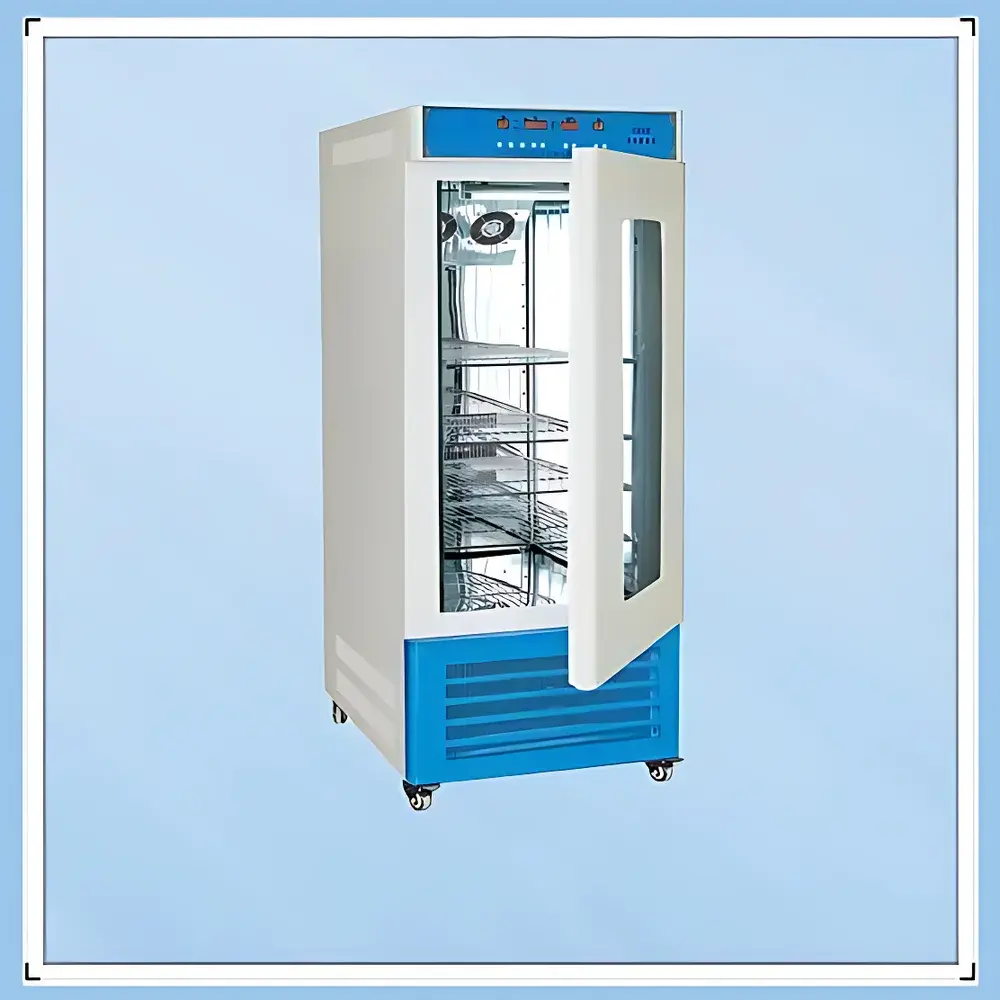
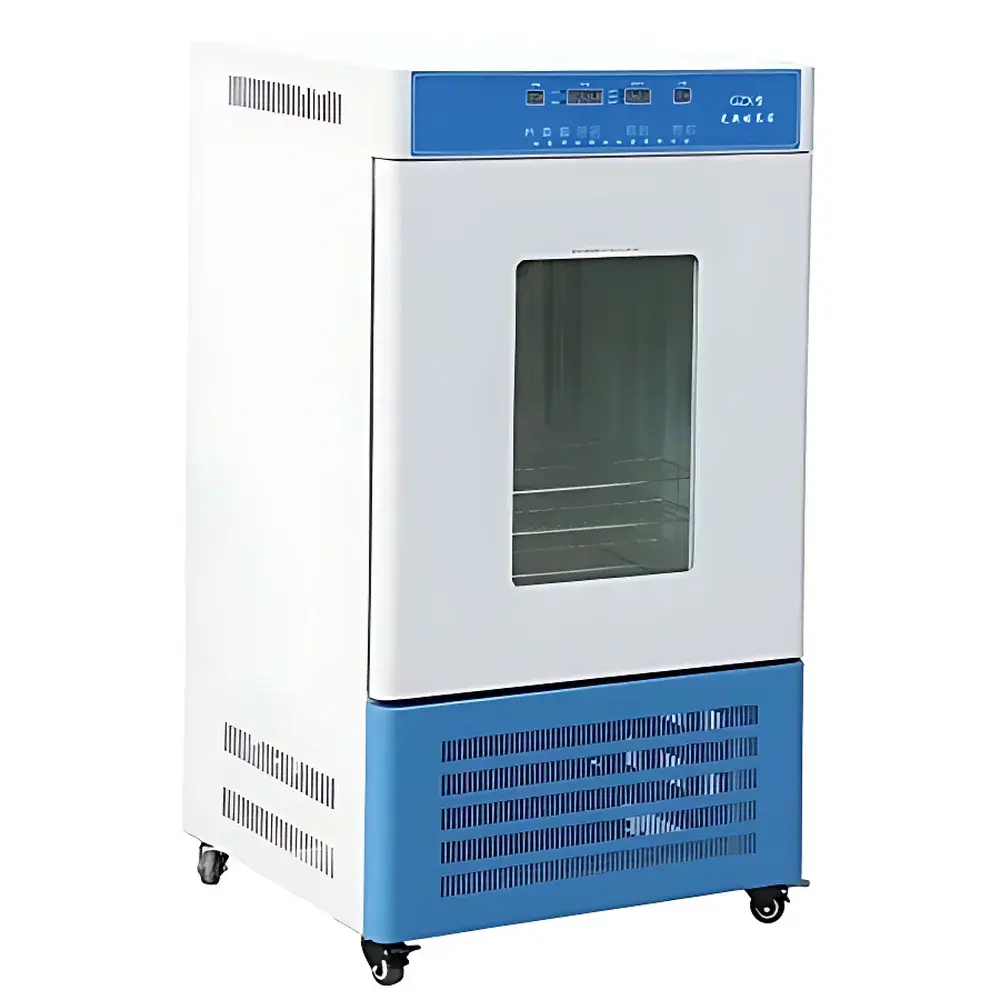
Zhongke Aobo GZX-150 Plant Growth Chamber
| Brand | Zhongke Aobo |
|---|---|
| Origin | Beijing, China |
| Model | GZX-150 |
| Capacity | 150 L |
| Temperature Range (with light) | 10–65 °C |
| Temperature Range (dark) | 5–65 °C |
| Illumination Range | 0–10,000 lx |
| Temperature Uniformity | ±1 °C |
| Power Consumption | 800 W |
| Internal Dimensions (D×W×H) | 400×500×750 mm |
| External Dimensions (D×W×H) | 640×660×1420 mm |
| Net Weight | 72 kg |
| Voltage/Frequency | 220 V / 50 Hz |
Overview
The Zhongke Aobo GZX-150 Plant Growth Chamber is a precision-engineered environmental control system designed for reproducible, long-term plant physiology studies, seed germination assays, photobiological research, and controlled-environment microbiology. It operates on a dual-mode thermal regulation principle—combining Peltier-assisted or compressor-based cooling with PID-controlled resistive heating—to maintain stable setpoint temperatures across defined light/dark cycles. The chamber integrates independent control of temperature, illumination intensity, and timing profiles, enabling simulation of diurnal rhythms, seasonal photoperiods, and stress-conditioned growth environments. Its sealed, stainless-steel interior minimizes contamination risk and supports GLP-compliant experimental workflows in academic, agricultural, and pharmaceutical R&D laboratories.
Key Features
- Robust 304 stainless-steel inner chamber with seamless, radius-rounded corners for easy decontamination and resistance to corrosion from humidity and nutrient vapors.
- Intelligent microprocessor controller with real-time digital display, programmable 30-segment illumination scheduling, and user-defined ramp/soak temperature profiles.
- Environmentally compliant refrigeration system using R134a-free compressor technology, paired with low-turbulence axial fans for uniform air distribution and minimized thermal stratification (±1 °C stability).
- Adjustable multi-level LED or fluorescent lighting arrays (0–10,000 lx), calibrated for photosynthetically active radiation (PAR) spectrum compatibility; optional four-sided illumination configuration available for uniform canopy irradiance.
- Comprehensive safety architecture including compressor overheat protection, sensor fault detection, door-open alarm, and automatic cut-off during sustained temperature deviation (>±3 °C).
- Expandable I/O interface supporting RS-485 Modbus RTU communication, USB data logging (via integrated U-disk port), optional thermal printer output, and remote SMS alerting for critical parameter excursions.
Sample Compatibility & Compliance
The GZX-150 accommodates standard botanical trays (e.g., 12-well plates, Magenta boxes), petri dishes, hydroponic racks, and small-cage animal enclosures (for insect or juvenile rodent studies). Its internal volume (150 L) and height clearance (750 mm) support upright growth of model species including Arabidopsis thaliana, rice seedlings, tobacco, and leguminous crops. The unit complies with GB/T 23953–2009 (Chinese national standard for plant growth chambers) and meets essential requirements of IEC 61000-6-3 (EMC emission limits) and IEC 61000-6-2 (immunity). While not certified to UL/CSA or CE for North American/EU markets out-of-box, its electrical design aligns with general-purpose lab equipment safety expectations under ISO 13850 and EN 61010-1 when installed per manufacturer-specified ventilation guidelines.
Software & Data Management
The embedded controller firmware provides local parameter configuration via tactile keypad and LCD interface, with non-volatile memory retaining up to 10 user-defined protocols. Optional PC software (Windows-compatible, USB/RS-485) enables export of time-stamped temperature and illumination logs in CSV format, trend visualization, and batch protocol deployment. Audit-trail functionality—including operator ID tagging, parameter change timestamps, and event-driven log entries (e.g., door opening, alarm activation)—supports traceability in regulated environments. Data files are compatible with third-party analysis tools such as MATLAB, Python (Pandas), and GraphPad Prism for downstream statistical modeling of growth kinetics or phenotypic response curves.
Applications
- Controlled-environment phenotyping: Quantifying morphological, biochemical, and transcriptional responses to light quality, photoperiod, and temperature gradients.
- Seed viability and germination rate standardization per ISTA and AOSA protocols.
- Cultivation of phototrophic microorganisms (e.g., cyanobacteria, microalgae) under defined PAR and spectral composition.
- Pre-acclimation and hardening of tissue-cultured plantlets prior to greenhouse transfer.
- Antibiotic susceptibility testing under variable light conditions for light-sensitive bacterial strains.
- Development and validation of circadian rhythm assays in genetically modified plant lines.
FAQ
What is the maximum sustainable illumination intensity inside the chamber?
The GZX-150 delivers up to 10,000 lux at shelf level using standard lamp configurations; actual PAR irradiance (µmol/m²/s) depends on lamp type and spectral output.
Can the unit operate continuously at 5 °C in complete darkness?
Yes—the refrigeration system is rated for stable operation down to 5 °C without illumination; ambient room temperature should remain ≤30 °C for optimal compressor efficiency.
Is the controller compliant with FDA 21 CFR Part 11 requirements?
The base controller does not include electronic signature, role-based access, or full audit-trail encryption required for Part 11 compliance; however, optional PC software with configurable user permissions may be deployed in validated environments under site-specific SOPs.
What maintenance intervals are recommended for long-term reliability?
Clean condenser coils every 3 months in dusty environments; verify sensor calibration annually using NIST-traceable reference thermometers and lux meters; replace gasket seals if door compression force diminishes.
Does the chamber support CO₂ enrichment or humidity control?
No—this model provides temperature and illumination control only. Humidity and CO₂ modulation require integration with external subsystems (e.g., standalone humidifier or gas mixing module) via custom I/O scripting or PLC interfacing.



